top of page

📢 STT 訂閱專區已上線

免費文章會照常更新,一篇都不會少。訂閱是「加強版」——每週深度週評、財報法說的完整判讀、所有長篇深度報告全包。

免費讓你跟上,訂閱讓你看懂、能做判斷。

月訂 NT$199|年訂 NT$2,000(約 NT$167/月)
👉 立即訂閱: vocus.cc/salon/simpletechtrend

OFC 2026: The Ultra-Low-Power Challenge of Photonic Scale-Up Interconnects and the Technology Roadmaps Decoded – OFC Panel

6 days ago
6 min read

Updated: 4 days ago

Introduction: The Scale-Up Battle to Break Copper's Physical Limits

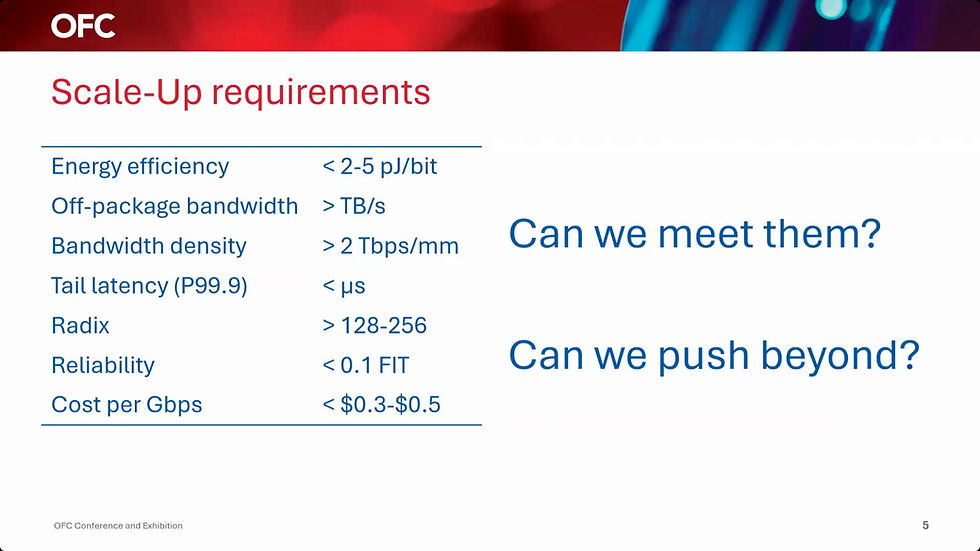
As AI model sizes grow exponentially, the scale-up network linking XPUs (GPUs/TPUs/NPUs) is under unprecedented bandwidth and power pressure. At the OFC 2026 workshop "Chasing the Limit: On the Path to Photonic Scale-Up with Ultra-Low-Energy/Bit," the supply chain clashed over the intra-rack bottleneck, which carries as much as 85% of data traffic. With conventional optics at 10-20 pJ/bit, I/O alone could easily eat 30% to 40% of an AI server rack's total power, crowding out the compute it is meant to serve. The workshop brought together NVIDIA, Broadcom, Marvell and other heavyweights to discuss how to squeeze power down to 1-3 pJ/bit at 1.6T/3.2T and beyond while hitting extremely strict FIT (Failures In Time) reliability targets — and it laid out the concrete volume-production path, and the forks in the road, from NPO (Near-Packaged Optics) to CPO (Co-Packaged Optics).


OFC 2026 – Introduction: The Scale-Up Battle to Break Copper's Physical Limits illustration
OFC 2026 – Introduction: The Scale-Up Battle to Break Copper's Physical Limits illustration 2
OFC 2026 – Introduction: The Scale-Up Battle to Break Copper's Physical Limits illustration 3

Company by Company: A Head-to-Head on Architecture, Light Sources and Packaging

Faced with the harsh demands of scale-up networks, each company presented a very different technical answer and set of metrics:

  • NVIDIA (Janet Chen)

    • AI model size grows more than 4x every two years, while I/O bandwidth grows only 1.4x — a severe and widening bandwidth gap.

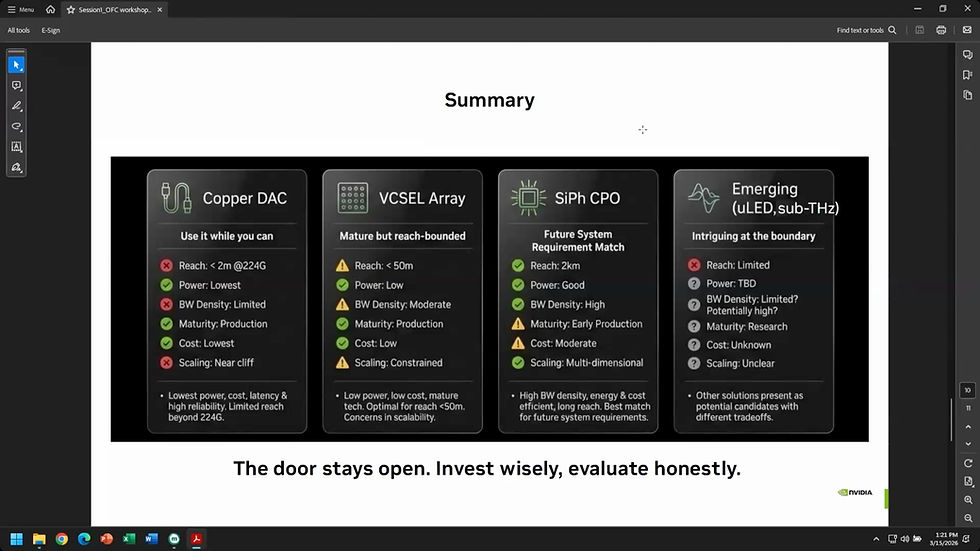
    • NVIDIA is pushing hard on deep integration of optical engines with the XPU (a CPO architecture) to fix the idle-I/O problem where data simply can't get off the chip fast enough.

    • To improve system stability and cut power, NVIDIA explored the potential of microresonator technology to replace more power-hungry conventional approaches.

Company by Company: A Head-to-Head on Architecture, Light Sources and Packaging illustration
Company by Company: A Head-to-Head on Architecture, Light Sources and Packaging illustration 2
Company by Company: A Head-to-Head on Architecture, Light Sources and Packaging illustration 3
Company by Company: A Head-to-Head on Architecture, Light Sources and Packaging illustration 4
Company by Company: A Head-to-Head on Architecture, Light Sources and Packaging illustration 5
Company by Company: A Head-to-Head on Architecture, Light Sources and Packaging illustration 6
Company by Company: A Head-to-Head on Architecture, Light Sources and Packaging illustration 7
Company by Company: A Head-to-Head on Architecture, Light Sources and Packaging illustration 8
Company by Company: A Head-to-Head on Architecture, Light Sources and Packaging illustration 9
  • Broadcom (I-Hsing Tan)

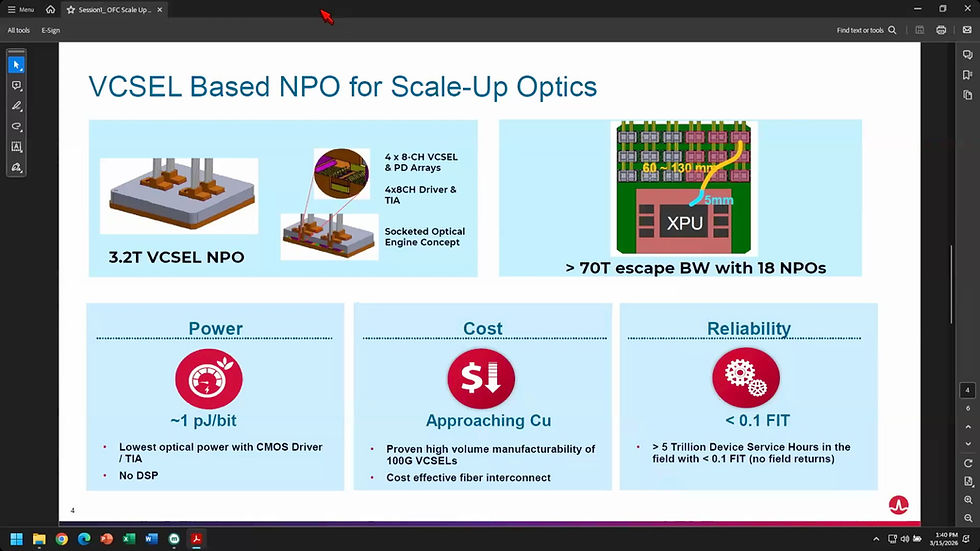
    • For scale-up networks, Broadcom strongly backs VCSEL-based NPO and CPO solutions.

    • With 100G PAM4 signaling, the NPO approach tolerates 6 to 13 dB of insertion loss and brings power down to 1 pJ/bit.

    • On cost and reliability, Broadcom claims its solution comes in below $0.1/GB and has logged zero failures across more than 53 million device operating hours (calculated at 0.15 FIT).

    • For north-south interconnect on a single GPU node, it supports up to 70 Tbps of escape bandwidth.

Company by Company: A Head-to-Head on Architecture, Light Sources and Packaging illustration 10
Company by Company: A Head-to-Head on Architecture, Light Sources and Packaging illustration 11
Company by Company: A Head-to-Head on Architecture, Light Sources and Packaging illustration 12
Company by Company: A Head-to-Head on Architecture, Light Sources and Packaging illustration 13
Company by Company: A Head-to-Head on Architecture, Light Sources and Packaging illustration 14
  • Marvell (Lenin Patra & Phil Winterbottom)

    • Marvell noted that legacy 32 Gbaud schemes need no equalizer but carry too much lane overhead, while 100 Gbaud schemes require a full DSP and CDR.

    • Today's electrical "sweet spot" sits at 56 Gbaud, paired with an analog DSP for equalization to sharply cut power.

    • Full optical-link power, SerDes included, can now be held to 3 pJ/bit (of which the laser is about 0.7 pJ/bit, with the 1.8V MRM modulator taking a very large share).

Company by Company: A Head-to-Head on Architecture, Light Sources and Packaging illustration 15
Company by Company: A Head-to-Head on Architecture, Light Sources and Packaging illustration 16
Company by Company: A Head-to-Head on Architecture, Light Sources and Packaging illustration 17
Company by Company: A Head-to-Head on Architecture, Light Sources and Packaging illustration 18
Company by Company: A Head-to-Head on Architecture, Light Sources and Packaging illustration 19
Company by Company: A Head-to-Head on Architecture, Light Sources and Packaging illustration 20
Company by Company: A Head-to-Head on Architecture, Light Sources and Packaging illustration 21
Company by Company: A Head-to-Head on Architecture, Light Sources and Packaging illustration 22
Company by Company: A Head-to-Head on Architecture, Light Sources and Packaging illustration 23
Company by Company: A Head-to-Head on Architecture, Light Sources and Packaging illustration 24
Company by Company: A Head-to-Head on Architecture, Light Sources and Packaging illustration 25
Company by Company: A Head-to-Head on Architecture, Light Sources and Packaging illustration 26
Company by Company: A Head-to-Head on Architecture, Light Sources and Packaging illustration 27
Company by Company: A Head-to-Head on Architecture, Light Sources and Packaging illustration 28
Company by Company: A Head-to-Head on Architecture, Light Sources and Packaging illustration 29
Company by Company: A Head-to-Head on Architecture, Light Sources and Packaging illustration 30
  • Coherent (Chris Kocot)

    • Comparing a "Fast and Narrow" VCSEL architecture with a "Slow and Wide" LED architecture, VCSELs demonstrated outstanding energy efficiency.

    • Coherent said its optimized link needs only 0.18 pJ/bit of total optical energy (calculated from a combination of 0.3 for optical components, 0.1 for electronics, and so on).

    • Looking ahead to 200G and 400G per lane, directly modulated VCSELs are nearing their physical limits; getting there will require a "Quantum Leap" in architecture, such as externally modulated VCSELs.

Company by Company: A Head-to-Head on Architecture, Light Sources and Packaging illustration 31
Company by Company: A Head-to-Head on Architecture, Light Sources and Packaging illustration 32
Company by Company: A Head-to-Head on Architecture, Light Sources and Packaging illustration 33
Company by Company: A Head-to-Head on Architecture, Light Sources and Packaging illustration 34
Company by Company: A Head-to-Head on Architecture, Light Sources and Packaging illustration 35
Company by Company: A Head-to-Head on Architecture, Light Sources and Packaging illustration 36
Company by Company: A Head-to-Head on Architecture, Light Sources and Packaging illustration 37
Company by Company: A Head-to-Head on Architecture, Light Sources and Packaging illustration 38
Company by Company: A Head-to-Head on Architecture, Light Sources and Packaging illustration 39
Company by Company: A Head-to-Head on Architecture, Light Sources and Packaging illustration 40

  • University of Toronto (Joyce Poon)

    • From a system-level reliability view, the rack holds a huge number of optical transceivers, which account for 23% of hardware failures — slightly more than the GPUs themselves.

    • In single-lane failure cases, the laser is the biggest culprit, responsible for as much as 90% of failures.

    • To build a truly seamless compute fabric, optical interconnect must match the bandwidth density of die-to-die electrical links — which at a 127-micron fiber pitch means >1 Tbps per fiber.

Company by Company: A Head-to-Head on Architecture, Light Sources and Packaging illustration 41
Company by Company: A Head-to-Head on Architecture, Light Sources and Packaging illustration 42
Company by Company: A Head-to-Head on Architecture, Light Sources and Packaging illustration 43
Company by Company: A Head-to-Head on Architecture, Light Sources and Packaging illustration 44
Company by Company: A Head-to-Head on Architecture, Light Sources and Packaging illustration 45
Company by Company: A Head-to-Head on Architecture, Light Sources and Packaging illustration 46
Company by Company: A Head-to-Head on Architecture, Light Sources and Packaging illustration 47
Company by Company: A Head-to-Head on Architecture, Light Sources and Packaging illustration 48
Company by Company: A Head-to-Head on Architecture, Light Sources and Packaging illustration 49
Company by Company: A Head-to-Head on Architecture, Light Sources and Packaging illustration 50
Company by Company: A Head-to-Head on Architecture, Light Sources and Packaging illustration 51
Company by Company: A Head-to-Head on Architecture, Light Sources and Packaging illustration 52
Company by Company: A Head-to-Head on Architecture, Light Sources and Packaging illustration 53
  • Furukawa Electric (Kazuya Nagashima)

    • Showed high-density CPO packaging for 200G operation, emphasizing the practicality of 8-channel interfaces and compatibility with standard MPO connectors.

    • Thermal management is critical to reliability: Furukawa's separated liquid-cooling design keeps the VCSEL substrate below 50°C or even 40°C, ensuring an extremely low FIT rate below one in a million.

Company by Company: A Head-to-Head on Architecture, Light Sources and Packaging illustration 54
Company by Company: A Head-to-Head on Architecture, Light Sources and Packaging illustration 55
Company by Company: A Head-to-Head on Architecture, Light Sources and Packaging illustration 56
Company by Company: A Head-to-Head on Architecture, Light Sources and Packaging illustration 57
Company by Company: A Head-to-Head on Architecture, Light Sources and Packaging illustration 58
Company by Company: A Head-to-Head on Architecture, Light Sources and Packaging illustration 59
Company by Company: A Head-to-Head on Architecture, Light Sources and Packaging illustration 60
Company by Company: A Head-to-Head on Architecture, Light Sources and Packaging illustration 61
Company by Company: A Head-to-Head on Architecture, Light Sources and Packaging illustration 62
Company by Company: A Head-to-Head on Architecture, Light Sources and Packaging illustration 63
Company by Company: A Head-to-Head on Architecture, Light Sources and Packaging illustration 64
Company by Company: A Head-to-Head on Architecture, Light Sources and Packaging illustration 65
Company by Company: A Head-to-Head on Architecture, Light Sources and Packaging illustration 66
Company by Company: A Head-to-Head on Architecture, Light Sources and Packaging illustration 67
Company by Company: A Head-to-Head on Architecture, Light Sources and Packaging illustration 68

  • Enlightra (John Jost) & Columbia University/xScape (Michal Lipson)

    • For multi-wavelength solutions, microcomb technology is key to breaking the bandwidth ceiling. Enlightra has shown 100+ channels generated from a single laser and a microring resonator, reaching 50 Tbps and even 2 Pbps.

    • Columbia/xScape has commercialized comb technology with a plug-and-play 8-wavelength light source offering 40% conversion efficiency and 0.5 mW per line, solving multi-wavelength locking and power problems.

    • The industry should shift its attention to receiver efficiency: today's IMDD needs about 5,000 photons per bit, leaving as much as 20 dB of headroom versus the quantum limit.

Company by Company: A Head-to-Head on Architecture, Light Sources and Packaging illustration 69
Company by Company: A Head-to-Head on Architecture, Light Sources and Packaging illustration 70
Company by Company: A Head-to-Head on Architecture, Light Sources and Packaging illustration 71
Company by Company: A Head-to-Head on Architecture, Light Sources and Packaging illustration 72
Company by Company: A Head-to-Head on Architecture, Light Sources and Packaging illustration 73
Company by Company: A Head-to-Head on Architecture, Light Sources and Packaging illustration 74
Company by Company: A Head-to-Head on Architecture, Light Sources and Packaging illustration 75
Company by Company: A Head-to-Head on Architecture, Light Sources and Packaging illustration 76
Company by Company: A Head-to-Head on Architecture, Light Sources and Packaging illustration 77
Company by Company: A Head-to-Head on Architecture, Light Sources and Packaging illustration 78
Company by Company: A Head-to-Head on Architecture, Light Sources and Packaging illustration 79
Company by Company: A Head-to-Head on Architecture, Light Sources and Packaging illustration 80
Company by Company: A Head-to-Head on Architecture, Light Sources and Packaging illustration 81
Company by Company: A Head-to-Head on Architecture, Light Sources and Packaging illustration 82
Company by Company: A Head-to-Head on Architecture, Light Sources and Packaging illustration 83
Company by Company: A Head-to-Head on Architecture, Light Sources and Packaging illustration 84
Company by Company: A Head-to-Head on Architecture, Light Sources and Packaging illustration 85
Company by Company: A Head-to-Head on Architecture, Light Sources and Packaging illustration 86
Company by Company: A Head-to-Head on Architecture, Light Sources and Packaging illustration 87
Company by Company: A Head-to-Head on Architecture, Light Sources and Packaging illustration 88
Company by Company: A Head-to-Head on Architecture, Light Sources and Packaging illustration 89
Company by Company: A Head-to-Head on Architecture, Light Sources and Packaging illustration 90
Company by Company: A Head-to-Head on Architecture, Light Sources and Packaging illustration 91
  • AttoTude (Chris Fludger)

    • Proposed a non-optical terahertz RF chip solution that directly challenges short-reach optics for 10-40 meter rack-to-rack links.

    • The terahertz approach offers very low power of <3-4 pJ/bit (supporting 200G/400G), inherits the aerospace-grade reliability of RF ASICs with over a billion hours of MTBF, and has an alignment tolerance of up to 10 microns, sharply lowering packaging cost.

Company by Company: A Head-to-Head on Architecture, Light Sources and Packaging illustration 92
Company by Company: A Head-to-Head on Architecture, Light Sources and Packaging illustration 93
Company by Company: A Head-to-Head on Architecture, Light Sources and Packaging illustration 94
Company by Company: A Head-to-Head on Architecture, Light Sources and Packaging illustration 95
Company by Company: A Head-to-Head on Architecture, Light Sources and Packaging illustration 96
Company by Company: A Head-to-Head on Architecture, Light Sources and Packaging illustration 97
Company by Company: A Head-to-Head on Architecture, Light Sources and Packaging illustration 98

The Numbers Face-Off: Power vs. Reliability at the Limit

At this year's OFC, the metrics each technology camp put on the table showed sharp contrasts and direct competition:

  • Power numbers collide: Broadcom's VCSEL NPO pushes the metric down to the 1 pJ/bit class; Coherent went further with 0.18 pJ/bit of core optoelectronic energy. Marvell's silicon photonics plus analog DSP approach, by contrast, delivers 3 pJ/bit for the total link at the system level. VCSELs have an inherent edge on raw power, but silicon photonics offers a more complete answer for bandwidth scaling (WDM).


  • The reliability debate: Broadcom dropped a bombshell, claiming 53 million hours of zero failures (0.15 FIT) for its existing components. Many in the room — including academia's Joyce Poon — pushed back hard: at million-node AI cluster scale, lasers account for 90% of single-point failures, and Meta's data shows that a 0.004% daily failure rate across a million nodes means 40 system crashes a day. Separating the laser from the hot XPU (the ELSFP architecture) or using aggressive liquid cooling (Furukawa's approach) has therefore become the two moats for CPO volume production.


Consensus and Points of Divergence

Industry consensus:

  1. Pluggables are reaching the end of the road for intra-rack scale-up: To reach terabit-class beachfront density and ultra-low power, moving optics to NPO or CPO is an irreversible trend.


  2. Slimming down and removing the DSP: Digital DSPs that lean on advanced process nodes burn too much power. Whether through LPO (Linear Pluggable Optics), analog DSP, or removing the transmit-side DSP, these moves are necessary to hit sub-5 pJ/bit targets.


Key divergences:

  1. The light-source choice (VCSEL vs. CW laser + SiPh vs. microcombs): Broadcom is sticking with 100G/200G VCSELs, stressing low cost and immediate manufacturability; the camp including Marvell and NVIDIA favors the higher-bandwidth-density silicon photonics WDM path. Enlightra believes the future belongs to single-source, multi-wavelength combs that eliminate complex fiber and laser arrays.


  2. When will non-optical solutions strike back: Optics is seen as the savior beyond 2 meters, but AttoTude's terahertz ASICs show that high-frequency RF can still compete with conventional optics at 10-40 meters with <4 pJ/bit — adding a new variable to the scale-up roadmap.


Supply Chain and Market Impact

This technology shift will have far-reaching financial and market-share consequences across the global optical communications and semiconductor supply chain:

  • Wafer-level packaging (TSMC / major OSATs): CPO deployment depends heavily on TSV (through-silicon via), silicon bridges and high-density 3D packaging. Foundries with 2.5D/3D co-packaged optics capability will hold core pricing power.

  • Laser chip suppliers: If the market shifts to external laser sources (ELS) and microcombs, traditional single-wavelength DFB laser makers will face pressure to restructure their product lines, while vendors with high-power, high-efficiency CW lasers and next-generation VCSELs (e.g., multi-core, high-bandwidth modulation) stand to see explosive growth.

  • Module and connector makers: "Fewer fibers" has become end customers' biggest pain point. Component suppliers that can deliver high-channel-count, blind-mate connectors and MPO thermal-integration solutions will capture rich margins in the CPO era.

Supply Chain and Market Impact illustration

Simple Tech Trend's Take

OFC 2026 marks the point where AI optical interconnect moved from a "bandwidth race" into the deep water of "efficiency and reliability." STT believes that over the next 12-24 months, NPO combined with VCSELs will capture the first wave of the 100G/200G-per-lane short-reach market, on the strength of its maturity and very low power. However, with giants like NVIDIA pushing it forward, silicon photonics CPO with external lasers and analog DSP will take over the top-tier AI clusters after 2027. Meanwhile, investors should closely watch startups in optical connectors and microcombs — breakthroughs in these adjacent technologies will be what really decides whether CPO makes it across the valley of death.

Comments

Rated 0 out of 5 stars.
No ratings yet

Add a rating
bottom of page