


OCP Global Summit 2026 | Arista, Jabil | Abhinav Sharma, Matt McGuff | From Switches to Systems
1. Why Arista and Jabil Took the Stage Together
This talk had no new chip and no new optical module, only factory photos. But it answered a question that is often ignored: switch silicon upgrades fast, so why does network deployment so often fall behind?
Jabil is one of Arista's main contract manufacturers (the other is Celestica). Abhinav Sharma, Mechanical NPI Engineering at Arista, and Matt McGuff, Sr. Director Technology at Jabil, presented together under the title "From Switches to Systems", subtitled "The Factory as Part of the AI Architecture".
Put simply: in the 102.4T generation, whether switches go live on time depends on whether the factory can steadily ship liquid-cooled network racks with thousands of fibers every week.
2. Breaking Down the Four Shifts in the Network Rack
Arista opened with a comparison table:
Item | Today | Future |
Switch capacity | 51.2T | 102.4T and beyond |
Fiber count | Hundreds | Thousands |
Cooling | Air | Liquid |
Form factor | TOR integrated | Dedicated network rack |

▲ Network racks are moving from 51.2T, air cooling and top-of-rack integration to dedicated network racks with 102.4T and beyond, liquid cooling and thousands of fibers (Image source: Arista, Jabil | 2026 OCP Global Summit presentation (p. 2))
The photo shows a full rack of Arista switches, front panels packed with yellow fiber cables. The point of the table is its last row: the network no longer lives at the top of a compute rack; it becomes a rack of its own. Once it is its own rack, it needs its own liquid-cooling loop, power shelf, fiber routing and rack-level test, and manufacturing difficulty moves up to the rack level.
Working through the numbers from the closing remarks:
16 switches × 64 ports × 2 MPO cables per port = 2,048 fiber cables
Assuming 64-port 800G 51.2T switches, one rack carries about 819 Tb/s (STT estimate; not stated in the talk)
The comparison is an earlier rack with 8 switches; Arista said the transition between the two was "fairly quick"

▲ One rack: 16 switches, 64 ports each, 2 MPO cables per port, for a total of 2,048 fiber cables, each of which must be cleaned, inspected, routed and labeled (Image source: Simple Tech Trend original, data from Arista, Jabil 2026 OCP Global Summit presentation)
Fiber count as a bottleneck is something we covered for scale-up architectures in What Killed Slow-and-Wide Was Not Physics, It Was 60,000 Fibers (in Chinese); this talk shows the same problem has already arrived early in scale-out switch racks.
3. Ten Factory Priorities
Jabil broke rack integration into ten priorities grouped into four themes:
Physical systems: rack-level integration (FAT, L11, cluster validation), liquid cooling (CDUs, quick disconnects, leak testing and detection), fiber and cabling (cleaning, bend radius, routing, labeling), power architecture (ORv3, 48V)
Test and repair: fast repair strategy (rack twins, hot-swap), manufacturing test evolution (optical, thermal, cluster)
Smart factory and data: vision, AOI and predictive analytics, plus genealogy and MES integration
Scale and people: readiness for hundreds of racks a week, workforce development (cooling certs, optics, safety)
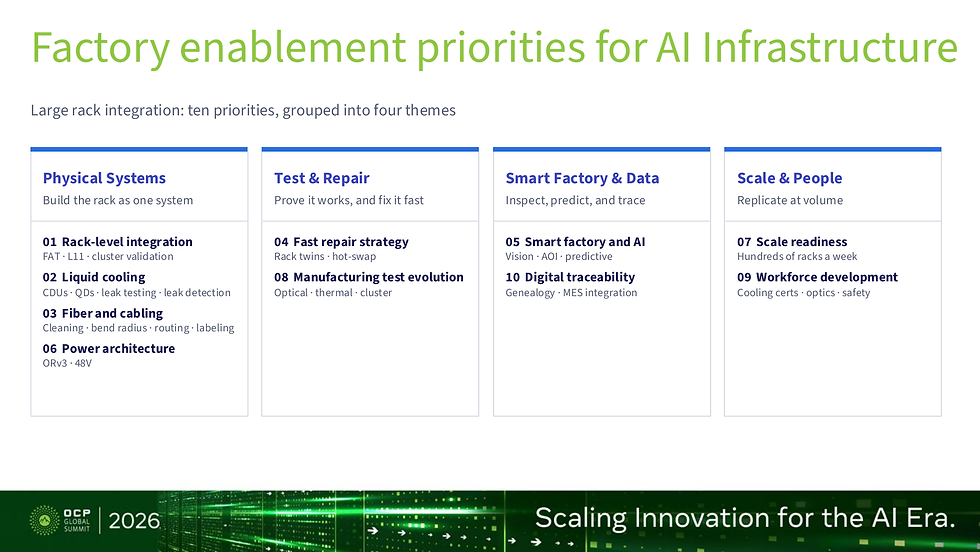
▲ Jabil's ten priorities for rack integration, grouped into four themes: physical systems, test and repair, smart factory and data, and scale and workforce (Image source: Arista, Jabil | 2026 OCP Global Summit presentation (p. 4))
The most notable change is in repair logic. McGuff said debug has traditionally been reactive; now, for speed and scale, the goal is to quickly identify the bad replaceable unit, pull it and replace it so debug does not slow the line. The data collected during manufacturing already goes to customers for traceability; Jabil also uses it to train AI that predicts failures, shortens mean time to repair and raises first-time fix rates.
"Hundreds of racks a week" is the timing signal on that slide: this is no longer NPI pilot production, it is volume cadence.
4. Breaking Down Three Challenges With No Standard Yet
The most valuable slide is page five, "Challenges Faced": all three columns are questions the industry has not settled.
First, switch storage conditions. Custom cold plate designs drive different N2 decay rates during storage; what happens to switches stored with coolant or N2 in place is not yet defined. Direct fulfillment centers and service depots add further storage variables. Arista is working with coolant suppliers and cold plate vendors on how long stagnant coolant can sit in a switch before problems appear.
Second, fiber cable quality. Particles as small as dust drive up insertion loss, so every cable must be a "known good" cable. The slide lists the open questions directly:
Is 100% cleaning needed before final assembly? Dry or wet?
Lower-quality cables force 100% incoming inspection, which slows the line significantly
Once cables are bundled, troubleshooting is nearly impossible
Sharma said both MMC and MPO connectors are within scope.
Third, fiber handling and routing. The speakers called this one unexpected: standard BICSI training is meant for technicians, and a roughly week-long course is too costly and does not scale for 50 operators at one factory. Arista is working with fiber suppliers on a scaled-down course covering build sequence, bundling, bend radius and labeling.

▲ The three challenges listed by Arista and Jabil: switch storage conditions, fiber cable quality, and fiber handling and routing (Image source: Arista, Jabil | 2026 OCP Global Summit presentation (p. 5))
None of these are physical limits; they are gaps in process specifications. A gap means whoever writes the SOP first and proves the yield controls lead time.
5. From Eight to Sixteen Switches: A Repeatable Ramp Model
The answer is a four-step model: fabric intent (topology, traffic, optical requirements) → system co-design (switch, cooling, power, rack, fiber paths) → validation (signal integrity, leak detection, regulatory, rack test) → industrialization (repeatable factory build, service and deployment).
Five practices for ramping new architectures quickly:
Standardize wherever possible: one manifold and common liquid-cooling and power infrastructure across racks
Concurrent design and industrialization: DFM/DFA and the L11 BOM developed together with the switch architecture
Reusable factory assets: configurable jigs and a standard line layout that a new architecture drops into
Test methods built with the architecture: optical, thermal and cluster tests defined during design, not added at ramp
Supplier readiness ahead of demand: long-lead equipment and manifolds ordered early, with second sources identified

▲ Arista's network rack architecture transitioning from 8 switches (left) to 16 switches (right), accelerated by standardization and parallel industrialization (Image source: Arista, Jabil | 2026 OCP Global Summit presentation (p. 6))
The capability stack on the last slide spells out the split: Arista owns the network product and NOS (EOS or SONiC), while Jabil owns the thermal system (including its Mikros cold plates), optical path, rack infrastructure (power, busbar, manifolds) and industrialization. The title is "One Accountable System, Not a Chain of Handoffs". McGuff put it bluntly: if any layer goes wrong, all the customer sees is a problem.
For thermal detail, compare 51.2T NPO Switch Thermal Design, the approach of Celestica, Arista's other manufacturing partner.
6. Risks and Counterarguments
No yield or lead-time numbers. The talk disclosed no actual weekly output, first-pass yield or ramp timeline, so "fairly quick" cannot be verified.
The challenge list is still a work in progress. Cleaning specs, storage conditions and training standards are all still in DOE; the speakers said they will "continue to learn", which means early volume could still be slowed by cable inspection.
CPO or NPO could rewrite the fiber problem. If designs beyond 102.4T move to on-board optical engines or co-packaging, front-panel cable counts and connector types will change, and today's pluggable cabling SOPs may not carry over.
"Single accountability" is also lock-in. For customers, deep OEM-plus-single-EMS ties raise switching costs; whether hyperscalers accept that depends on second-source arrangements.
7. What It Means for Taiwan's Supply Chain
A change in the unit of competition is the biggest issue for Taiwan's networking ODMs. Taiwan's white-box switch makers (such as Accton) are strong in single-box design and manufacturing; when the network becomes a "dedicated liquid-cooled rack", customers want delivery that includes manifolds, power shelves, thousands of fibers and rack-level test. This talk is Jabil publicly showing it is already on that line.
Liquid-cooling components have an entry point, but must cross over to network racks. Taiwan's thermal suppliers already have volume experience in GPU server cold plates and manifolds, but switch cold plates must also cool optical modules and storage conditions still lack a standard; whoever defines the spec with the OEM first gains the head start.
ORv3 and 48V power shelves are home turf. The slides list ORv3 and 48V as the power architecture direction, a spec Taiwan's power supply makers have already positioned for.
Cable cleaning and inspection is an underrated opportunity. Incoming inspection, cleaning and labeling of 2,048 cables require automated inspection equipment and high-quality MPO/MMC cables; this spec is not locked yet, and it is a window for Taiwan's fiber component and equipment makers to watch. For the financial side of Celestica's switch manufacturing, see Earnings Highlights: Celestica (CLS) Q2 FY2026.
8. Conclusion
This 11-minute talk covered the least glamorous yet most schedule-defining part of AI networking. 102.4T switch silicon can tape out on time, but 2,048 cables per rack, the liquid-cooling loop and rack-level test decide when it actually goes live.
Arista and Jabil's answer is to treat the factory as part of the architecture: from the day the fabric intent is defined, manufacturing, test and supply chain are designed alongside it. The moat of this model is not any single technology but the SOPs that have no standard yet: coolant storage, cable cleaning and operator training. Three things to watch over the next 12 months: whether OCP issues common specs for cable cleaning and liquid-cooled storage, the first shipment cadence of 102.4T dedicated network racks, and whether Taiwan's ODMs win full network-rack orders.
Silicon decides how fast the network can run; the factory decides how fast the network can be running.
This article is for technology and industry trend analysis only and does not constitute investment advice.


Comments