


OCP Global Summit 2026 | NVIDIA | Ajay Kamalvanshi | Every Megawatt Counts: DSX MaxLPS
1. Why This Talk Matters
The speaker, Ajay Kamalvanshi, is Senior Director of GPU System Software at NVIDIA. When he joined in 2009 he worked on GPU Boost and notebook Max-Q, which is to say "squeeze the most performance out of a fixed power or thermal limit." Seventeen years later the same idea has scaled from one GPU to an entire data center: the LPS in MaxLPS stands for Land, Power, Shell, where shell means the building.
He opened with a line from Jensen Huang's GTC 26 keynote: every unused watt is revenue lost. NVIDIA describes the AI factory as a five-layer cake, with energy at the bottom and applications at the top, and the goal is to turn every watt delivered by the grid into tokens.
This is the same argument optical vendors made at the same summit. Credo backed out an opportunity cost of about $100 per watt from compute power contracts; we covered its bet on optics in Earnings Highlights: Credo (CRDO) | Q1 FY2027, and OIF has already written pJ/bit into official requirements, see OIF Draws an Official Map for AI Interconnect. The difference is that optical vendors save watts at the component level, while NVIDIA "reclaims" watts at the scheduling level.
Power, not silicon, now sets the ceiling on AI factory revenue.
2. Breaking Down the Problem: Power Locked Up by the Worst Case
Racks today are provisioned against nameplate power: every GPU is assumed to run at Max-P. But the inference power NVIDIA measured on GB300 (no power capping) tells a different story:
DeepSeek-R1 at about 1,040 W and GPT3-175B at about 1,060 W are the two workloads closest to the limit, and both still sit about 25% below the 1,400 W Max-P.
Mixtral 8x7B draws about 850 W and Qwen3-235B about 710 W, roughly half.
None of the four workloads even reaches the 1,100 W Max-Q line.

▲ Measured per-GPU power on GB300 across four inference workloads, all below the 1,400 W Max-P and 1,100 W Max-Q settings (Image source: NVIDIA | 2026 OCP Global Summit presentation (03:21))
The single-rack example is even more direct. Take GB200 running Kimi-K2.5 (FP4, Dynamo, TRT-LLM, 8K/1K):
Rack power | MaxP | MaxLPS |
GPU TGP setting | 1,200 W | 800 W |
Provisioned rack power | 120 kW | 90 kW |
Throughput | 1x | Same |
Racks in the same power envelope | 1x | 33% more |
Cutting TGP from 1,200 W to 800 W leaves throughput unchanged, which means 120 kW divided by 90 kW: 1.33x as many racks in the same power envelope.
3. Breaking Down the Evidence: From One Rack to 1 GW
NVIDIA stacks numbers at four levels to reach the same conclusion. The most convincing is the rack-group level: four GB300 racks running DeepSeek-R1, Qwen3-235B, GPT3-175B and Mixtral-8x7B, with a 540 kW total budget and 135 kW per rack, consumed only 330 kW combined, leaving 210 kW stranded. With dynamic allocation, the same 540 kW supports a fifth rack and consumption rises to 425 kW.

▲ With a 540 kW budget, static power allocation leaves 210 kW idle; MaxLPS dynamic allocation fits one more rack in the same budget and draws 425 kW in practice (Image source: Simple Tech Trend original, data from NVIDIA's 2026 OCP Global Summit presentation)
Level | Scenario | Uplift | Source |
Single rack | GB200, Kimi-K2.5 inference | +33% racks | Slide |
Rack group | GB300, 540 kW, four workloads | 4 racks to 5 (+25%) | Slide |
Customer | Nscale | +37% GPUs, perf/W about +48% | Oral, citing an NVIDIA blog |
1 GW simulation | DSX Sim | 274,968 to 399,096 GPUs (+45%) | Slide screenshot |
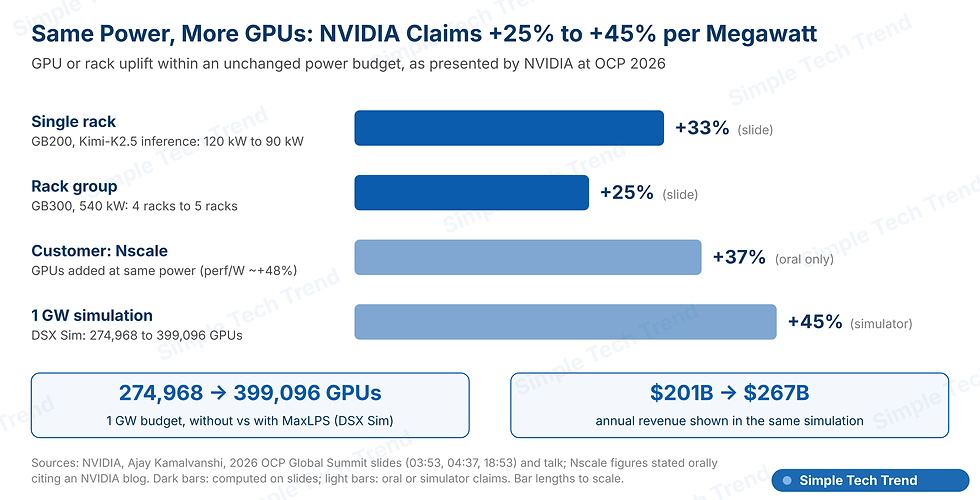
▲ GPU gains claimed by MaxLPS under the same power budget, from +33% for a single rack to +45% in a 1 GW simulation (Image source: Simple Tech Trend original, data from NVIDIA's 2026 OCP Global Summit presentation)
Note that the higher the level and the prettier the number, the lower the verifiability: +33% and +25% are fully computed on the slides, +37% appears only orally, and +45% comes from a simulator screen. Lambda offered only an endorsement quote from Dave Ward, with no numbers.
4. Architecture Breakdown: Four Jobs of Dynamic Power Software
The core of MaxLPS is Dynamic Power Software (DPS), which runs on the data center's management nodes and does four things:
Hierarchical power constraints: it imports the power topology from facility design specs or the BMS (building management system), sets circuit-breaker limits level by level from CPU, GPU and rack up to SU (scalable unit) and DU (deployable unit), and guarantees no limit is ever exceeded.
Closed-loop control: it reads power and sets limits through out-of-band (OOB) Redfish without disturbing running workloads. The rule is simple: if consumption is more than 20% below allocation, reclaim; if it is within 5%, add power; between 5% and 20%, do nothing.
Coordination with OT: the grid can send curtailment signals via OpenADR, for example on a hot day in Arizona; ISVs like Emerald AI help find stranded grid power, and NVIDIA claims 100 GW can be unlocked in North America; AI agents like Phaidra optimize CDUs (coolant distribution units), and cooling power saved can be shifted to IT.
Workload optimization: it steers power between IP blocks inside the GPU, between GPU and CPU, and between GPU and NVSwitch, and plugs these policies into the Dynamo inference framework to steer across prefill, attention and decode stages.

▲ MaxLPS decision rules for each node: reclaim when 20% below the allocation, replenish when within 5%, and hold between 5% and 20% (Image source: NVIDIA | 2026 OCP Global Summit presentation (10:13))
The biggest concern with oversubscribing power is SLAs. NVIDIA's answer is three priority tiers: P0 is frontier model training, provisioned at Max-P; P1 is the latency-sensitive premium/ultra segment where customers pay for SLAs, provisioned to workload need and prioritized for boost; P2 is the value segment, provisioned at Max-Q. When a curtailment event hits, P2 is throttled to its floor first (50 kW per rack in the slide example), then P1, then P0, and jobs are stopped only as a last resort, with power restored when the event ends.
5. The Real Challenge: Telemetry Is Too Slow
A closed-loop controller is only as good as how fast it sees power. Kamalvanshi was candid: this was built inside NVIDIA, and only after working with NCPs (NVIDIA Cloud Partners) did the team realize that field telemetry is not reliable enough and its latency is too high. Most power equipment today speaks only Modbus or Redfish, which were never designed for fast power telemetry.
NVIDIA has three responses:
Work with BMC firmware partners to improve the latency and reliability of Redfish interfaces, and provide test suites for partners to adopt.
Push UDP-based streaming telemetry in the OCP GPU Management Interfaces workgroup; the spec is in v2.0.0, and NVIDIA contributes Zapp as the reference implementation.
Extend fast telemetry to power devices such as PQMs and BESS so they talk directly to the system management stack.

▲ The four challenges and collaboration areas NVIDIA lists, with DSX Sim's GPU count and annual revenue comparison under a 1 GW budget on the right (Image source: NVIDIA | 2026 OCP Global Summit presentation (18:53))
MaxLPS will ship with Vera Rubin as part of the DSX reference stack, integrated with the open-sourced NICo (NVIDIA Infrastructure Controller) and the multi-tenant Launch Layer; the slide frames it as a blueprint for scaling to a 1 GW data center. Anyone without a data center can download DSX Sim to try it.
6. Risks and Counterarguments
Oversubscription is a bet that workloads will not peak together. If all four workloads approach Max-P at once, for example when large-scale training kicks in, throttling is the only answer; that is a real cost to paying customers' SLAs, and NVIDIA gave no numbers on throttling frequency or performance loss.
What is saved is "allocation," not "consumption". In the 540 kW example, consumption rises from 330 kW to 425 kW, so the grid sees more load. For power bills and cooling, MaxLPS makes the data center fuller, not leaner.
Power swings get bigger. Higher average utilization plus fast allocation changes mean more frequent load fluctuation. The talk did not cover 800V DC or power smoothing, but listing BESS in the telemetry scope suggests storage will shift from a backup role to a control element in this architecture.
Verifiability comes in tiers: +37% and perf/W of about 48% were stated only orally, and +45% comes from a simulator screenshot, so they should be checked against NVIDIA's official blog before publication.
Lock-in: DPS, DSX Exchange and Zapp are all NVIDIA software; the interfaces align with OCP, but scheduling authority effectively moves from the operator into NVIDIA's stack.
7. What It Means for Taiwan's Supply Chain
The server BMC is the first link called out. NVIDIA explicitly asked for better BMC Redfish latency and reliability and is providing test suites. Taiwan's ASPEED is the main global supplier of server BMC chips, and AI servers carrying those BMCs are largely assembled by Taiwanese ODMs, so how well the MaxLPS closed loop works depends heavily on this layer.
Power equipment must move from "supplying" to "reporting". The PQMs, RPPs (rack power panels), UPSs, CDUs and BESS on the slide all need to report to DPS via fast streaming telemetry. For Taiwanese power supply, UPS, energy storage and liquid cooling vendors, datasheets will soon carry a "telemetry latency" line next to efficiency and power density.
The cooling story will change. AI agents like Phaidra shift power saved at the CDU to IT, so the value of cooling equipment moves from "how much heat it removes" to "how much it can be orchestrated." To plug into this system, Taiwanese liquid cooling vendors need to open their control interfaces, not just ship hardware.
More racks per MW is a volume tailwind. If the same data center can host 25% to 33% more racks, demand for servers, rack power and liquid cooling manifolds scales up with it; but lower provisioned power per rack also discounts the single narrative of "ever higher watts per rack." This is our inference; NVIDIA gave no supply chain figures.
8. Conclusion
MaxLPS is not hardware, but it rewrites the planning unit of the AI factory: from "kW per rack" to "GPUs per MW". What can be fully verified on the slides is +33% at the rack level and 4 to 5 racks at the rack-group level, and those two numbers alone show that 25% to 40% of the power in nameplate-provisioned data centers has been locked up.
The timing is clear: MaxLPS ships with Vera Rubin, and hyperscaler and NCP partners are already running PoCs and inference pilots. Over the next 12 months, watch three things: when mainstream BMCs and power equipment implement the OCP telemetry spec v2.0.0, whether NVIDIA publishes SLA loss data under curtailment events, and whether a customer beyond Nscale reports a verifiable GPU uplift.
In an era when power is locked up, the cheapest new power plant is the 39% of the data center's power that never gets used.
For technology and industry trend analysis only. This is not investment advice.


Comments