


Barclays 23rd Annual Global Technology Conference | Credo Technology Group | From AEC to ZeroFlap: Defining Absolute Reliability for AI Clusters
This Barclays session featured Credo (CRDO) CEO Bill Brennan and CFO Daniel Fleming.
Throughout the interview, Credo came across as highly confident, stressing that it is no longer a company that "sells cables" but a key supplier of System-Level Reliability. From its dominance in AEC to optics and new products that tackle the Memory Wall, here are my key takeaways and analysis:
1. AI Deployment Is Still in the "Early Innings" — the Focus Shifts from Speed to Reliability
Bill Brennan said bluntly that AI infrastructure is definitely still in the "Early Innings." As GPU clusters scale from 10,000 to 100,000 or even 1 million GPUs, the logic of connectivity has fundamentally changed:
A single point of failure is extremely costly: In these hyperscale clusters, the link from a GPU to the first-tier switch (T0) usually has no redundancy. Once that link drops (a Link Flap), the entire training run may be interrupted, costing millions of dollars in compute and time.
The ZeroFlap concept: This is why xAI and Oracle came to Credo. Traditional optical links tend to be unstable in liquid-cooled, high-density environments, while copper is inherently highly reliable. Credo's mission is to use AEC technology to make these links "ZeroFlap" (zero flapping / zero link drops).
2. AEC (Active Electrical Cables): The Moat Is "Full-Stack In-House Development"
Credo is not worried about competitors emerging in the market (such as the so-called "Golden Cables"), because the business models differ:
System Ownership: Credo does not just design SerDes chips; it owns full vertical integration — from chip design and cable manufacturing to testing and quality control.
Customization: Customers (such as hyperscalers) need more than standard products — they need lengths and connector configurations designed for specific racks, even specific cable colors (hence the Purple Cable).
Moat: Competitors that simply buy chips and assemble cables will find it hard to match the reliability Credo achieves through end-to-end validation.
3. Entering the Optics Market: ZeroFlap Optics (ZF Optics)
This was a major highlight of the interview. Credo is replicating its AEC playbook in optics with ZF Optics:
What problem does it solve? AEC is great, but reaches beyond 7 meters still require optics, and traditional optical modules lack intelligent monitoring.
Telemetry: Credo designed a custom optical DSP that monitors the health of every link in real time while transmitting data (signal integrity, ESD damage, dust on fiber).
Predictive maintenance: Before a link actually fails, the system can detect signal degradation and notify management software to proactively take that GPU offline, avoiding disruption to the whole cluster. This is a strategy of transforming from a "Component Vendor" into a "Solution Provider."
4. Breaking the Memory Wall: Omni Connect (Weaver)
Beyond connecting GPUs, Credo is also starting to tackle the bottlenecks in memory bandwidth and capacity.
The limits of HBM: HBM is fast, but expensive and limited in capacity, and it must sit right next to the GPU (physical distance limit of about 25mm).
The Omni Connect solution: Using its low-power SerDes technology, Credo extends the distance between the memory controller (Weaver) and the GPU to 10 inches (250mm) while maintaining very high transmission efficiency.
Use cases: This lets customers replace part of their HBM demand with lower-cost DDR memory — especially in Inference scenarios (such as AI video generation), where models are huge and need large memory capacity. It is a highly cost-effective solution.
5. On CPO (Co-Packaged Optics): Too Early to Call
On the much-hyped CPO, Bill Brennan kept his usual pragmatic stance:
No urgency: Today's copper cables (AEC) and pluggable optics still beat CPO on cost, power and reliability.
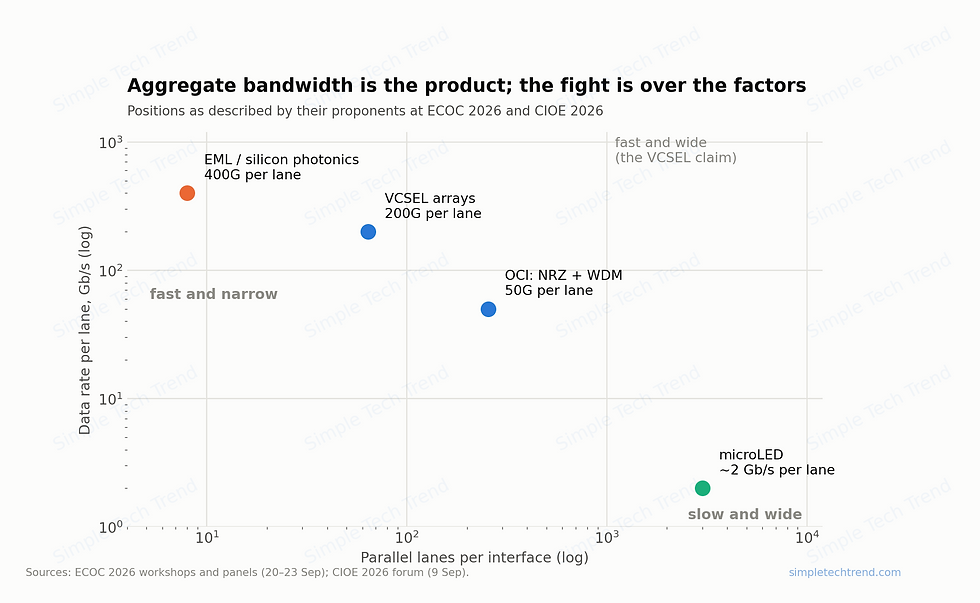
Technology path: Credo believes that even if physical limits are eventually reached, the ALC (Active Linear Cable) it is developing, combined with Micro LED technology, will be a lower-power, lower-cost option than CPO.
Conclusion
Credo's strategy is very clear: in the AI era, interconnect cables are no longer a commodity but a core component that determines system stability.
Whether by dominating short-reach links with AEC, making longer-reach transmission intelligent with ZF Optics, or solving the memory wall with Omni Connect, Credo is leveraging its SerDes IP advantage to keep expanding its TAM (Total Addressable Market) in the data center. For investors, the company has evolved from a pure hardware supplier into the reliability gatekeeper of AI infrastructure.


Comments