


ECOC 2025 Tech Spotlight: Institute of Science Tokyo Demonstrates a 2.88 Tbps 16-Channel VCSEL Array with Multicore Fiber for Co-Packaged Optics
Updated: 16 hours ago
Introduction
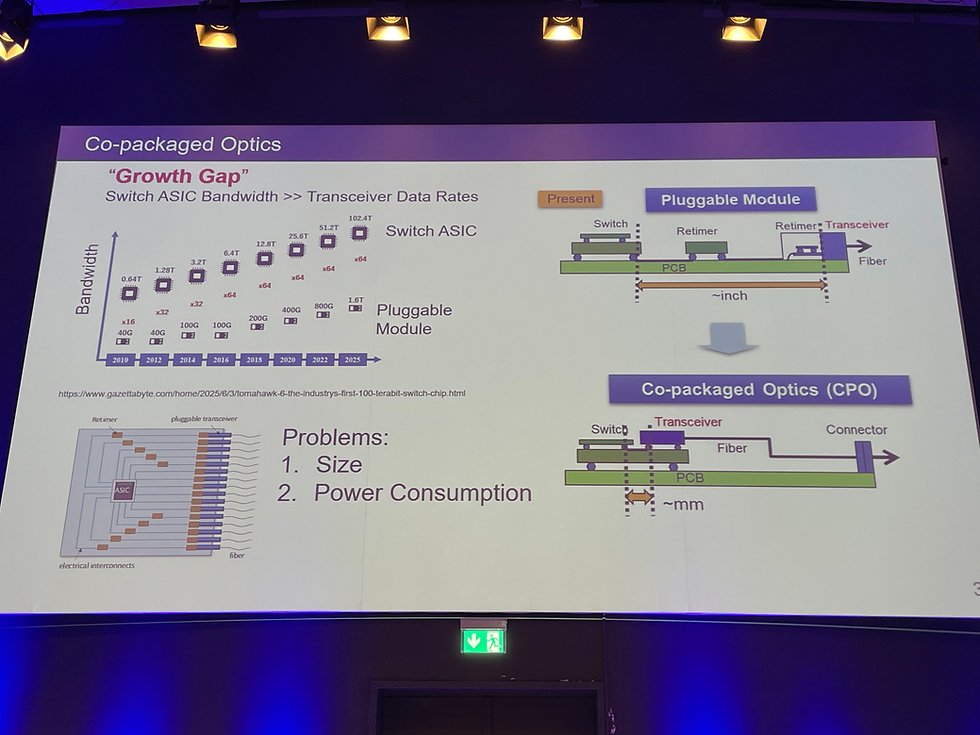
As AI and cloud data centers scale at breakneck speed, traditional copper interconnects and short-reach multimode fiber can no longer keep up. To close the gap between switch ASIC bandwidth and the reach limits of optical modules, co-packaged optics (CPO) is widely seen as a key technology for next-generation data centers.
At ECOC 2025, a team from Institute of Science Tokyo (formerly Tokyo Tech) presented the world's first 2.88 Tbps 16-channel VCSEL array combined with multicore fiber, offering a new path to high-density, low-power, high-speed links.
Key Points
1. Background and Motivation
Current challenges:
850 nm VCSELs are mature for sub-100 m links, but cannot meet the growing reach and speed demands of AI data centers.
As data rates climb (800G → 1.6T → 3.2T), fiber loss and dispersion severely limit where 850 nm PAM4 can be used.
The proposed solution:
Use 1060 nm VCSELs, which see lower dispersion in single-mode fiber, and can even gain bandwidth through the "pulse compression" effect.
Pair them with multicore fiber (MCF) for high-channel-density parallel transmission.
2. The Breakthrough: A 16-Channel 1060 nm VCSEL Array
Design highlights:
Single-mode output, avoiding multimode distortion.
A metal-aperture design that uses coupling effects to boost modulation bandwidth.
Top-emitting structure: no flip-chip packaging required, lowering cost and simplifying testing.
Performance:
Modulation bandwidth: 29 GHz (back-to-back), rising to 34 GHz after 500 m of fiber.
Optical output power: >2.5 mW per channel.
SMSR (side-mode suppression ratio): >30 dB, ensuring single-mode operation.
3. Transmission Results
1.6 Tbps experiment:
16 × 100 Gbps PAM4 over 500 m of multicore fiber.
Extinction ratio: 2.2 dB.
2.88 Tbps breakthrough:
16 × 180 Gbps (108 Gbaud) over 500 m of multicore fiber.
Extinction ratio: 2.0 dB; TDECQ (eye quality) = 4.2 dB.
A world-first demonstration, proving that VCSELs are viable for Tbps-class applications.
4. Integration with Multicore Fiber (MCF)
Fiber specs:
16 cores with a 40 µm core pitch.
Couples directly to the VCSEL array with no collimation optics.
Coupling loss:
Typically <3 dB.
Down to 1.7 dB after optimization.
5. Outlook
Higher lane rates:
PAM-4 → 200 Gbps/channel.
PAM-6 → 300 Gbps/channel.
PAM-8 → 400 Gbps/channel.
Capacity roadmap:
A single module could reach 6.4 Tbps (16 × 400 Gbps).
And potentially scale to 12.8 Tbps.
Applications:
CPO integrated with switch ASICs, cutting power and easing reach limits.
Short-reach links inside AI data centers, potentially displacing 850 nm VCSELs as the new mainstream.
Conclusion
The Institute of Science Tokyo work shows what VCSEL technology can do when 1060 nm emission, single-mode operation, and multicore fiber are combined:
Breaking speed and reach limits: 2.88 Tbps achieved over a 500 m link.
Design innovation: a metal-aperture structure plus top-emitting architecture delivers both high bandwidth and low cost.
Application value: highly significant for CPO and short-reach optical interconnects in AI data centers.
Future development: a path toward the 12.8 Tbps class, bringing ultra-high-density, low-power solutions to next-generation data centers.
The result suggests that VCSELs can not only extend their lead in short-reach links, but may also enter the Tbps era through CPO and multicore fiber.




Comments