


ECOC 2025 Workshop: Which Modulator Technology Will Win Next-Gen Optical Transceivers? System Requirements and the Technology Race
Introduction
As data centers and AI training clusters scale rapidly, optical transceiver speeds are moving quickly to 400G, 800G and even 1.6T and beyond. These applications place tougher demands on modulators: higher bandwidth, lower power, smaller footprint, and the ability to integrate with silicon photonics platforms.
At a dedicated ECOC 2025 workshop, experts from industry and academia gathered to debate a single question: "Which modulator technology will win in next-generation optical transceivers?" The session had two parts: the first focused on system and application requirements, the second reviewed the latest progress across modulator technologies.

Content
LightCounting (Roy Rubenstein) — The Market and Application View
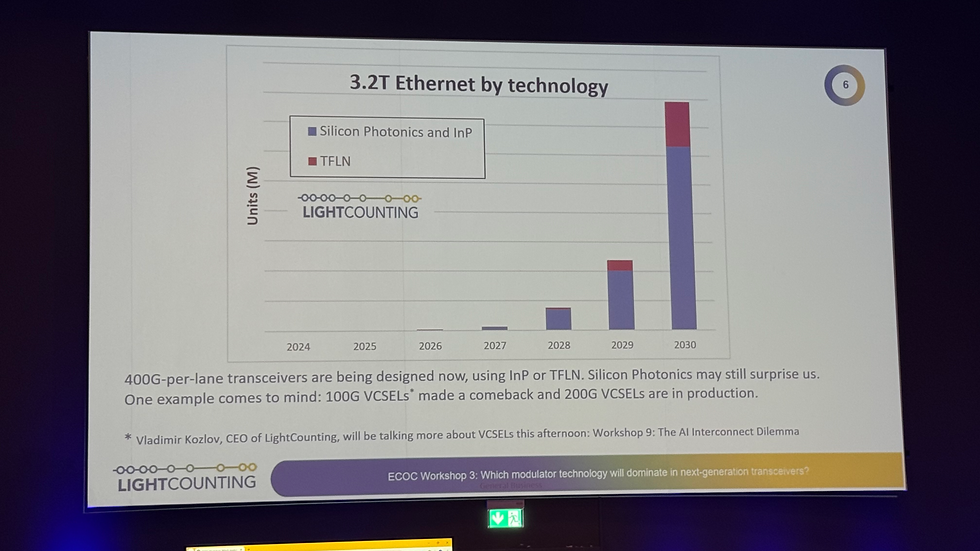
Speaking from a market research perspective, Roy Rubenstein noted that the AI and big-data era is driving explosive demand for optical links in data centers. That demand is not just about higher speeds; it is also about power, cost and scalability. He stressed that the choice of modulator technology must account for whether it can support high-volume markets in production, not just lab performance. From LightCounting's point of view, technology maturity and manufacturability will be the core factors deciding which modulator wins.




Nubis Communications (Marco Lamponi) — System Architecture and the CPO Driver
Marco Lamponi focused on the shift in module and system architecture. With the rise of CPO (Co-Packaged Optics) in particular, modulator integration, packaging approach and electro-optical co-design are becoming increasingly important. He pointed out that while traditional pluggable optics can meet market demand quickly, CPO will significantly cut power and relieve interconnect bottlenecks in AI and large-scale HPC. Nubis's view is that a modulator's competitiveness will depend on how well it integrates with the ASIC/driver in a CPO environment.


NVIDIA (Liron Gantz) — System Requirements Driven by AI
Starting from NVIDIA's application perspective, Liron Gantz emphasized that low latency, high reliability and power constraints are the key requirements of AI clusters. Across GPU interconnect and data center networking, NVIDIA sees that modulators must not only hit high data rates (>400G per λ) but also deliver overall system efficiency. He specifically noted that co-design of the modulator and the DSP will matter more than chasing raw bandwidth. For NVIDIA, the selection criterion is not just performance but whether a technology meets real deployment needs in scale-out and scale-up architectures.


Coherent Corp. (Anna Tatarczak) — Balancing InP and Hybrid Integration
Anna Tatarczak shared the roadmap for InP and hybrid-integrated modulators. Coherent's strategy is to build on InP's strengths in lasers and modulators while exploring hybrid integration with silicon photonics platforms to reduce packaging complexity and cost. She noted that for enterprise and cloud markets, reliability, maturity and a complete supply chain often matter more than extreme performance. Coherent's view is that InP/hybrid technology offers a pragmatic path that maintains high performance while reaching the market quickly.



IMEC – Ghent University (Peter Ossieur) — Research and Technology Readiness
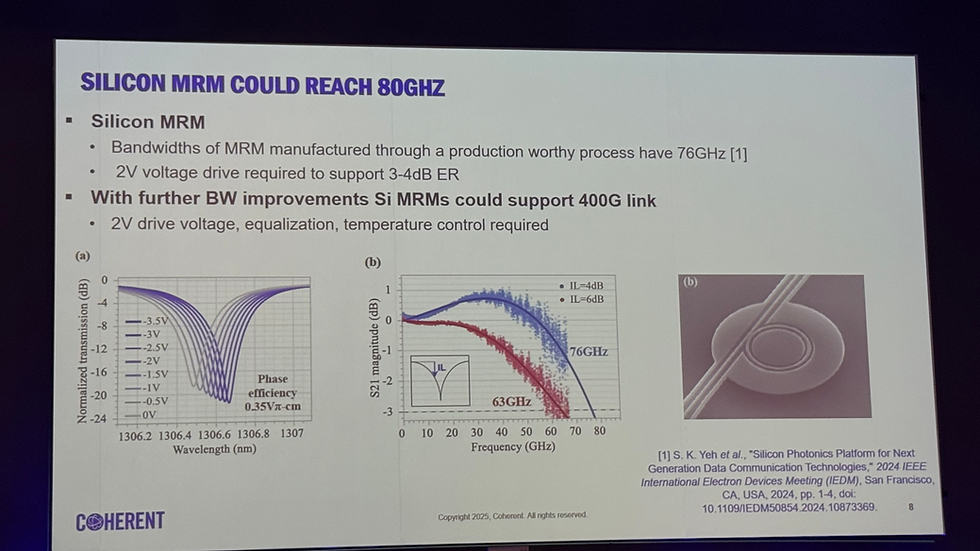
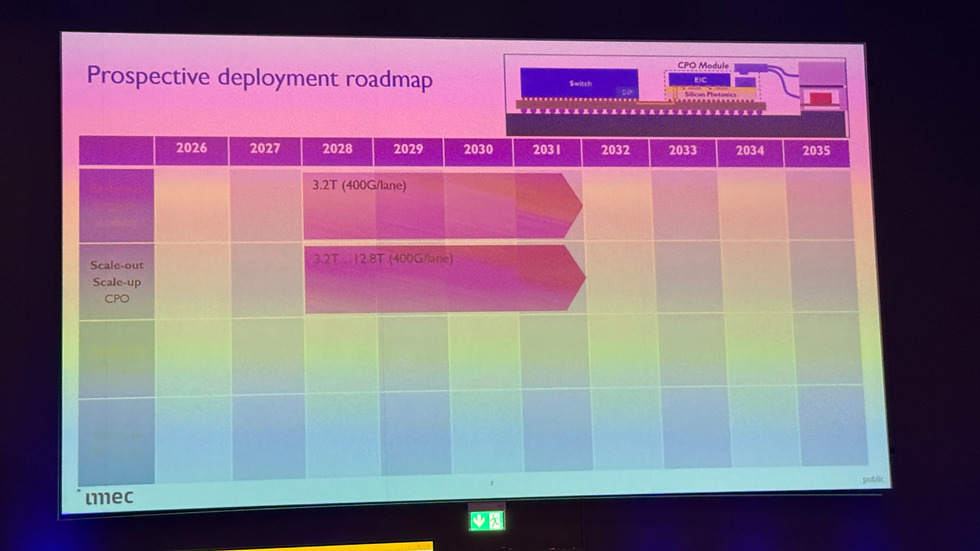
From the research perspective of IMEC and Ghent University, Peter Ossieur discussed the key to modulator technology evolution: process transfer and industry acceptance. Many emerging materials and structures have shown impressive results in the lab, he argued, but to enter volume production they must solve yield, process compatibility and long-term reliability. IMEC's view is that Technology Readiness Level (TRL) is what ultimately determines which technology actually reaches the market.




ETH Zürich (Jürg Leuthold) — Challenges and Opportunities for Plasmonic Modulators
Jürg Leuthold presented the latest results on plasmonic modulators. Although metal waveguiding is usually seen as high-loss, he pointed out that with the right structural design it can exploit a low RC time constant and strong nonlinear effects to reach ultra-high bandwidth (>500 GHz, even approaching 1 THz). His team has achieved sub-1 V drive voltage, Mach-Zehnder and ring modulators only a few micrometers in size, and demonstrated 100 km DSP-free transmission. He acknowledged that plasmonics faces loss and manufacturing challenges, but argued that, much like early electric vehicles, it could upend the silicon photonics and InP landscape if the industry is willing to invest.


KIT (Christian Koos) — A Dual-Track Strategy: SOH and TFLT
Christian Koos compared Silicon-Organic Hybrid (SOH) and Thin-Film Lithium Tantalate (TFLT) in detail.
SOH strengths: ultra-low drive voltage (hundreds of mV), high VπL efficiency, direct compatibility with CMOS drivers, and seamless integration with silicon photonics. He showed 112G results driven directly by CMOS, with power of only 10–20 fJ/bit.
SOH challenges: the thermal and photochemical stability of organic materials still needs more data. The best packaging so far reaches 6,000 hours @ 85°C, with work under way to push this to 125°C.
TFLT strengths: lower RF loss than TFLN, a more stable bias point, and the material is already widely used in smartphone filters, giving it potential for low cost and high reliability.
In his view, SOH suits highly integrated, low-power applications, while TFLT suits high-power, high-reliability requirements.


Liobate (Xinlun Cai) — The High-Performance Potential of TFLN
Xinlun Cai reported on the use of Thin-Film Lithium Niobate (TFLN) in high-speed transmission. His key points:
Strengths: TFLN offers high performance (>110 GHz bandwidth), low half-wave voltage (Vπ < 2.5 V), good design flexibility (single-ended and differential drive), and shows promise in both PAM4 and coherent applications.
Challenges: integrating photodetectors (PDs) is still difficult and requires InP/SiGe heterogeneous packaging. Market acceptance is also still being built, and more reliability data is needed (currently about 5,000 hours).
Progress: Liobate can already fabricate 6-inch and 8-inch wafers and has worked with industry partners to demonstrate 400G transmission modules, showing that TFLN is moving toward commercialization.


OpenLight (Molly Piels) — A Heterogeneous InP Integration Platform
Speaking for OpenLight, Molly Piels highlighted the unique advantages of a heterogeneous InP integration platform:
Platform features: beyond modulators, it can simultaneously integrate lasers, PDs and SOAs, forming a complete photonics platform.
Current performance: 95 GHz single-ended bandwidth, 600 µm length, roughly 1–2 pJ/bit, and GR-468 reliability qualification passed.
Challenges: bandwidth drops under differential drive, which requires more advanced packaging (such as 3D integration) to solve.
In her view, the greatest value of the InP platform is a complete solution rather than single-component performance, which makes it well suited to high-volume manufacturing and system deployment.


Mitsubishi Electric (Mizuki Shirao) — EML's Lasting Strengths and Transition Challenges
Mizuki Shirao stressed that the Electro-absorption Modulated Laser (EML) remains the workhorse technology for today's pluggable optics:
Technical strengths: a high-mesa structure maintains strong optical confinement while lowering capacitance, enabling bandwidth above 100 GHz.
Packaging innovation: an AlN + glass hybrid substrate separates the RF lines from the heat-sinking substrate for low inductance and strong heat dissipation, with modules shown exceeding 110 GHz.
Roadmap: a dual-channel integrated EML chip was shown reaching 224 Gbps x2 with no significant crosstalk.
Challenges: in CPO applications, EML's integrated laser actually becomes a drawback, because reliability and serviceability requirements call for an external light source (ELS). EML must therefore adapt through changes in packaging and system architecture.


Conclusion
The workshop made clear that no single modulator technology will dominate the next-generation market. Each has its strengths and weaknesses:
Plasmonic: ultra-fast and extremely compact, but still facing loss and manufacturing challenges.
SOH / organic materials: ultra-low drive voltage and strong CMOS compatibility, but long-term reliability must still be proven.
TFLT / TFLN: high performance and a good cost structure, well suited to coherent communications, but integration and market acceptance are still being established.
InP heterogeneous integration: offers the advantages of a complete platform, but packaging and differential drive still need breakthroughs.
EML: mature and reliable, well suited to today's pluggable optics, but laser placement must be rethought for the CPO era.
The eventual winner is likely not a single material or technology, but the solution that strikes the best balance across system, packaging and supply chain.
Q&A Highlights
ETH Zürich (Jürg Leuthold) — The Plasmonic Challenge
Focus of the question: plasmonic modulators offer stunning bandwidth, but the industry's main concerns are high loss, yield and scalability.
Response: Leuthold acknowledged that early devices had losses as high as 40 dB, but these are now below 6 dB, mostly from fiber coupling rather than the device itself. Current lab yield is about 50%, he said, but could improve dramatically with industry investment. He put it bluntly: "The biggest obstacle is not physical limits, but the industry's conservatism and lack of conviction."
KIT (Christian Koos) — Reliability of SOH and TFLT
Focus of the question: can organic materials (SOH) withstand long-term high temperatures and the packaging process?
Response: Koos said SOH has been tested for more than 6,000 hours at 85°C and work is under way to raise that to 125°C. Short reflow cycles are a challenge but can be addressed with cross-linked polymers and packaging engineering. He also acknowledged that material bias drift still exists, but can be improved through molecular design and material optimization. For TFLT, he sees no significant reliability issues, since the substrate is already widely used in smartphone RF filters.
Liobate (Xinlun Cai) — TFLN Volume Production and Differential Drive
Focus of the question: TFLN uniformity on large wafers and the feasibility of differential drive.
Response: Xinlun acknowledged that a monthly capacity of 1,000 wafers is still at the planning stage and not yet at volume-production level. He showed within-wafer performance uniformity data and said the team is developing new structures to improve differential-drive stability. On PD integration, he said they are researching SiGe PDs and III-V PDs in parallel to overcome current limitations.
OpenLight (Molly Piels) — Differential-Drive Challenges and Cost of the InP Platform
Focus of the question: the bandwidth drop of heterogeneous InP modulators under differential drive, and process cost.
Response: Piels explained that the RF structure causes bandwidth to fall by about 30–40%, which is still acceptable for 100G and 200G systems, while 400G needs optimization. She sees the real breakthrough in 3D packaging and co-packaging with the driver. On cost, InP wafer processing is more complex than pure SiPh, but volume production is possible through mature foundries such as Tower, and the platform has passed GR-468 reliability qualification.
Mitsubishi Electric (Mizuki Shirao) — EML's Limits in CPO
Focus of the question: EML suits pluggables, but does it retain its advantage in CPO and high-temperature environments?
Response: Shirao said EML's strength lies in monolithic integration of the laser and modulator, which is ideal for pluggables. In CPO, however, serviceability and reliability requirements usually push the laser outside (ELS). EML's future in CPO therefore depends on packaging innovation (such as heterogeneous integration or external-laser designs); otherwise it will lose competitiveness. He also showed results with integrated microlenses and multi-channel EMLs, demonstrating that EML still has room to develop.
Panel Consensus and Discussion
Need for standardization: several speakers argued that the industry needs module-level black-box standards; otherwise every company has to iterate repeatedly with each customer, wasting time and money. OIF and the emerging Advanced Photonics Coalition were named as potential drivers.
Defining power: there was broad agreement that modulator fJ/bit should not be reported in isolation, but should include the combined power of driver + modulator.
Application differences: the general view was that pluggable, CPO and coherent line systems place vastly different demands on modulators. No single technology will dominate; instead, multiple technologies will coexist, each serving different application scenarios.


Comments