


OCP Global Summit 2026 | Shenzhen Litra Technology | Zhongxiang Zhang | Wavelength-Granular OCS with Solid-State OPA
1. Why This Talk: Two Old Problems of OCS
The appeal of OCS (optical circuit switching) in AI clusters is straightforward: high bandwidth, low energy and no optical-electrical-optical conversion per hop. But Litra opened by naming two limits of today's OCS:
Reconfiguration speed: MEMS and liquid-crystal (LCoS) switching take milliseconds, far slower than the communication intervals of distributed training.
Switching granularity: whole-fiber switching allocates bandwidth only in integer-fiber units, a poor match for sparse MoE traffic.
As we wrote in ECOC2026 | 95% of OCS shipments are one company's business: Google, today's OCS shipments are concentrated almost entirely at Google, mainly for slow re-arrangement of cluster topology. Litra wants something else: to turn OCS from a topology tool into a traffic tool. It places itself in the middle of the speed axis: electro-optic switches are nanosecond-class, MEMS/LCoS millisecond-class, and its solid-state OPA (optical phased array) reconfigures in 0.3–10 microseconds.
2. Breaking Down the Energy Model: 3.2 W Divided Three Times
Litra's core claim is that "switch power is a misleading metric"; what dominates fabric energy is three multipliers:
Multiplier | Problem | Litra's countermeasure |
Insertion loss | Every dB is paid back in laser launch power | Structural sub-dB design at device level |
Bandwidth utilization | Whole-fiber switching strands capacity under sparse traffic | Wavelength-granular, near-continuous allocation |
Hop count | Every electrical hop costs tens of pJ/bit | Optical bypass, roughly two orders of magnitude saved |
The framework itself is right, and consistent with treating pJ/bit as a system-level metric in OIF draws an official map for AI interconnect. The problem is the next chart.
Litra uses E_bit = P_port / R: an electrical switch costs about 20 pJ/bit per hop, flat across generations; its OCS only holds the switch state at near-constant power, so 400G, 800G and 1.6T come out at 8, 4 and 2 pJ/bit. STT back-calculation: 8 pJ × 400 Gb/s, 4 pJ × 800 Gb/s, 2 pJ × 1.6 Tb/s — all three equal 3.2 W.
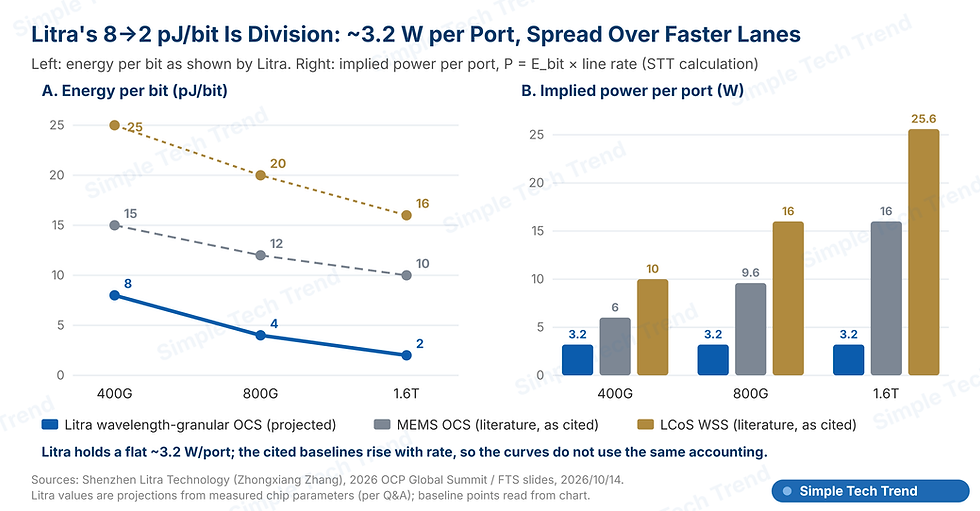
▲ Litra's 8/4/2 pJ/bit all back out to about 3.2 W per port, while the MEMS and LCoS literature baselines imply per-port power that rises with line rate, so the two are not computed the same way (Image source: Simple Tech Trend original; data from Shenzhen Litra Technology 2026 OCP Global Summit presentation)
Two things to see clearly here:
Any passive or constant-hold-power optical switch enjoys the same division. In STT's view, a MEMS mirror also only needs a holding drive voltage, so in theory it too should fall in proportion to line rate. Yet the literature baselines Litra cites (STT chart reads) are about 15, 12 and 10 pJ/bit for MEMS and about 25, 20 and 16 pJ/bit for LCoS WSS; STT back-calculates per-port power rising from 6 W to 16 W and from 10 W to 25.6 W. The baselines do not follow P/R, meaning the two sides count different terms, which discounts the claim that "each generation doubles the advantage."
This is projection, not measurement. The slide itself says "projected", and when the session host asked in Q&A whether it was measured, the speaker answered: "That's theory... All the device parameters are measured. But the system parameter are projected."
Our judgment: the chart proves the structural advantage of optical switching over electrical switching, not Litra's advantage over other OCS.
3. Breaking Down the Device: Turning Dispersion from Defect into Feature
Litra's device differs from a silicon-photonics OPA:
A large-scale nano-antenna array, fully solid-state with no moving parts; no waveguide — light couples directly into the antennas.
A traveling acoustic field writes a programmable phase grating across the array; because the acoustic perturbation is weak, a bottom DBR (distributed Bragg reflector) forms a high-Q cavity with the antennas to amplify it.
Tuning the RF drive frequency and phase offset steers the beam in 2D; with sub-wavelength antenna pitch there is a single diffraction order and no grating lobes over the full field of view.
The smartest step is at system level. Nano-antenna steering is naturally dispersive — different wavelengths steer to different angles — usually treated as a defect. Litra uses it instead:
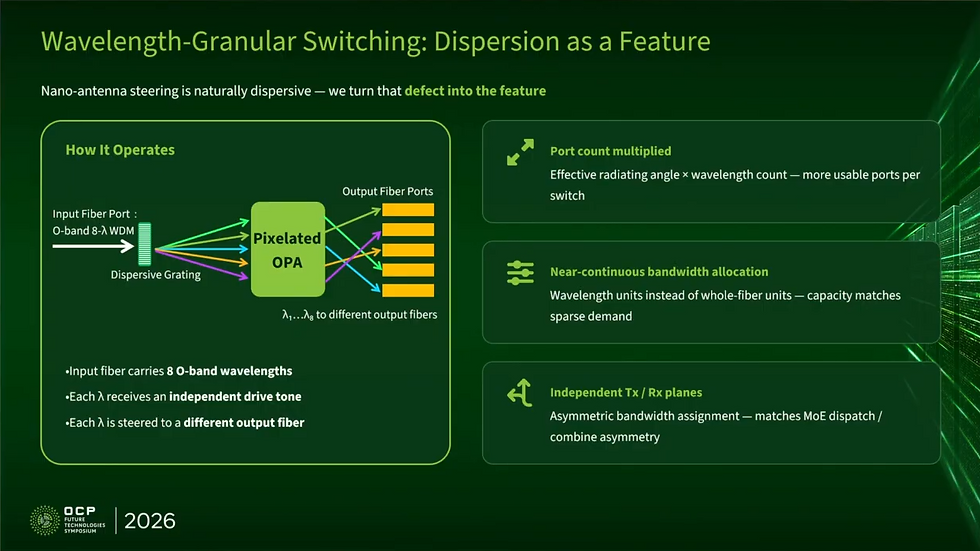
▲ The input fiber carries 8-wavelength O-band WDM; a dispersive grating spreads it out, a pixelated OPA steers each wavelength independently, and λ1 through λ8 go to different output fibers (Image source: Shenzhen Litra Technology | 2026 OCP Global Summit presentation)
Each wavelength gets an independent drive tone and is steered to a different output fiber; the speaker likened it to "an OCS with a large-array WSS."
Usable port count = effective radiating angle × wavelength count.
Tx and Rx are independent planes, allowing asymmetric bandwidth assignment that matches MoE dispatch/combine asymmetry.

▲ Switching a whole fiber sends the entire bundle to one destination; switching per wavelength lets the 8 wavelengths in one fiber go to 8 destinations (Image source: Simple Tech Trend original; data from Shenzhen Litra Technology 2026 OCP Global Summit presentation)
4. System Studies Wrote the Spec — The Numbers Laid Out
Litra cited three system studies to show the requirement is already defined:
ACTINA (SC'25): reconfiguration latency under 100 µs improves training communication time by up to 2.3×; microsecond-class reaches that regime, millisecond-class does not.
mFabric (SIGCOMM'25): MoE all-to-all traffic is sparse, and whole-fiber switching covers only a fraction of expert pairs.
OFC 2026 M3F.3: a strictly non-blocking OCS combining spatial and wavelength routing, 4,096×4,096 ports and 819.2 Tb/s in a single layer. STT calculation: 200 Gb/s per port.
Chip-level results:
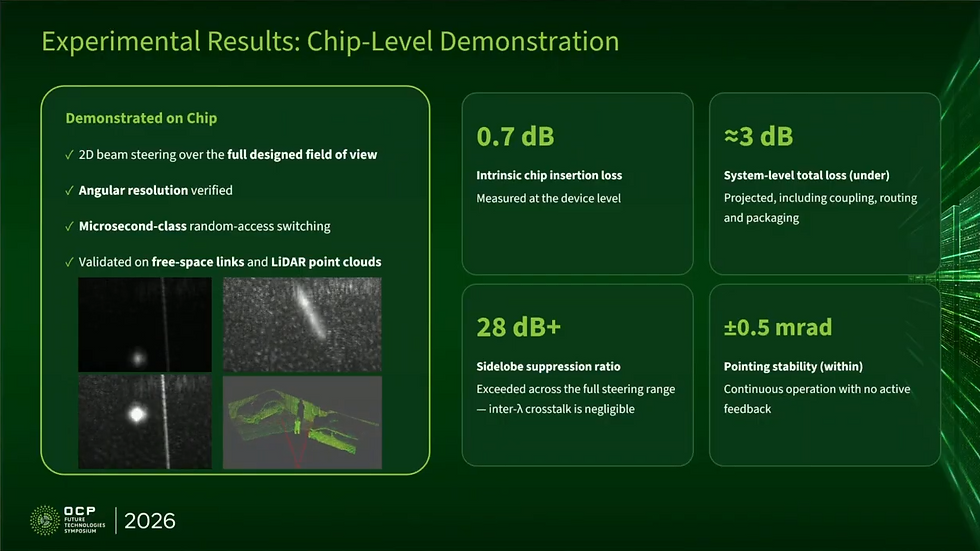
▲ Intrinsic chip insertion loss 0.7 dB, estimated total system loss within about 3 dB, sidelobe suppression above 28 dB, pointing stability ±0.5 mrad (Image source: Shenzhen Litra Technology | 2026 OCP Global Summit presentation)
Metric | Value | Nature |
Intrinsic chip insertion loss | 0.7 dB | Measured |
System total loss (coupling, routing, packaging) | Within about 3 dB | Projected |
Sidelobe suppression ratio | 28 dB+, 50 dB version in development (oral) | Measured / in development |
Pointing stability | ±0.5 mrad, continuous operation without active feedback | Measured |
Reconfiguration time | 0.3–10 µs | Device spec; µs-class random-access switching shown on chip |
Note: 2D steering, angular resolution and µs-class random-access switching have so far been validated on free-space links and LiDAR point clouds, not on fiber-to-fiber data links.
5. Risks and Counterarguments
Litra listed its own "trade-offs stated honestly" table, which deserves credit, but every item points to a commercialization challenge:

▲ Litra's four stated engineering trade-offs: separate Tx/Rx planes double the hardware, a fixed wavelength grid, multiple tones sharing the crosstalk budget, and state that must be actively held (Image source: Shenzhen Litra Technology | 2026 OCP Global Summit presentation)
The gap between 3 dB and "sub-dB". The countermeasure table says structural sub-dB design, but that is the chip alone; at about 3 dB system loss, STT calculates the laser launch power must double. In a CPO/NPO era where laser power is already tight, this is the biggest challenge.
Wavelength count limited by crosstalk budget. Eight wavelengths share a multi-tone crosstalk budget; scaling to more wavelengths requires sidelobe suppression to keep up, which is what the 50 dB version targets.
Fixed wavelength grid, not broadband-transparent. It is tied to the O-band 8-λ ecosystem; a different wavelength plan means a different device.
Doubled hardware. Separate Tx/Rx planes buy asymmetric allocation at the cost of roughly 2× switch hardware.
Thermal drift of an actively held state. The results slide says "no active feedback," while the trade-off table cites closed-loop pointing control as mitigation; which holds in volume remains to be seen.
Microseconds need someone to use them. However fast the OCS reconfigures, the scheduler and switch ASIC must keep up; Litra lists "co-designed control with switch ASICs" as a next step, meaning that part is not done.
Geopolitics. Litra is a Chinese company based in Shenzhen; the hurdle for US hyperscaler adoption is not only technical.
6. What It Means for Taiwan's Supply Chain
The slides name no Taiwanese companies, so this section covers structural position only.
O-band 8-λ WDM is the key premise. Litra deliberately aligns with the existing O-band 8-λ source ecosystem, meaning that if this class of OCS succeeds, it benefits the supply chain already making multi-wavelength O-band sources and transceivers, with no new wavelength spec required.
Most of the 3 dB system loss is coupling and packaging. The chip accounts for only 0.7 dB; the remaining ~2.3 dB (STT calculation) sits in fiber coupling, routing and packaging. If the architecture holds, fiber coupling and optical packaging decide system loss — an entry point worth watching for Taiwan's optical packaging supply chain.
No volume timeline before 2027. Per the speaker's oral remarks, the first ASIC taped out in 2025, the second version is current, and larger-scale fabric testing starts in early 2027; for Taiwan's supply chain this is a technology watch item, not orders.
7. Conclusion
The most memorable thing from Litra's talk is the 8, 4, 2 pJ/bit curve, but that is just constant power divided by line rate — any constant-hold-power optical switch can draw it. What is genuinely new is moving the OCS allocation unit from fiber to wavelength, with µs-class reconfiguration from an acoustically driven solid-state OPA. That directly answers the MoE-era problem of whole-fiber switching giving too much capacity while covering too few pairs.
STT's stance is clear: until Litra shows fiber-to-fiber data with 8 wavelengths operating simultaneously and measured system loss no higher than 3 dB, it remains a chip that has proven itself on LiDAR. Over the next 12–18 months, watch three things: measured system loss in the early-2027 fabric tests, whether the 50 dB sidelobe version pushes wavelength count beyond 8, and whether the switch-ASIC control interface is published.
The next OCS contest is not about whose switch uses less power, but who can split one fiber into eight destinations without paying an extra 3 dB.
This article is for technology and industry trend analysis only and does not constitute investment advice.


Comments