


OFC 2026 - Building AI Ready Fabrics: Scaling from IMDD to Coherent DCI - Microsoft Azure
Updated: Oct 7
In the opening keynote of the OFC 2026 Data Center Summit, Dr. Yawei Yin, a key figure in Microsoft Azure's network architecture, shared in-depth insights into how network infrastructure is evolving in the AI era. With AI model size surging 750x every two years — far outpacing Moore's Law at 2x — the network has become the single most critical bottleneck limiting what compute can deliver.
The core of the talk was how to build "AI Ready" network fabrics and push them from traditional pluggable IMDD (intensity modulation / direct detection) technology all the way to the new frontier of coherent DCI (data center interconnect).
The Gap Between Compute and Network: Scale-Up, Scale-Out, and Scale-Across
By 2026, Microsoft's infrastructure footprint has reached more than 70 regions, more than 400 data centers, and a staggering 18 Pb/s of total capacity. Yet the "Speed Gap" between compute and network has widened to more than three orders of magnitude.
To address this, Microsoft defines a three-dimensional scaling architecture:
Scale-up: synchronous, high-frequency communication among XPU servers within a rack.
Scale-out: connecting clusters of tens of thousands of GPUs within a data center.
Scale-across: because a single site typically has only 50-300 MW of power while next-generation training clusters need 1-5+ GW, distributed multi-site training is no longer an option but an architectural necessity.
The Brutal Showdown of Energy Efficiency (pJ/bit)
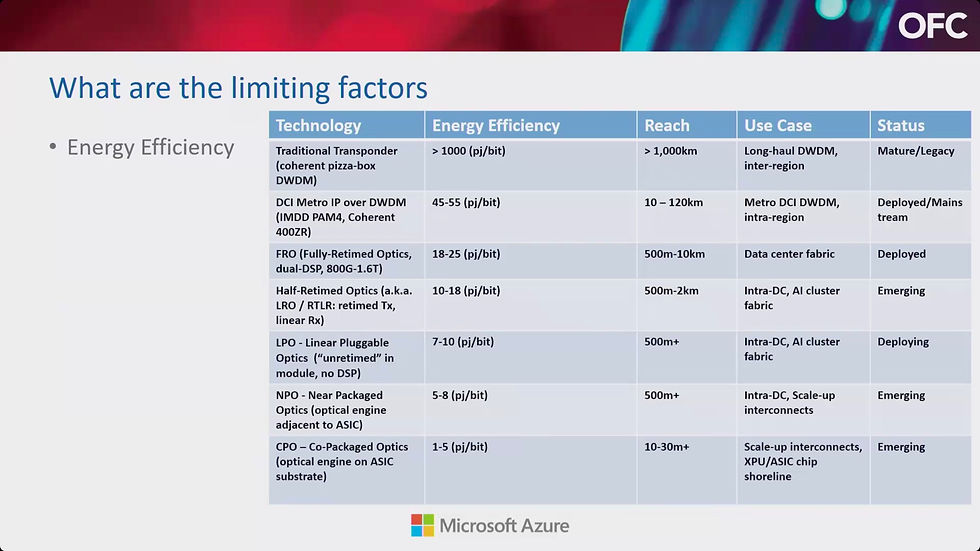
In AI fabrics, power is the ultimate factor that sets scaling limits. Dr. Yawei Yin presented a highly authoritative energy-efficiency comparison of optical technologies:
Technology | Energy Efficiency (pJ/bit) | Reach | Status |
Traditional Transponder | >1000 | >1,000 km | Mature/Legacy |
DCI Metro (IP over DWDM) | 45-55 | 10-120 km | Mainstream |
FRO (Fully-Retimed Optics) | 18-25 | 500 m - 10 km | Deployed |
LPO (Linear Pluggable Optics) | 7-10 | 500 m+ | Deploying |
CPO (Co-Packaged Optics) | 1-5 | 10-30 m+ | Emerging |
Microsoft noted that the coherent DSP accounts for more than 60% of the power and 50% of the cost of an AOC (active optical cable). Microsoft is therefore pushing a Media Converters approach: by integrating the coherent DSP into pluggable modules and eliminating high-frequency electrical traces on the line card, long-haul energy efficiency is expected to drop from 1,000 pJ/bit to about 100 pJ/bit.
Reliability Challenges: From Gunshots to AI-Agent Management
Once network infrastructure moves outside the data center (scale-across), the availability of outside plant (OSP) fiber is only about 97.7%. Dr. Yawei Yin showed a series of surprising failure causes:
Fiber hit by gunshots, arrows, and gnawed by rodents.
Outages caused by excavator work or landslides.
Unlike traditional cloud computing, which is fault tolerant, an AI cluster is a tightly coupled supercomputer. Once a single point of failure hits a synchronous training job, the entire run stalls.
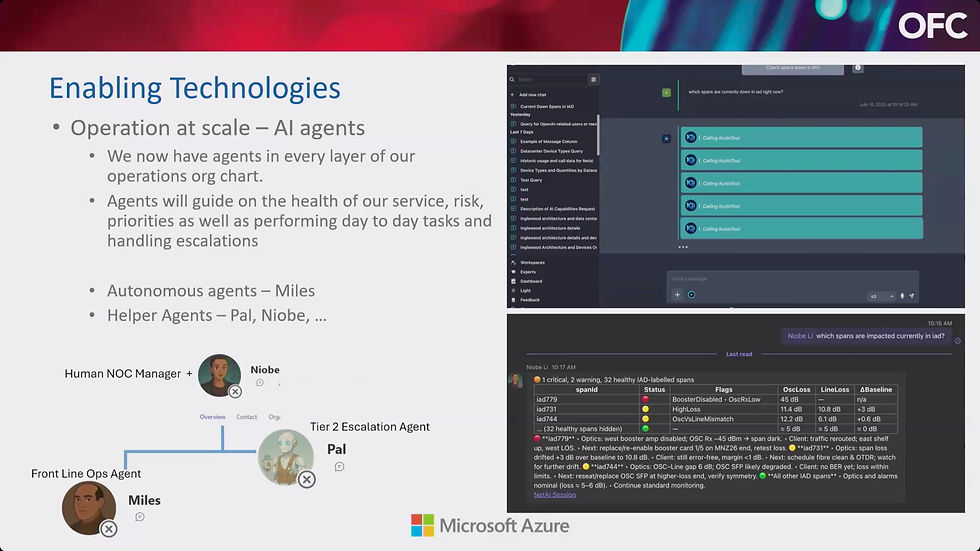
To operate at this scale, Microsoft has brought an AI agent team (Miles, Pal, Niobe) into operations, handling everything from first-line telemetry analysis to second-level alarm handling and interaction with data center technicians. This lets a team of just 20-30 people effectively manage more than 500,000 devices.
Key Enabling Technologies: Hollow Core Fiber and OCS
To address latency and bandwidth limits, Microsoft showcased two key physical-layer technologies:
Hollow Core Fiber (HCF):
Low latency: light travels about 33% faster in air than in glass, cutting WAN latency by 33% and expanding the radius of a data center availability zone (AZ) by 47%.
Ultra-low loss: a world record of <0.11 dB/km was set in 2025.
No nonlinear effects: significantly increases per-fiber capacity.
Optical Circuit Switching (OCS):
Because the radix growth of electrical packet-switching ASICs can hardly keep up with the connectivity needs of hundreds of thousands of GPUs, OCS offers a flexible way to reconfigure topology.
Microsoft is evaluating different OCS implementations, including MEMS mirrors, digital liquid crystal and piezoelectric actuators.
Simple Tech Trend's View:
Dr. Yawei Yin's talk sends a clear signal: optical communications is no longer an "external accessory" of the data center but the core backbone of the AI supercomputer. Here is our outlook for the next 12-24 months:
The rise of the Media Converter: coherent technology moving inside the data center (intra-DC) is now a given. Microsoft's emphasis on 1600ZR and integrated media converters signals a new volume ramp for 400G/800G coherent modules.
An architectural revolution in distributed training: when 5 GW of power cannot be delivered at a single site, optimizing network latency (e.g., with HCF) will become core to the competitiveness of AI players.
A parallel era for LPO and CPO: although CPO offers excellent 1-5 pJ/bit efficiency, Microsoft stressed its challenges in serviceability and yield. In 2026-2027, LPO (Linear Pluggable Optics) will remain the workhorse of AI cluster deployments.
Microsoft is currently facing widespread shortages of lasers and other components. This is a very long-term tailwind for the optical transceiver supply chain (e.g., Coherent, Marvell, Broadcom) and for TSMC's advanced packaging (for CPO/OCI).







Comments