


OFC 2026 - 800G CPO Breakthrough: 1060-nm Single-Mode VCSEL Reaches 2 km at 4.1 pJ/bit - Furukawa Electric
Exploding AI/ML compute demand has pushed the power and density of conventional pluggable transceivers up against physical bottlenecks. At OFC 2026, Furukawa Electric presented its latest progress in co-packaged optics (CPO): a 53-Gbaud × 8-channel 1060-nm single-mode VCSEL solution.
Beyond easing the space constraints of high-density interconnects, the single-mode laser design pushes VCSEL reach to 2 km, covering the full range of intra-datacenter links.
Core Technology: From Multicore Fiber (MCF) to a Standard Ecosystem
The focus of Furukawa Electric's work this time is commercial viability. Compared with its earlier 16-channel 1.6-Tb/s solution, which relied on 19-core multicore fiber (MCF) and faced a high standardization barrier, the new 8-channel design shows much more mature industry integration:
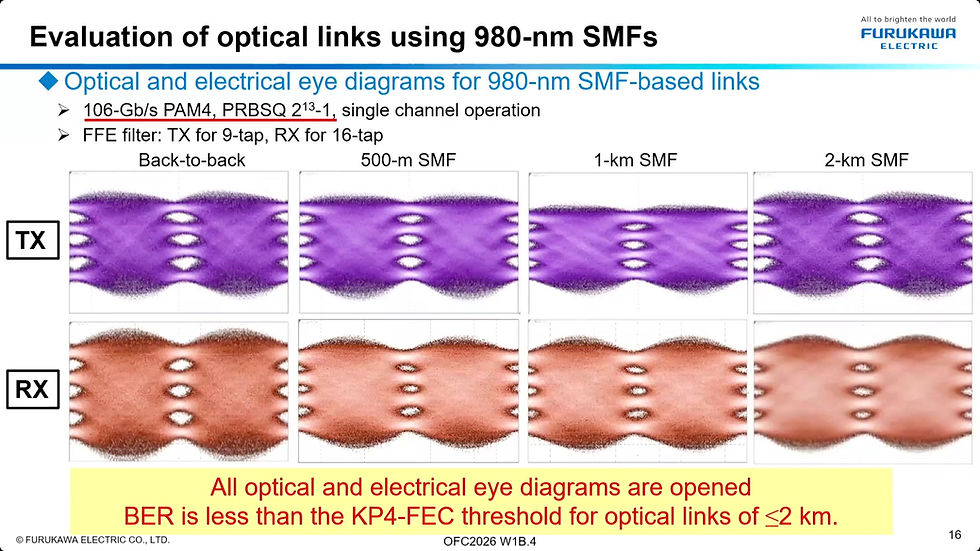
Standard interfaces: it uses a standard MT ferrule and commercial 980-nm single-mode fiber (SMF), greatly improving interoperability and cost.
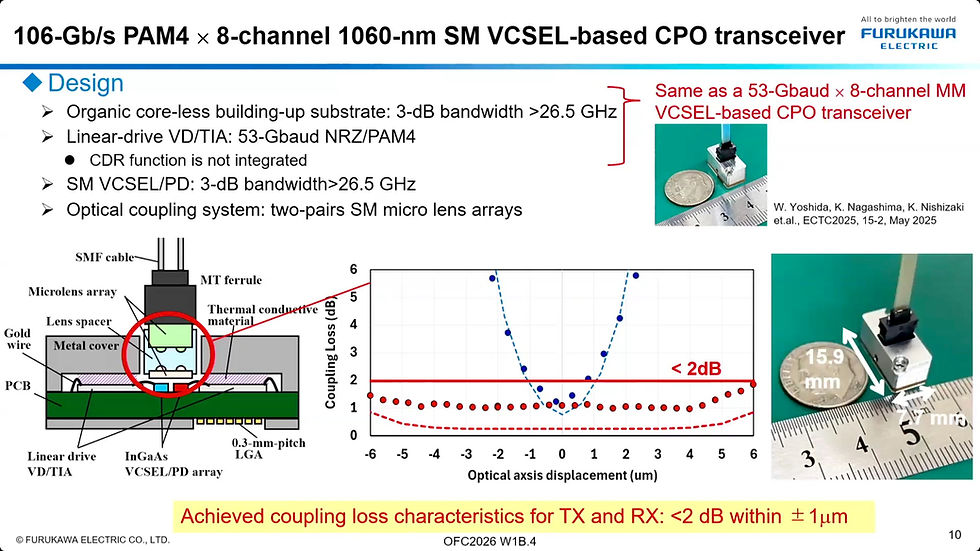
Ultra-compact package: the module measures just 7.7 mm × 15.9 mm × 7.95 mm.
CDR-less design: by shortening the electrical trace between the GPU/ASIC and the CPO interposer, the power-hungry CDR chip is removed, delivering low latency and high energy efficiency.
Device Innovation in the 1060-nm Single-Mode Top-Emitting VCSEL
To achieve single-mode operation and high bandwidth in a VCSEL architecture, Furukawa Electric introduced several key device techniques:
Metal aperture: an aperture formed by a ring-shaped p-type electrode confines the transverse modes to ensure single-mode operation.
Bandwidth enhancement: 3-dB bandwidth exceeds 26.5 GHz, enough to support 53-Gbaud signaling.
Optical coupling: two sets of single-mode microlens arrays keep coupling loss below <2 dB (with +/- 1 um misalignment tolerance), which is critical for the link budget of longer-reach transmission.
Key Performance Metrics and Test Data
The experiments covered both 53-Gb/s NRZ and 106-Gb/s PAM4 signals, and the results show that the 1060-nm VCSEL has the potential to replace conventional silicon photonics (SiPh) solutions:
Metric | Measured Result | Industry Significance |
Aggregate data rate | 800 Gb/s (106-Gb/s PAM4 × 8) | Meets today's mainstream GPU interconnect bandwidth needs. |
Reach | 2 km (980-nm SMF) | Breaks the stereotype that VCSELs are short-reach (SR) only, covering the full link range. |
Link energy | 4.1 pJ/bit | Far below the ~20 pJ/bit of conventional pluggable modules. |
Side-mode suppression ratio (SMSR) | 40 dB | High spectral purity preserves signal quality over longer distances. |
Signal Quality
53-Gb/s NRZ: BER better than 1E-12 after 2 km.
106-Gb/s PAM4: with all 8 channels running simultaneously, BER after 2 km is 9E-6, comfortably below the KP4-FEC threshold.
Supply Chain and Market Impact
Furukawa Electric's result has far-reaching implications for the datacenter supply chain:
VCSEL suppliers (e.g., Broadcom, II-VI): the shift of VCSEL technology from multimode (MM) to single-mode (SM) puts it in direct competition with silicon photonics (SiPh) in the CPO market.
Packaging and test houses: the CPO's 0.3-mm-pitch LGA interface and organic core-less build-up substrate demand more precise optoelectronic integration and packaging capability.
Switch and server architecture: low power consumption significantly relieves thermal pressure in AI data centers and should accelerate CPO adoption in next-generation 1.6T and even 3.2T switches.
Simple Tech Trend's Take
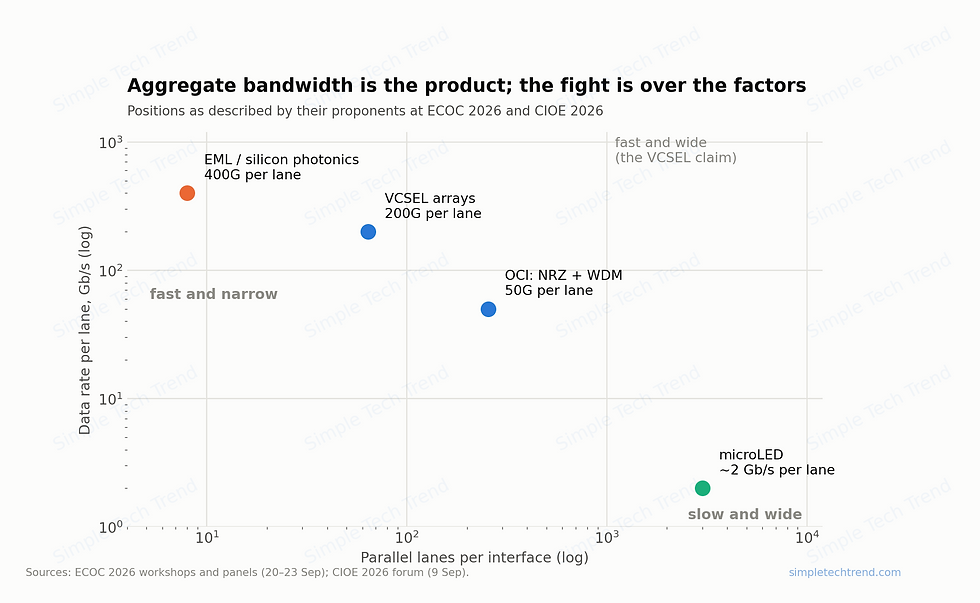
Editor's note: VCSELs have long been seen as a cheap solution limited to under 100 meters, while 2 km-plus links belonged to silicon photonics or EML lasers. With its 1060-nm single-mode technology, Furukawa Electric has broken that boundary.
Energy efficiency is king: 4.1 pJ/bit is highly competitive. For AI clusters, every milliwatt saved translates directly into lower TCO (total cost of ownership).
A clear path to 1.6T: in Q&A, the speaker said the next step is 100-Gbaud (200G per channel). That means a 1.6T CPO module is within reach without adding optical-interface complexity.
Ecosystem compatibility stands out: dropping expensive multicore fiber (MCF) in favor of standard SMF is a precise strategic call that makes Furukawa Electric's solution far easier for existing datacenter infrastructure to adopt.
We expect that within the next 12-24 months, single-mode VCSELs will become the strongest technology branch in CPO besides silicon photonics, especially in cost- and power-sensitive back-end interconnect scenarios.







Comments