


2025 OCP APAC Summit | Scale-up for AI: Balancing Compute, Memory and Networking | Broadcom
Updated: 14 hours ago
Summary
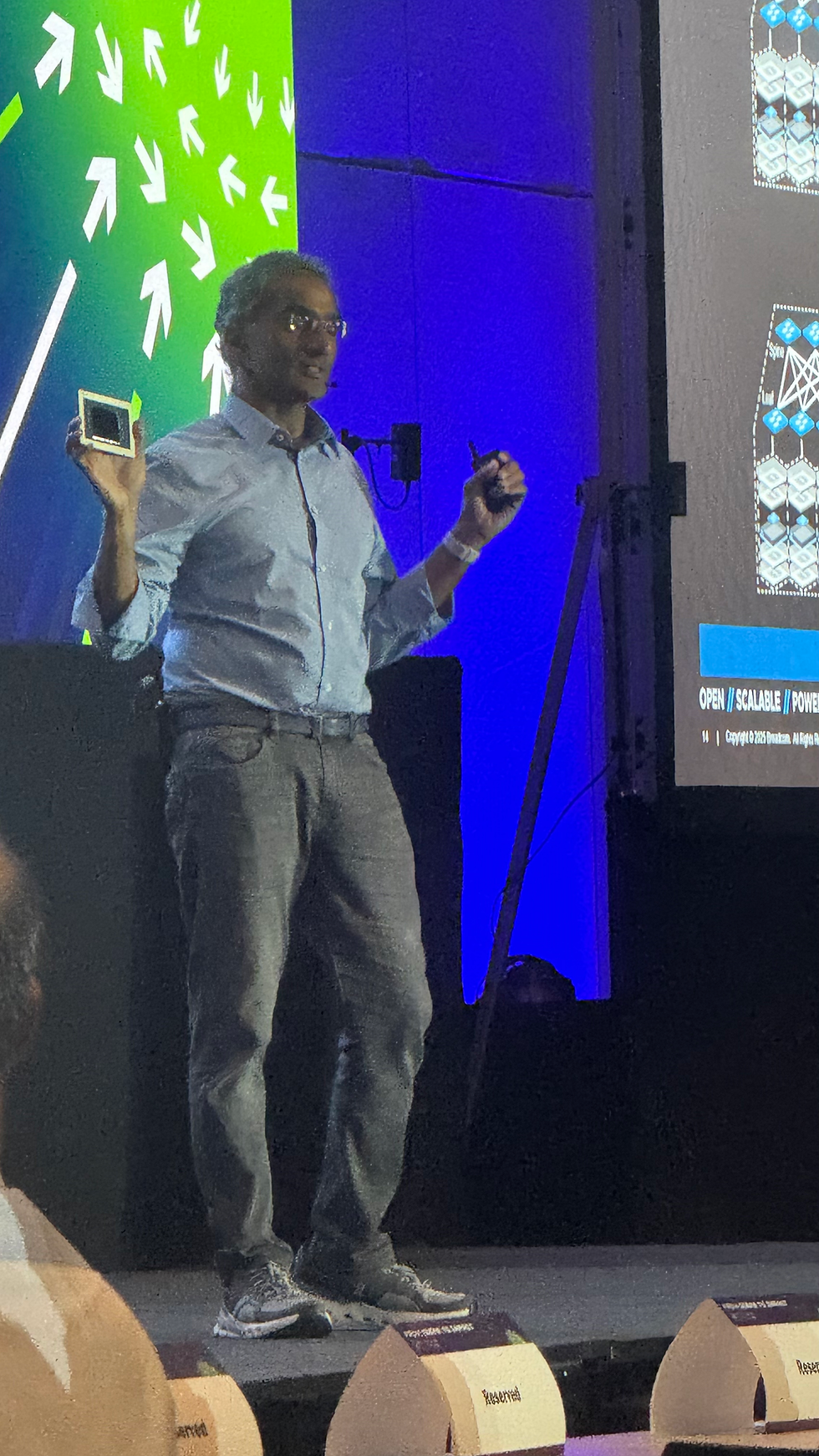
At the 2025 OCP APAC Summit, Broadcom presented Ethernet-centric scale-up and scale-out solutions for building hyperscale AI training clusters. With the 100 Tbps Tomahawk Ultra switch chip and the AI Fabric Router, it supports distributed computing that scales from a single rack to across data centers, delivering <400 ns latency, 200,000+ GPU clusters and links spanning 100 km. This open-standards approach pushes next-generation AI infrastructure toward higher performance, lower power and simpler topologies.
Content
1. Background and Challenges
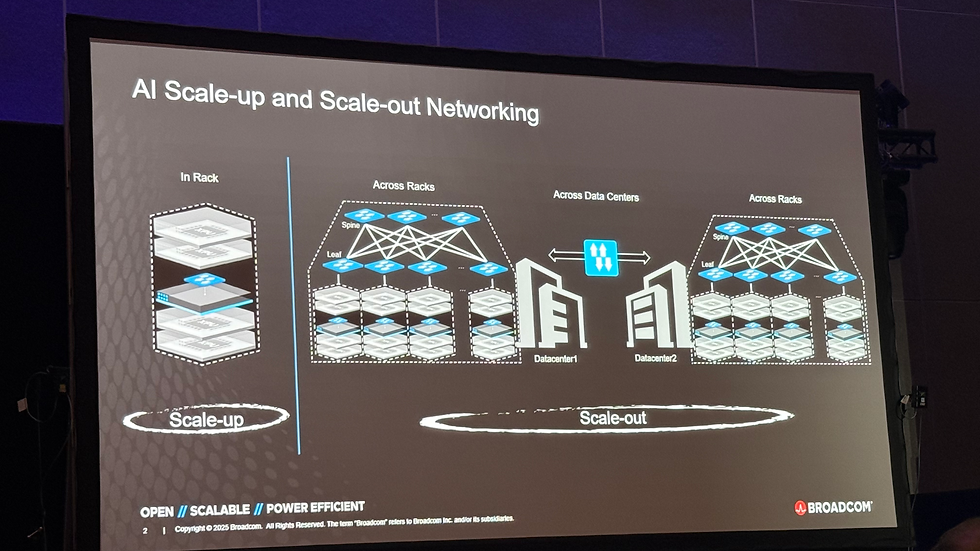
AI model sizes are growing exponentially, and a single rack can no longer hold all the compute. As demand extends to hundreds or thousands of GPUs/XPUs, systems must move beyond in-rack scaling (scale-up) into cross-rack and cross-data-center scaling (scale-out). This makes network requirements more demanding than ever:
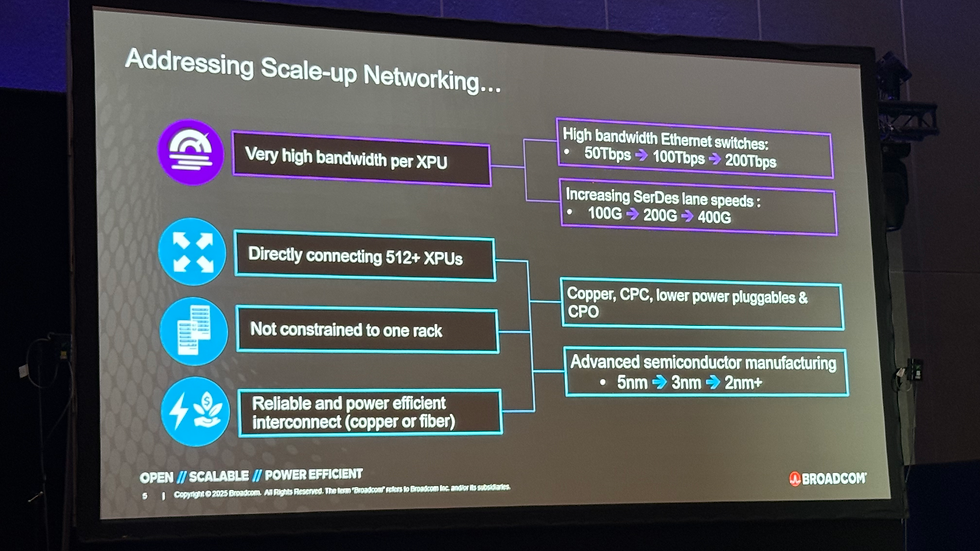
High bandwidth: HPM-to-XPU bandwidth has reached 40–100 Tbps
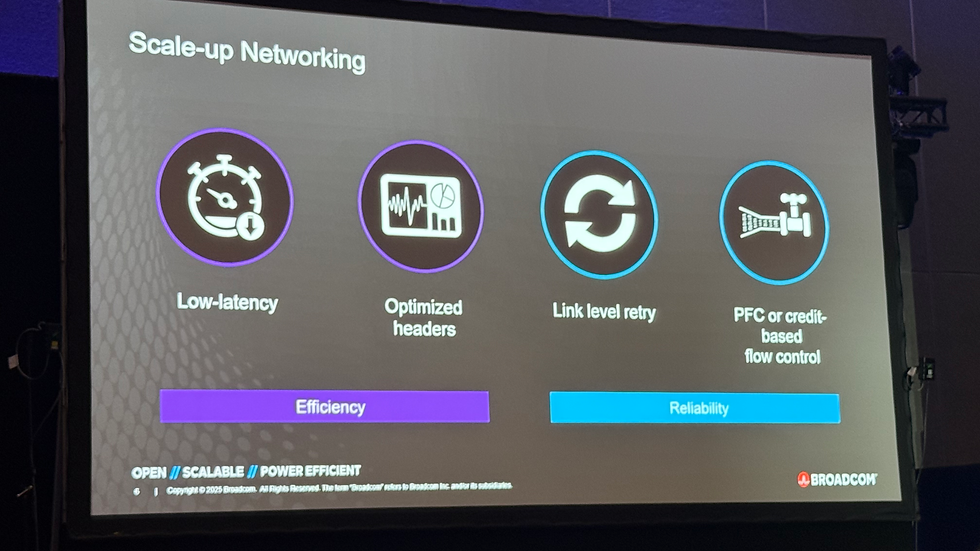
Low latency: data exchange must complete within a few hundred nanoseconds
High reliability: fewer packet errors and retransmissions
Efficiency and scalability: lower optics and copper costs while supporting larger clusters


2. Core Elements of a Scale-up Network
2.1 Current Bottlenecks
Copper backplanes have limited reach, capping the number of XPUs in a single domain (currently <100)
Existing switches lack sufficient radix and bandwidth
As GPU/HPM interfaces rise to 100 Tbps, current topologies struggle to keep up
2.2 Broadcom's Solution
Ethernet-based scale-up (SU) architecture:
Open standard, co-developed by the OCP community
Round-trip latency from XPU through the Ethernet switch <400 ns
Of that, the switch accounts for only 250 ns; the remaining 150 ns comes from up/down stack traversal

Tomahawk Ultra switch chip:
50 Tbps bandwidth, 250 ns latency
Path to a future 100 Tbps version, reducing fiber count and simplifying network tiers

3. From Scale-up to Scale-out
3.1 Internal Scale-out (Within the Data Center)
A single data center will host 128,000–200,000 GPUs
With 100 Tbps switches, a two-tier topology enables a simpler network:
67% fewer optical modules
Lower latency
Higher reliability (fewer fiber links and hops)


3.2 Cross-Data-Center Scale-out
Reaching million-GPU clusters requires connecting multiple 50–60 MW data centers
Broadcom introduced the AI Fabric Router:
Supports links spanning 60–100 km
Deep-buffer design, multi-chip stacking, integrated HBM
Line-rate encryption to secure data across sites

4. Ethernet's Strategic Position
Broadcom emphasized Ethernet's ubiquity, openness and economics:
Multi-vendor interoperability
Free from proprietary or licensing restrictions
Lower cost than proprietary protocols (e.g., NVLink)
Continuously extended and optimized through the OCP community
5. Technology Trends and Outlook
Interface rates will move from 100G SerDes to 200G and 400G
Network topologies will shrink from three tiers to two, cutting latency and power
Optics will replace copper as the mainstream, driving hyperscale compute expansion
Cross-data-center integration creates a new form of AI supercluster
Conclusion
With its Ethernet-centric scale-up/scale-out solutions, Broadcom strikes a balance between low latency and high bandwidth to meet the needs of next-generation AI supercomputing clusters. Its open standards and collaboration with the OCP community will accelerate the industry's shift from in-rack compute to globally distributed, cross-data-center AI platforms.
Core value includes:
Network interconnect latency below 400 ns
100 Tbps-class switch chips that simplify topology
Support for 200,000+ GPU clusters and links spanning 100 km
Long-term sustainability through open standards and industry collaboration
Over the next few years, with SerDes upgrades and wider adoption of optics, Ethernet will become the mainstream interconnect for hyperscale AI training and drive a transformation of the entire data center architecture.

Comments