


Will Comb Lasers Replace DFB Arrays? To Understand CPO Light Sources, First Clear Up a One-Word Misunderstanding
What the industry calls "comb / multi-wavelength light sources" splits into two camps: true combs (Kerr, QD and EO combs) and DFB laser arrays. What ships in volume today is DFB arrays, not true combs.
Combs sound tailor-made for CPO, yet the market still hasn't formally adopted them, and the reason lies in a fundamental technical weakness.
To judge when combs turn the corner, watch one number: when the wavelength count jumps from 8 to 16.
1. A One-Word Misunderstanding: Not Every Comb Is a Comb
When someone says "this is a comb light source," first ask: which kind of comb?
NVIDIA divides CPO multi-wavelength light sources into four routes: a single high-power DFB, a DFB laser array, a quantum-dot mode-locked comb (QD comb), and a pumped nonlinear-resonator comb (Kerr comb). Only the last two are optical frequency combs in the strict sense, where a single source generates a whole row of evenly spaced wavelengths. The much-discussed DFB array is essentially "N DFBs in one package," not a comb.
That line determines who can ship today. The most commonly confused example: Ayar Labs' SuperNova is often called a comb, but it uses a DFB array, not a Kerr comb. Companies on the true-comb path, such as Xscape, Quintessent and Innolume, are all still fundraising or at the prototype stage.

2. Why CPO Needs a Source That Generates a Whole Row of Wavelengths
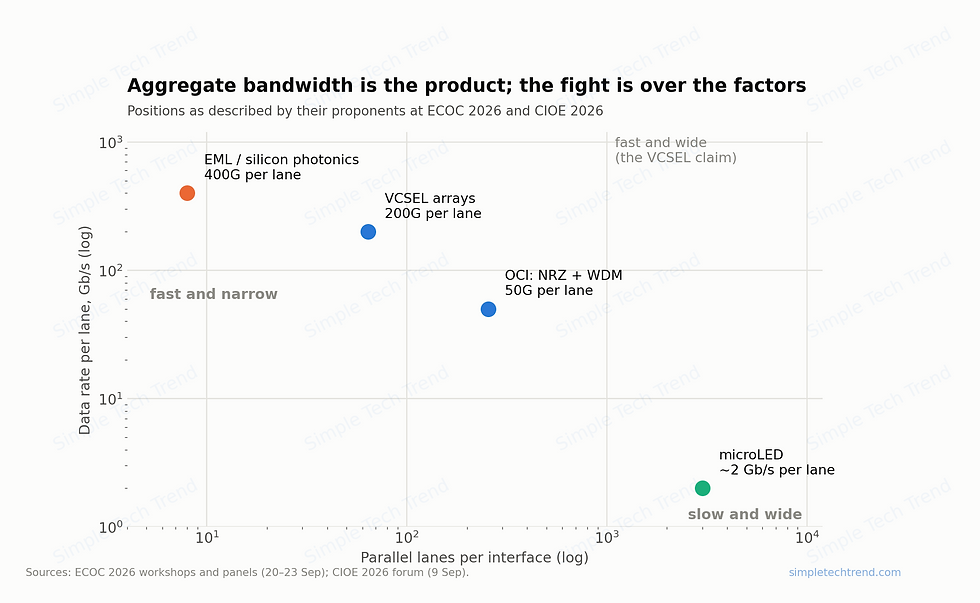
To understand why combs are on the table, start with an architectural shift underway in data center optical interconnect: from "fast and narrow" to "slow and wide."
The old way to raise speed was to push a single lane to 400 Gb/s. The consensus has now flipped: spread the data across 8 wavelengths at 50 Gb/s each, trading more wavelengths for better per-fiber capacity and energy efficiency. That directly creates a new need: many light sources at once, with well-aligned wavelengths. The CW-WDM MSA standards body was formed for exactly this, explicitly pushing O-band multi-wavelength source targets to 8, 16 and 32 wavelengths.
Here's the problem: as wavelength count grows, the old approach of "one laser per color" starts to strain. That is precisely where combs come in. One source generates a whole row of evenly spaced wavelengths that naturally align with the WDM grid, with no per-laser tuning. It sounds like a solution made for CPO.
But between "sounds perfect" and "usable today" lies the distance of an entire supply chain.
3. Four Types of Combs: First Sort Out Who Fights Which Battle
Before going further, here is a table that lays out how the four comb types divide the work. The point is not to memorize specs but to know which type fights which battle.
Type | Channels | Spacing | Power per line | Best battlefield |
Kerr / DKS microcomb | 100+ | ~50 GHz | Weak (efficiency issue) | Long-haul coherent, ultra-high spectral efficiency |
QD comb (quantum-dot mode-locked) | 26–89 | 100–200 GHz | Stronger (>10 dBm, 200GHz version) | Short-reach data center optical I/O |
EO comb (thin-film lithium niobate) | 70–148 | 5–25 GHz, tunable | High, flat | Coherent transmission, LO replication |
Gain-switched | Few | Continuously tunable | Medium | Low-cost, narrowband |
Kerr combs have the highest ceiling (a single device has demonstrated 44.2 Tb/s at 10.4 bits/s/Hz spectral efficiency), but conversion efficiency is a long-standing weakness. QD combs are the best fit for short-reach data center links: they are single-chip and electrically pumped, need no dispersion engineering, can run at 140°C without a TEC, and can be isolator-free. EO combs are inherently coherent with flat per-line power, a clean solution for coherent transmission, at the cost of RF drive and higher power.
By now you know what a comb is, why CPO needs one, and how the four types divide the work. But the question that really matters is still open: can it actually beat DFB arrays? And if so, when?
That wraps up the key points of this article.
STT's full analysis, covering the technical weakness that keeps combs from beating DFB arrays, the trigger number for a turnaround, the supply chain positioning map, and where combs sit on the "light source power shift" timeline, is available in our premium section.


Comments