


OCP Global Summit 2026 | Credo | LK Bhupathi | Going Wide: Scalable and Reliable Optical Interconnects
1. A Million-GPU Cluster Loses an Optic Every 6 Minutes
This was an Expo Hall technical session, and Credo's LK Bhupathi stated the problem up front: AI cluster scaling is limited not only by power and density, but by reliability. However reliable a single component is, multiply it by hundreds of thousands or millions and cluster-level reliability collapses quickly.
Credo's slide quantifies this in one table. Assumptions: 1,500 W per GPU, a 3-layer CLOS network, one front-end link per four scale-out links, and an optical port MTBF of 550K hours as reported by Meta at OCP 2025:
Cluster power / XPUs | Transceiver count | Mean time to an optics failure |
30 MW / 20k | >100k | 5 hours |
300 MW / 200k | >1M | 30 min |
1.5 GW / 1M | >5M | 6 min |

▲ Based on a 550,000-hour optical port MTBF, Credo estimates that a million-XPU cluster loses one optical module every 6 minutes (Image source: Credo | 2026 OCP Global Summit presentation (05:30))
Annualized: 10 per hour, 240 per day, roughly 80,000 per year. The slide subtitle puts it bluntly: One Bad Link, Hundreds of Stranded GPUs. A failed link does not stall one server; it stalls hundreds of GPUs in the same collective-communication group.
AWS's New Carlisle, Indiana data center is expected to host about 1M XPUs, and the industry is already talking about campuses two or three times that size. On this slope, optics failures turn from an operations problem into a capacity problem.
2. Why a Link Flap Is Worse Than a Dead Link
Credo's benchmark is its own AEC (active electrical cable): shipping for years with 100M-hour MTBF, about two orders of magnitude above the optical MTBF Meta reported (100M / 550K is about 180x). So the question becomes: can optics deliver copper-class reliability?
The first layer of the answer is ZeroFlap PHY-layer telemetry. Bhupathi stressed that the worst failure mode is not a dead link but a link flap: the link neither fully fails nor fully comes up, bouncing up and down, so upper-layer routing and collectives keep recomputing and the network never converges.
ZeroFlap builds a management channel into the PHY layer; MCUs at both ends continuously exchange per-channel health, detecting degradation before a channel actually fails. This extends the approach Credo built in the AEC era. As we covered in Credo (CRDO) Q1 FY2027 earnings, ZeroFlap and the PILOT diagnostics platform are already the core pitch of Credo's optical business.
Prediction alone is not enough. If seeing a channel degrade only lets you warn the upper layers that a link is about to drop, the cluster still stops. That is what the second layer is for.
3. Breaking Down Layer Zero Redundancy: 15% Spares Buy Two Orders of Magnitude
The second layer is Layer Zero Redundancy, the core of the talk. The architecture is straightforward:
The host interface passes through a gearbox, is split into N lanes of M Gbps slow channels, and lane mapping assigns them to a 2D emitter array
Most channels carry data, about 15% are held as spares, and dedicated channels carry management signals
When a data channel starts to degrade, the management channel sends health data to the far end and both chips move the data onto a spare
The switchover is hitless, with zero data loss, happens below the OSI stack, and is invisible to the workload

▲ ZeroFlap architecture: a PHY-layer management channel exchanges link-health data, and about 15% spare lanes enable hitless failover, targeting 100M-hour MTBF/MTBI (Image source: Credo | 2026 OCP Global Summit presentation (08:46))
Put simply: conventional optics buys reliability by making parts not fail; Credo buys it by not having to stop when parts fail. That is why the slide lists both MTBF (mean time between failures) and MTBI (mean time between interruptions); the latter is what cluster operators actually care about.
Plug the gap back into the table and the impact is concrete. If optical links truly reach 100M hours:
A cluster with 5M transceivers goes from one failure every 6.6 minutes to about one every 20 hours
Annual interruptions fall from about 80,000 to about 440

▲ Failure intervals for three cluster sizes at 550,000-hour vs. 100M-hour MTBF: a million-XPU cluster goes from about 6.6 minutes to about 20 hours between failures (Image source: Simple Tech Trend; data from Credo's 2026 OCP Global Summit presentation)
4. Why Wide-and-Slow Is Built for Redundancy
Redundancy is not new: servers have RAID, power supplies have N+1. Optics never did it because the cost structure of fast-and-narrow does not allow it: a 1.6T module has only 8 lanes of 200G, so one spare means 12.5% more optical lanes plus another laser, driver and DSP lane.
Wide-and-slow is the opposite. Credo's slide lists three benefits:
Bandwidth scalability: a 2D array can scale channel count and shrink pitch at the same time, with headroom to raise per-channel data rate
Optical reliability: lower current density per emitter and fewer failure modes, with inexpensive spare channels and hitless failover
Power efficiency: no PAM4 or complex DSP, simple NRZ modulation, and a native integrated light source

▲ Credo lists the advantages of wide parallel optics in bandwidth scalability, optical reliability and power (Image source: Credo | 2026 OCP Global Summit presentation (10:38))
The key phrase is "lower current density." As we covered in ECOC 2026: 850nm VCSELs fail at 1,600 hours, 1060nm runs 5,000 hours with zero failures, VCSEL array lifetime depends heavily on operating conditions. Slow channels mean no emitter has to be pushed to its limit, so reliability and power improve with the same design choice, something fast-and-narrow struggles to replicate.
5. Two Products: 1.6T ALC and a 30 Pb/s Blind-Mate Backplane
The 1.6T ZeroFlap ALC (Active Light Cable) is what Credo calls the best scale-out pluggable ever:
100M-hour MTBF and MTBI, with PILOT diagnostics integrated
12 W per end, 50 m reach
Versus Credo's AECs: 10x longer, 10x lighter, up to 30% less power
Volume in 2027

▲ 1.6T ZeroFlap ALC: 100M-hour MTBF/MTBI, 12 W per end, 50 m reach, volume production in 2027 (Image source: Credo | 2026 OCP Global Summit presentation (11:42))
Fifty meters means spanning an entire row, connecting GPUs, CPUs and switches directly, exactly the segment AECs cannot reach and where laser optics reliability is a headache.
The second is the ZeroFlap blind-mate optical backplane, which replaces the copper cables in today's scale-up backplane with fiber:
30 Pb/s and up to 1M fibers, connected automatically through blind-mate connectors
15% over-provisioning for hitless failover at the fiber level too
Uses Senko blind-mate connectors and a Credo ferrule
Versus today's copper backplane: 30x as dense (1.8 Pb per tray), 30x the reach (50 m), 90% less weight
Claims zero clean, zero maintenance
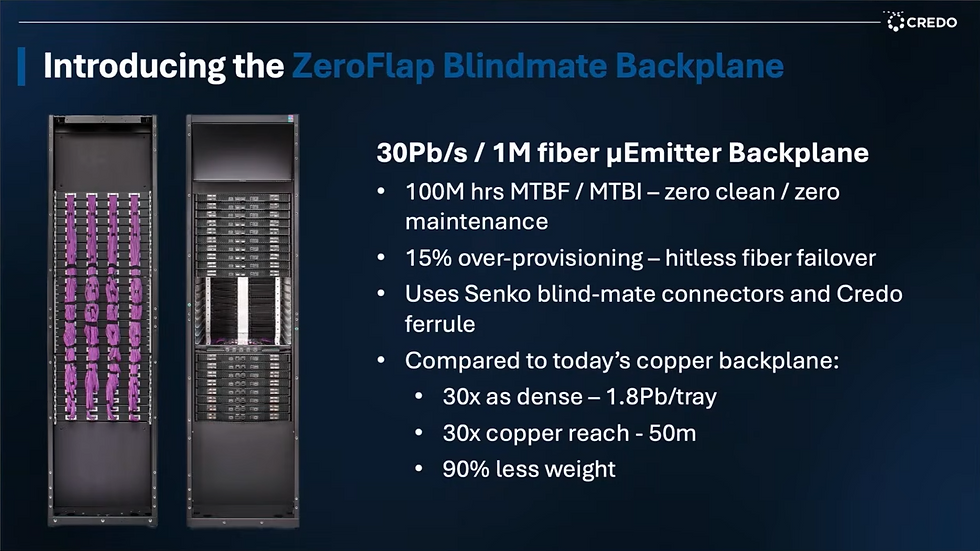
▲ ZeroFlap blind-mate backplane: 30 Pb/s, 1 million fibers, 15% redundancy, with 30x the density and reach of a copper backplane (Image source: Credo | 2026 OCP Global Summit presentation (14:06))
"Zero clean" is the easiest line to miss and the weightiest. The biggest operational challenge in fiber connectivity is end-face contamination and alignment, the exact point of What killed wide-and-slow was not physics but 60,000 fibers (in Chinese). Bhupathi's logic: with redundancy, you do not need 100% of channels to be clean and aligned. Extending redundancy from emitters to fibers lets the architecture absorb imperfect assembly and maintenance.
6. Risks and Counterarguments
100M hours is a design target, not field data. The slide says "ZeroFlap Performance," but there is no large-scale deployment data for the optical version yet; validation waits for ALC shipments in 2027.
What happens when spares are not enough? 15% spares absorb gradual degradation, but if a shared component (gearbox, MCU, light-source driver) fails, spare channels cannot help. Credo did not break down which failure modes are covered.
The 550K-hour baseline may be pessimistic. It is Meta's reported optical port figure, used by Credo to represent all optics; if newer pluggables improve, the gap to 100M hours narrows.
Spoken figures not backed by slides. Bhupathi said a CPO backplane could save up to 60% power versus copper and about $10M of opportunity cost per rack; the latter differs widely from the estimate in Credo's other keynote and does not appear on the slides, so treat it conservatively.
CPO timing is open. The backplane is NPO-based today; the CPO version is only "in the future," with no year given.
7. What It Means for Taiwan's Supply Chain
Reliability specs will move from components to systems, and validation becomes the barrier. When hyperscalers start buying on MTBI rather than MTBF, suppliers must deliver system-level telemetry and failure data. Taiwanese rack integrators and test houses that want wide-parallel optics assembly work need to build channel-level burn-in and health-monitoring capability early.
15% more fiber is structural. Redundancy sits not only in emitters but in the fiber layer. For the same bandwidth, cable and backplane assemblies carry more fibers and connectors: new value for cable assemblers, but higher demands on yield and automation. In the SRMO workstream Credo announced in its keynote the same week, the assembler list includes Taiwan's BizLink and Foxlink; watch when either starts booking ALC revenue.
No Taiwanese supplier in blind-mate connectors yet. The partner named in this talk is Japan's Senko, and the ferrule is Credo's own design.
8. Conclusion
This talk filled in the other half of Credo's wide-and-slow case: power is the entry ticket, reliability is the moat. As clusters reach a million XPUs and optics failures go from every 5 hours to every 6 minutes, any approach that relies only on better components cannot keep up with the scaling slope; Credo's answer is to build redundancy into Layer Zero so that "fail without stopping" becomes part of the architecture.
But in 2027 only the 1.6T ALC reaches volume; the backplane and CPO are still demos. Over the next 12 months, watch three things: real MTBI from the first ALC shipments, the range of failure modes the spares cover, and whether hyperscalers start writing MTBI into procurement specs. Once the third happens, the rules of comparison have changed.
The bigger the cluster, the less likely parts will not fail; the interconnects that survive are the ones that do not have to stop when they do.
This article is for technology and industry trend analysis only and does not constitute investment advice.


Comments