


ECOC 2025 Tech Focus: The State of the Optical Components Industry in the AI Era
Updated: 15 hours ago
Introduction
Since generative AI took off in 2023, cloud service providers (CSPs) worldwide have accelerated data center investment, driving unprecedented growth in the optical components market. From Datacom to Telecom, and from IMDD to Coherent, the industry is entering a new AI-driven era.
In its ECOC 2025 talk, Omdia used data and trend analysis to present the current state of the optical components market, its upcoming challenges and the direction of technology evolution.
Key Points
1. Market Investment and Regional Scale
Cloud service provider CAPEX: has grown steadily since 2017, with a clear inflection point in 2023 driven by generative AI.
Regional data center capacity:
Europe: 29 GW → expected to reach 47 GW by 2028.
Asia-Pacific (excluding China): 35 GW → 55 GW.
North America: 60 GW → 90 GW.
China: estimated at 35–60 GW, comparable to North America.
2. Datacom vs. Telecom
Datacom has taken center stage:
In Q1 2025, Datacom accounted for 65% of the optical components market (vs. only 46% in 2021).
Datacom revenue doubled over the past two years, from US$6 billion → US$12 billion.
Telecom: still sizable, but growing far more slowly than Datacom; future growth will rely mainly on coherent pluggables (ZR/ZR+).
3. Technology and Product Roadmap
Datacom modules:
2024–2025: 800G in volume deployment, with some 400G still shipping.
2026 onward: 1.6T modules ramp up gradually, moving further to 3.2T in 2029–2030.
Key challenge: power and thermals. Today's rack power capacity (125–250 kW/rack) is not enough to support future 400 kW/rack designs.
Coherent modules:
2025: 400ZR and 800ZR/ZR+ are the mainstream.
2027–2028: 1.6T ZR/ZR+ deployment begins.
2030: ZR+ technology matures, supporting broader DCI and backbone transport.
4. Key Emerging Technologies
Co-Packaged Optics (CPO):
Several vendors have shown prototypes; expected to become a viable solution in AI networks within five years.
Challenges: standardization and serviceability.
Optical Circuit Switching (OCS):
Google has deployed it for years, and other CSPs are evaluating it.
Could be adopted at the spine layer within a few years to improve AI data center efficiency.
Cooling and power:
High-power modules are pushing liquid cooling from servers into optical modules.
Power infrastructure must be upgraded to support future high-density GPU racks.
5. Market Structure and Competitive Landscape
Leading supplier ranking:
Coherent market: InnoLight > Lumentum > Eoptolink > Accelink.
Notably, Eoptolink climbed into the top three in just two and a half years, showing the competitiveness of Chinese vendors.
Trend: North American and Chinese suppliers dominate the top ten, reflecting the regional concentration of AI data center build-outs.
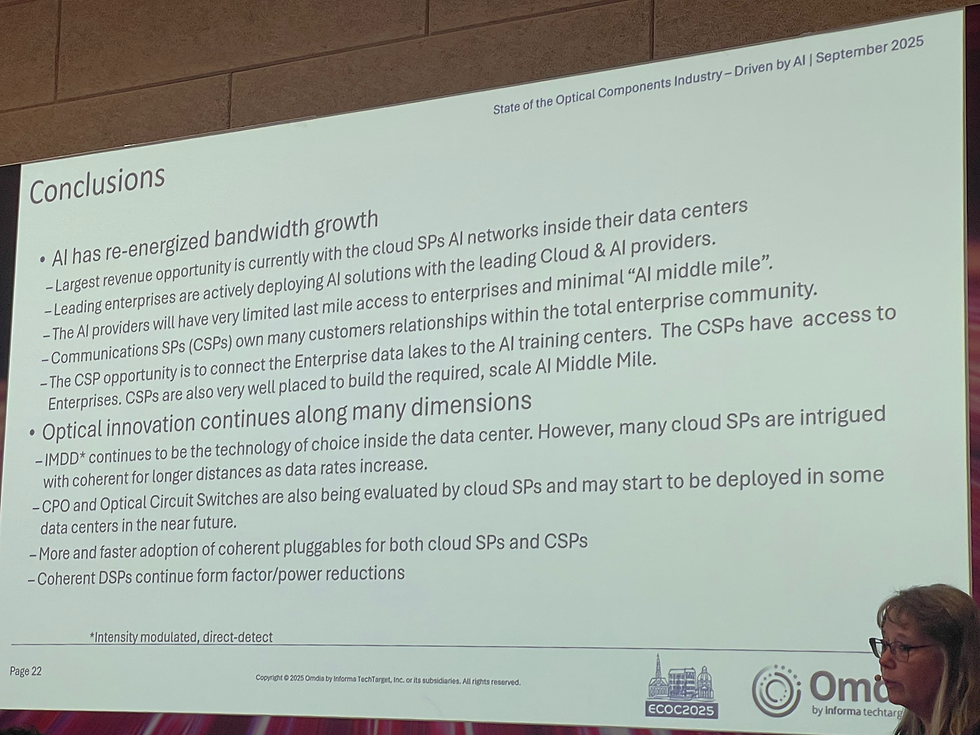
Conclusion
Omdia's analysis shows:
AI is the biggest driver of the optical components industry: annual growth reached 43% in 2023–2024, an unprecedented period of acceleration.
Datacom has overtaken Telecom: it is now the clear center of the optical components market and will keep leading through 2030.
A technology inflection: IMDD remains the workhorse, but Coherent is moving into the 10 km range and may eventually enter the data center.
New technologies bring uncertainty: the timing of CPO and OCS adoption is still unclear, but the industry broadly expects real deployments within five years.
Infrastructure challenges: power and cooling have become the core bottlenecks limiting AI data center expansion; future optical modules must solve both energy efficiency and cooling.
Overall, AI has not only changed the optical demand curve but also redefined the industry's center of gravity. To win in the coming competition, optical component suppliers must master high-volume shipping capacity, low-power design, and the ability to co-evolve with CSPs.




Comments