


ECOC 2025 Tech Focus: VCSEL vs. Silicon Photonics — Which Optical Interconnect Wins in the AI Era?
Updated: 21 hours ago
Introduction
As AI systems face mounting challenges in power, density and cost, optical interconnects have reached a critical fork in the road: Can VCSELs keep evolving to meet next-generation needs, or will silicon photonics become the mainstream? At the workshop, 12 experts from system vendors, module makers and chip design houses shared in-depth views on technology roadmaps, manufacturability, reliability and economic viability.

Views by Company and Speaker
LightCounting – Vlad Kozlov
Market trend: AI/cloud investment keeps growing faster than expected, driving optical module demand.
Technology observations:
Silicon photonics is already mainstream, especially in single-mode, LPO and CPO applications.
But VCSELs have made a strong comeback in recent years (100G and 200G products are already in volume production).
Thin-film LiNbO₃ and other materials (such as EAM) may also break in.
Conclusion: No single technology will dominate the market; multiple technologies will run in parallel.


Meta – Drew Alduino
AI network requirements:
Scale-up (in-rack): shorter reach, where copper, VCSEL and direct-drive DAC still hold an edge.
Scale-out (cross-rack): reach up to 500m, requiring single-mode SiPh or EAM.
Challenges:
AI workloads demand extremely low packet loss; traditional TCP fault tolerance is not enough.
Transceiver reliability directly affects AI cluster compute.
Conclusion: VCSEL can survive in scale-up, but scale-out will be dominated by silicon photonics.


Oracle – Mark Filer
Network architecture: AI clusters need non-blocking networks, <2µs latency and extremely high reliability.
Technology view:
The NIC-to-first-tier-switch link alone needs >65m, which is hard for VCSEL.
Most applications will move to single-mode fiber plus silicon photonics.
OCI is exploring LPO and CPO to cut cost and power.
Conclusion: SiPh is the mainstream choice, but manufacturing cost and reliability must be solved.


NVIDIA – Henning Lysdal
Segmentation:
Scale-up: short reach, in-rack, high-density environments → VCSEL/copper have the advantage (low power).
Scale-out: cross-rack, longer reach → silicon photonics is a better fit, especially in CPO architectures.
Bottlenecks:
VCSEL: reliability (lifetime concerns from high-current drive).
SiPh: insertion loss and the need for high-power lasers/DSP.
Outlook: integration onto silicon interposers or into advanced packaging will be key.


Huawei – Jiangwei Man
Application boundaries:
<100m: VCSEL is better.
500m: SiPh or EML solutions fit better.
Strengths:
VCSEL: low cost, small size, low power, and low packaging and test cost.
SiPh: more potential for longer reach and higher speeds (>200G).
Conclusion: the two will coexist across different application scenarios rather than eliminate each other.


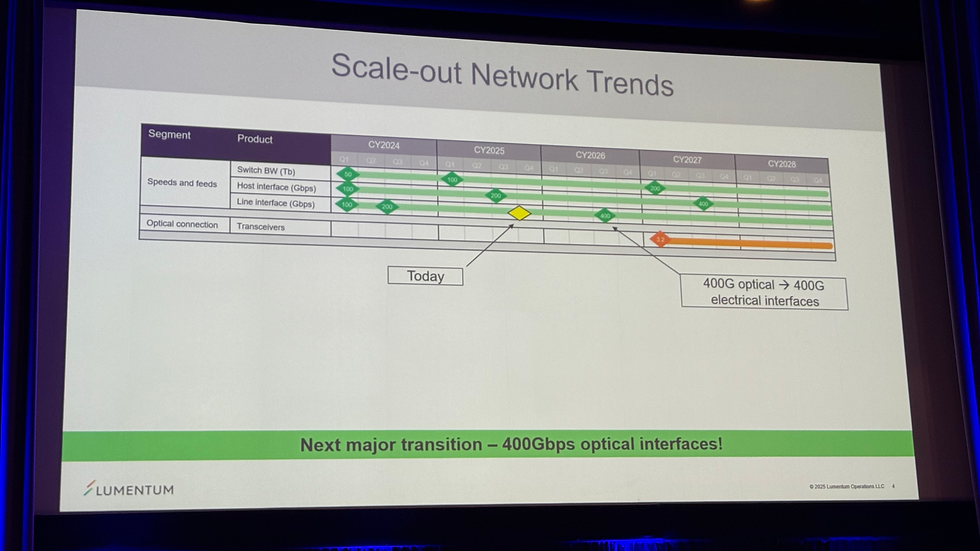
Lumentum – Matt Sysak
View: it's not just "VCSEL vs. SiPh" — emerging technologies such as InP and thin-film LiNbO₃ must be considered too.
Key challenges: reliability, power and supply chain.
Emphasis: CPO and LPO will reshape the market, but manufacturing cost and maturity remain bottlenecks.




Celestial AI – Subal Sahni
Position: a strong advocate of deep silicon photonics integration.
Core technology:
Developing the Photonic Fabric, which integrates optics directly into the XPU package.
Uses EAM (Electro-Absorption Modulator) for both small footprint and thermal stability.
Achieves Tbps/mm²-class density while reducing DSP and power.
Conclusion: SiPh is the long-term solution that can break through the "memory bottleneck" and the "power bottleneck".


Sicoya – Hanjo Rhee
View:
Silicon photonics has already achieved high-volume manufacturing capability in 200mm/300mm fabs.
It will need to combine III-V, SiN and other materials to raise speed and flexibility.
Mid-term: IM-DD remains mainstream.
Long-term: coherent silicon photonics has a chance to enter the data center.
Conclusion: silicon photonics platforms will keep expanding; their evolution depends on materials integration and packaging.


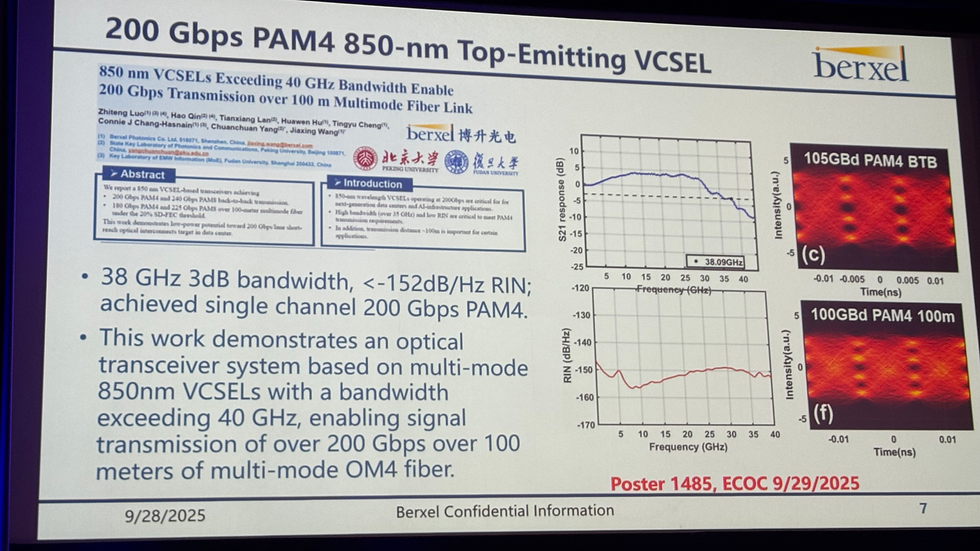
Berxel – Connie Chang-Hasnain
A firm VCSEL supporter:
2D array architecture → bandwidth density can keep scaling.
Mature multimode fiber/connectors → low cost and high tolerance.
Redundant design → improved reliability.
Progress: 25G/50G/100G VCSELs already in volume production; 200G PAM4 under development.
Conclusion: VCSEL still has room to evolve and will not disappear.




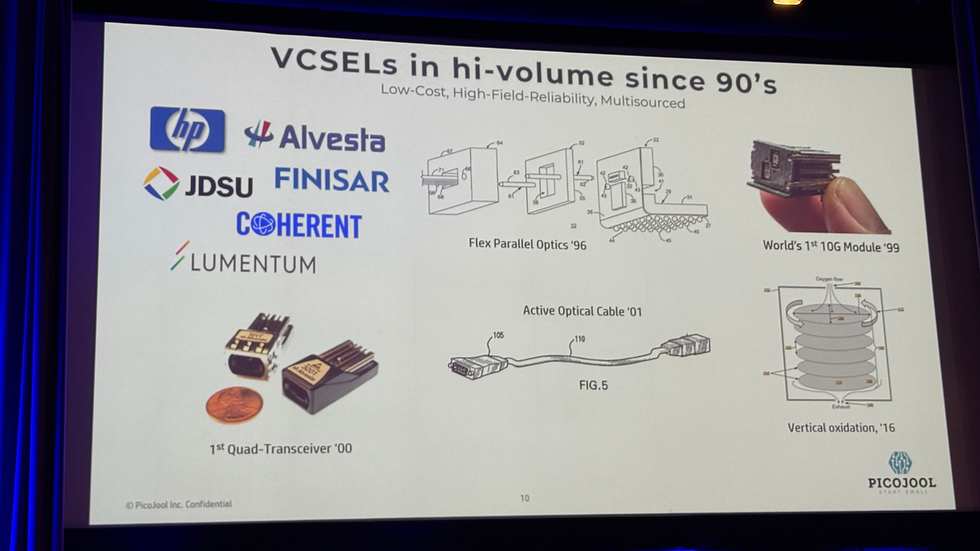
Picojool – Al Yuen
Field experience: in real deployments, copper is still the biggest competitor.
VCSEL strengths:
Well suited to short reach, no DSP needed, low power.
Clear cost and supply chain advantages.
Conclusion: "Don't underestimate copper" — and VCSEL will stay alive at 200G/400G.




TRUMPF – Roman Koerner
Position: focused on high-power and single-mode VCSEL technology.
View: improve VCSEL bandwidth and reliability through packaging and new architectures, extending it into longer-reach, higher-speed markets.


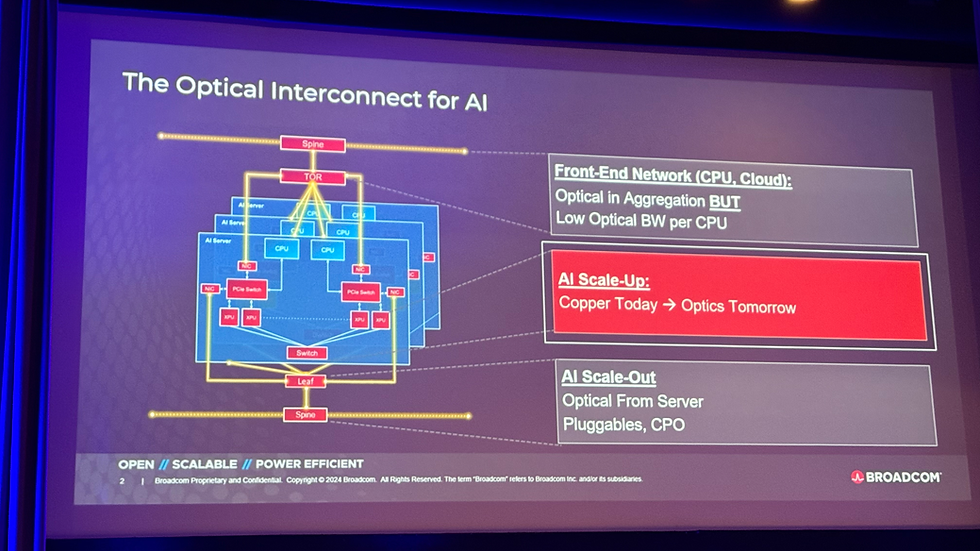
Broadcom – Anand Ramaswamy
View: NPO/CPO will not adopt just one technology.
Strategy: evaluate both VCSEL and SiPh to meet different reach, power and cost requirements.
Conclusion: the real deciding factors are cost, power and supply chain stability, not raw technical specs.



Summary
VCSEL: low power and low cost, suited to short reach (in-rack/scale-up); still competitive in the 200G–400G range.
Silicon Photonics: high density, long reach and strong integration with advanced packaging — set to dominate scale-out and CPO.
Copper: still the hidden winner thanks to outstanding cost-performance and reliability.
The conclusion is not "who gets eliminated" but multi-technology coexistence:
Copper/VCSEL target short reach.
SiPh targets long reach and system integration.
New materials/hybrid technologies (LiNbO₃, InP, EAM) may break through in specific applications.
Q&A Highlights
After two hours of intensive talks, the session moved into Q&A and panel discussion. Several key questions took center stage:
Q1: Is VCSEL reliability good enough for the AI era?
Meta and Oracle: stressed that large AI clusters require zero packet loss, and that VCSEL lifetime and self-heating under high-current drive are a concern.
Berxel and TRUMPF: argued that with 2D array redundancy and improved packaging, reliability can rise sharply and FIT rates can drop to acceptable levels.
Q2: Will power become the deciding factor?
NVIDIA: stated plainly that any I/O power directly eats into GPU compute resources, so CPO + silicon photonics is the path to lower power.
Picojool: cautioned not to overlook copper, which remains the best on power for short-reach applications.
Q3: What about supply chain risk and volume capability?
LightCounting: silicon photonics is widely adopted, but production is still concentrated in a few foundries.
Broadcom: emphasized that in CPO/NPO its strategy is to develop both VCSEL and SiPh to avoid single-technology supply disruption.
Berxel: the VCSEL supply chain is already highly mature, with no bottleneck expected in the near term.
Q4: Will a single technology eventually dominate?
Celestial AI: believes that as package-level integration becomes ever more critical, SiPh will gradually expand and may become the long-term solution.
Huawei and Sicoya: argued for multi-technology coexistence, with different reaches and data rates served by different solutions — a market of "division of labor" rather than "elimination."
Overall Consensus
VCSEL is not "dead" — it retains strong cost and power advantages in 100–200G short-reach applications.
Silicon photonics is key to long-reach, high-density interconnect, and will play a central role in AI clusters and CPO architectures.
Copper still cannot be ignored, offering exceptional cost-performance at short reach.
The coming years will be defined by multi-technology coexistence and rapid evolution; what ultimately decides the winners will be reliability, power and supply chain scalability.


Comments