


ECOC 2025 Tech Focus: 1.6T Deployment Status and Outlook for 100T Switching
Updated: 20 hours ago
Introduction
The explosive growth of AI has completely reshaped the bandwidth demand curve in data centers. Network speed transitions used to have ample time to mature: 400G and 800G each took several years. Today, however, the 1.6T adoption cycle has been dramatically compressed: 1.6T arrived almost as soon as 800G did.
At the ECOC 2025 panel "1.6T Deployment Status and Outlook for 100T Switching", representatives from Cignal AI, Coherent, Terahop, Broadcom, TFC Communication and China Telecom shared their views on the state of 1.6T, its technical challenges, and the outlook for 3.2T. The session was moderated by Source Photonics CTO Frank Chang.

Company Perspectives
Cignal AI — Market Trends and the AI Push
Scott Wilkinson presented the current market picture and data:
AI is driving explosive demand:
Historical growth: 35–45% per year
2024 growth: 200%
2025 forecast: 400%
Module shipments:
20,000 1.6T modules shipped in 1H25
Full-year forecast of about 500,000 units → a steep ramp in Q3 and Q4
Vendor strategy:
Even though the system side (switch ASICs, GPUs, chiplets) is not fully ready, module makers are rushing 1.6T products to market.
The core reason: capturing revenue from the first wave of the ramp. Transition windows are short, so early profits are critical.
Technical notes:
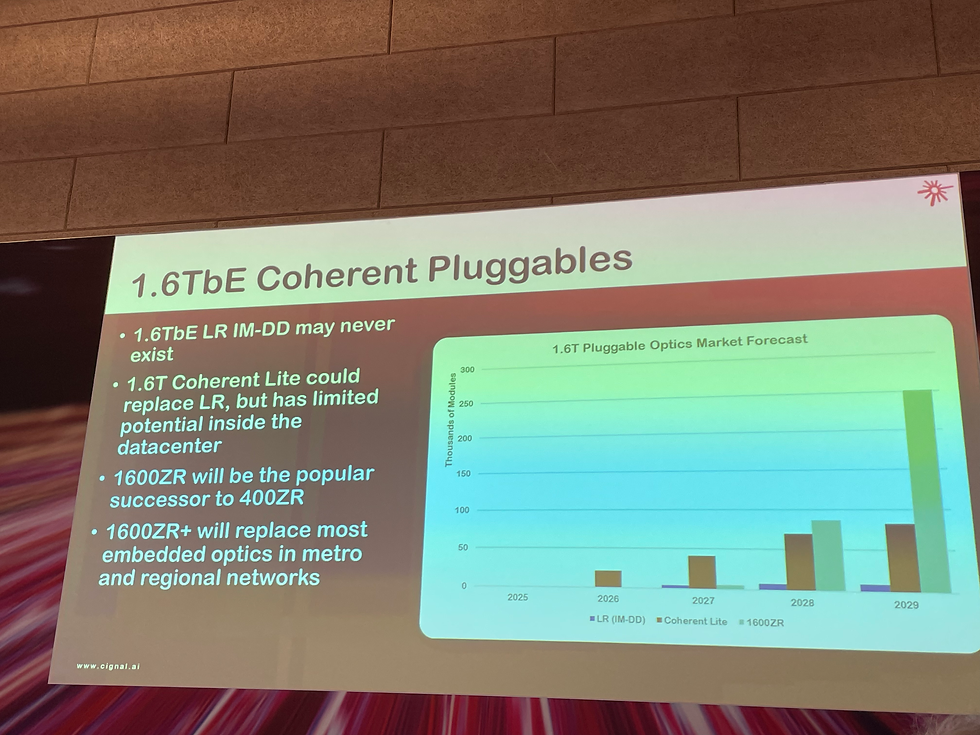
Beyond 1.6T PAM4, coherent pluggables (such as 1.6 ZR and ZR+) will rapidly replace traditional embedded solutions.
ZR+ is even expected to replace most long-haul embedded optics.


Coherent — Iterative Evolution and the Power Problem
Comparing successive speed generations, Sanjai Parthasarathi offered several observations:
Overlapping cycles: 1.6T is not a linear replacement; it coexists with 800G and 400G modules as multiple generations run in parallel.
Modulation and DSP:
PAM6/PAM8 may be needed, converted into PAM4 optical signals, or DSP gearboxing may be used (200 → 400 → 800Gbps).
Conventional PAM4 is approaching its limits, raising the difficulty further.
Power crisis:
Per-module power as high as 60W is not practical.
It must be reduced through more efficient DSPs, optoelectronic integration, and better packaging and thermal design.
Company strengths:
Coherent has full in-house supply of lasers, EML, CW and silicon photonics, so it can support multiple architectures at once.


Terahop — A Startup's View on Packaging
Speaking from a startup perspective, Ryan Yu focused on interconnect and packaging bottlenecks:
Problem: high-speed modules need massive I/O, putting pressure on package routing and power.
Potential solutions:
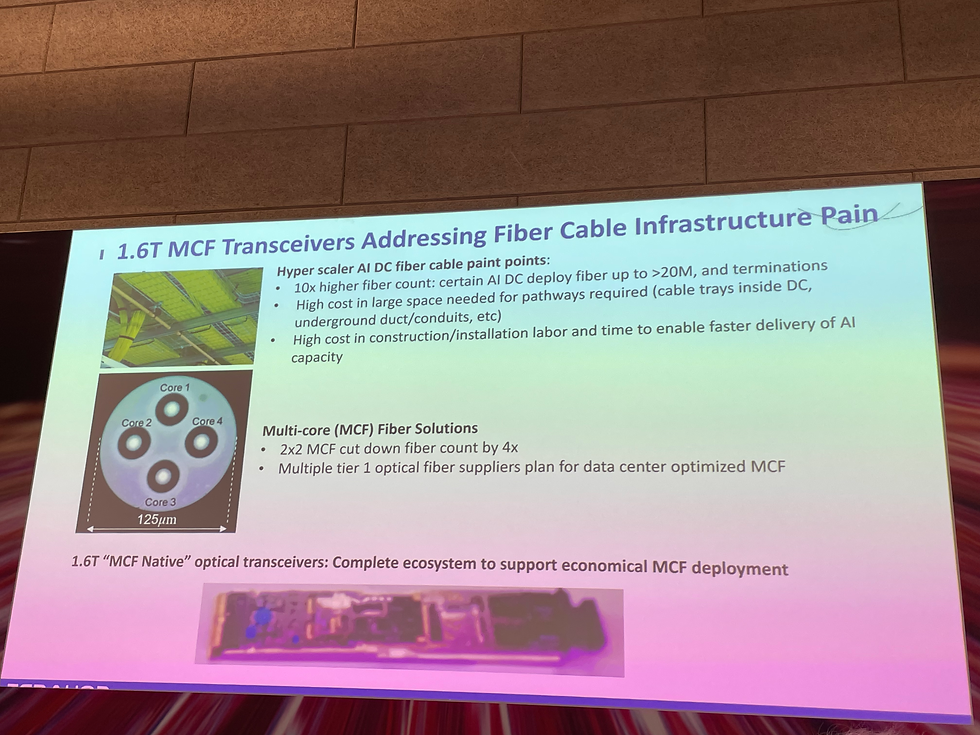
Multi-fiber architectures to spread out channel demand.
Chiplet-based architectures to reduce the burden on a single large ASIC.
View: traditional pluggables struggle to meet the tight packaging needs of GPUs/CPUs; tighter electro-optical coupling will be required.


Broadcom — From Vertical Integration to 400G/lane
Rajiv Pancholy shared Broadcom's system-level observations:
Challenges:
400G/lane is close to physical limits; dispersion effects are significant, and CWDM already runs into transmission problems at 2 km.
Power keeps doubling: 20W → 40W → 60W, which is unsustainable without innovation.
Materials exploration:
New materials such as lithium niobate (LiNbO₃) may become alternatives.
Broadcom strategy:
Strengthen system control through vertical integration (switch ASIC, SerDes, optical engine, packaging).
Has demonstrated 400G EML technology as a key enabler for 3.2T.

TFC Communication — Transmission and Cost Realities
Jinghui Li offered a view from the fiber and manufacturing side:
Dispersion challenge:
CWDM has problems already at 2 km → more efficient dispersion compensation or a move to parallel fiber is needed.
Packaging and cost:
As fiber channel counts grow, system complexity and cost rise with them.
View: commercial success requires not just technical feasibility but also lower total cost.


China Telecom — The Operator's Requirements
Junjie Li represented the operator's perspective:
Core concern:
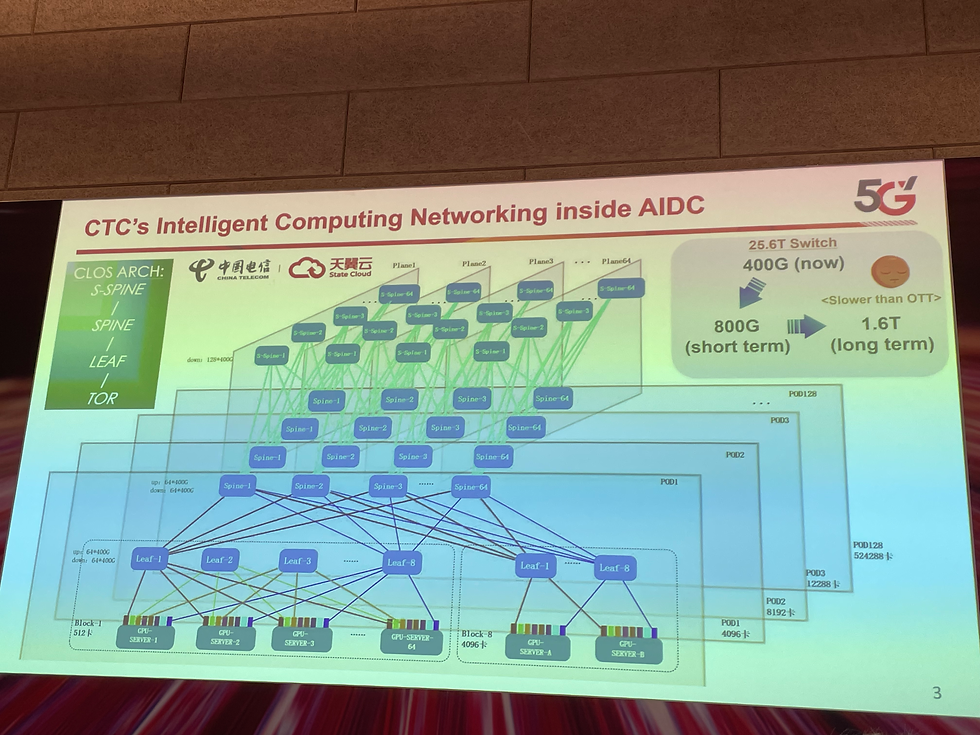
AI-driven cloud services need enormous bandwidth, but power consumption and operating costs are just as demanding.
Expectations:
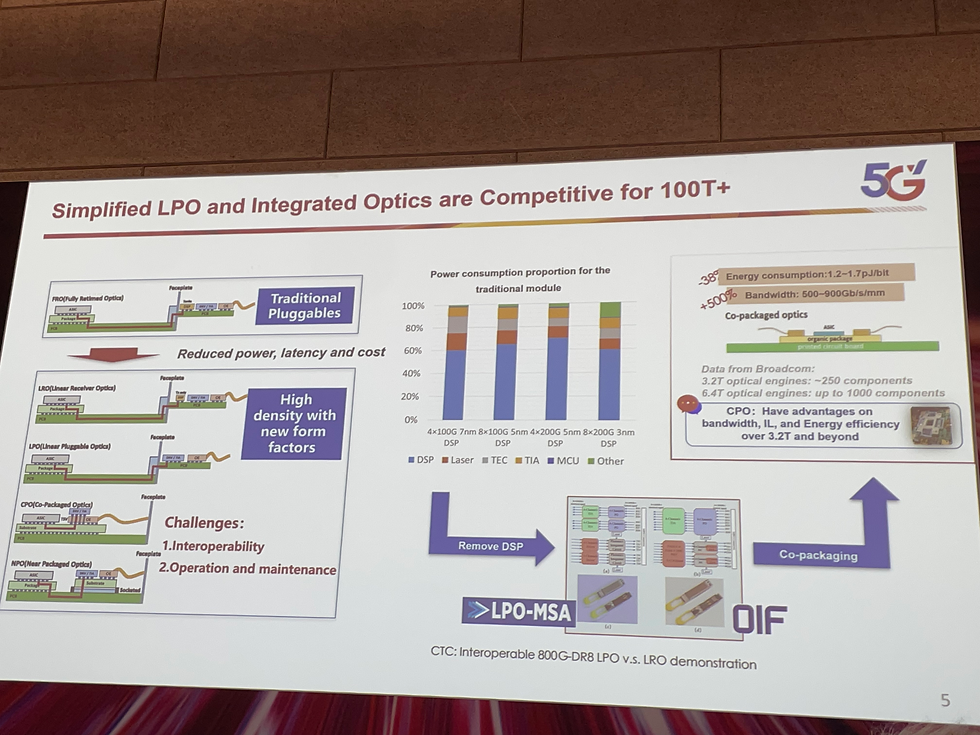
Vendors should deliver highly reliable, low-power 1.6T and 3.2T products.
Products must support large-scale deployment, not just technology demos.




Q&A Highlights
Q1. Are the challenges of going from 1.6T to 3.2T similar to past transitions?
Unanimous answer: it's harder.
Past speed doublings could be achieved with EML + silicon photonics; now there is no "obvious answer".
New materials, new modulation formats (PAM6/8) and multi-fiber architectures are all on the table.
Q2. What will the industry look like in five years?
Optimists: we'll be discussing 6.4T and 12.8T.
Conservatives: markets and policy are hard to predict; focus on the next 2–3 years.
CPO/LPO outlook:
Some experts believe pluggables are too expensive and will gradually be replaced by CPO/LPO.
By then, only 2–3 large companies may be able to build high-end optics.
Consensus: as long as there is market value, the industry will break through physical and engineering bottlenecks.
Conclusion
The panel delivered three clear messages:
AI is the biggest force accelerating bandwidth generations. The 1.6T ramp will be faster than ever, and positioning early is critical.
Power and dispersion are shared industry challenges. 400G/lane is nearly at its limit, and 3.2T will depend on new materials, innovative architectures and more power-efficient solutions.
Economics is the ultimate driver. If new technology delivers higher system value (for example, AI token throughput), the market will drive the transition.
Five years from now, whether the answer is 3.2T pluggables, CPO/LPO, or some other new interconnect technology, the optical communications industry will keep confronting physical limits. One thing is certain: as long as AI keeps driving cloud computing, the industry will never stop pursuing faster, more efficient optical interconnects.


Comments