


OCP Global Summit 2026 | NVIDIA | Ian Buck | AI Factories at Scale: Open Infrastructure for Agentic AI
1. Why This Keynote Is Worth Taking Apart
Ian Buck is NVIDIA's VP of Hyperscale and HPC, and one of the people CUDA started with. His 24-minute closing keynote looked like an annual contribution list: from Mellanox's SwitchX-2 in 2013, to MGX 1.0 (the Blackwell rack) in 2024 and MGX 1.1 (Blackwell Ultra) in 2025. This year it is MGX 1.2.
Behind the list sits a clear position: an AI factory is infrastructure, and it should last and be reusable like bridges and pipes. The slide uses three words, Productive, Durable and Fungible, and describes an ecosystem of 10 million developers and more than 300 supply-chain companies.
NVIDIA is not just selling GPUs; it is selling an asset that can still be rented out ten years later.
2. Token Economics: Durability Is Worth More Than Speed
The first argument is durability. The slide shows V100/DGX-1 at 10 years in service, A100 at 6 years and NVL72 at just 1 year. Buck cited a customer who bought Volta in 2019 and rented it at about $0.25 per hour; today it rents for about $1.
The second argument is output per watt. NVIDIA cited the SemiAnalysis AgentX benchmark on DeepSeek-V4-Pro:
Total token throughput per MW: Vera Rubin NVL72 vs GB300 NVL72 is 2x to 10x, reaching 30x at the highest interactivity
Cost per million tokens: 45x lower
The method is full-stack co-design: disaggregated serving, rate matching, large-scale expert parallelism, distributed KV caching with KV-aware routing, and fused CUDA kernels

▲ Vera Rubin NVL72 vs. GB300 NVL72: up to 30x token throughput per MW and 45x lower cost per million tokens (DeepSeek-V4-Pro, SemiAnalysis AgentX) (Image source: NVIDIA | 2026 OCP Global Summit presentation (slide 5))
The point to note: both 30x and 45x sit at the far right of the curve, in the high-interactivity region where agents demand low latency. For ordinary batch inference the gap is 2x to 10x. That is exactly why NVIDIA framed the keynote around agentic AI: the more agent workloads there are, the more the new generation's premium holds up.
3. MGX 1.2: From 90 Minutes to 1 Minute
The most important announcement was the contribution of the third-generation MGX spec used by Vera Rubin to OCP. Of the 15 items on the slide, the ones worth noting are:
Item | Spec |
Liquid-cooled busbar | 5,000 A |
Blind-mate manifold | 45°C liquid cooling |
Tray quick disconnects | In-tray MQD/MQDB, UQD08 flow rates |
Latch ejector bar | Supports 6,000 lb mating force |
Rack reinforcement | +100 lb of steel |
Copper spine | 4 cable cartridges, NVLink or Spectrum-X Ethernet |
Switch tray | 1U liquid cooled, NVLink or Spectrum-X |
The specs are not novel; the purpose is. Buck said a GB200 compute tray took 90 minutes to assemble, much of it spent on liquid-cooling plumbing and quick disconnects. With Vera Rubin's "no cables, no fans, no hoses" design, a tray takes one minute, and factories in the US, Taiwan and Asia now ship thousands of racks a week.

▲ Compute tray and switch tray of GB200 NVL72 (MGX 1.0) vs. Vera Rubin NVL72 (MGX 1.2); the latter removes cables, fans and hoses (Image source: NVIDIA | 2026 OCP Global Summit presentation (slide 7))
Put simply: MGX 1.2 turns the rack from hand assembly into plug-in assembly. For NVIDIA, it moves the capacity bottleneck away from assembly labor; for OCP members, common flow and connector specs mean liquid-cooling parts can be interchanged across brands.
4. Where Openness Stops: What Was Given and What Was Not
Lay out the whole keynote's contributions in one table and the boundary becomes clear:
Layer | Opened or shared at this keynote | Still NVIDIA proprietary |
Mechanical and cooling | Full MGX 1.2 spec | None |
Power | 800 VDC architecture (with partners) | None |
Data center | DSX reference design, grid resilience spec, MaxLPS and rack management open software | None |
Scale-out network | Spectrum-X supports Falcon, Meta RoCE, MRC, Adaptive RDMA | Spectrum-X switch silicon and CPO |
Scale-up network | None | NVLink 7 and CPO switch tray |

▲ What NVIDIA opens at OCP is mechanicals, power, data center and the scale-out transport protocol; NVLink and the CPO switch chips remain proprietary (Image source: Simple Tech Trend original; data from NVIDIA 2026 OCP Global Summit presentation)
The closer to silicon, the less is open. That is the opposite of the rival strategy we covered in OCP APAC Summit 2026: Ethernet starts eating scale-up: Broadcom pushes open Ethernet into scale-up, while NVIDIA opens everything outside the rack's core and keeps the NVLink layer.
Another signal is Spectrum-X going multi-protocol: Google's Falcon has been ported to ConnectX SuperNICs and BlueField DPUs, and Meta's 102.4T FBOSS switch (N-IceCube) uses Spectrum-6. NVIDIA is willing to let customers run their own transport, as long as the silicon underneath is NVIDIA's.
5. Vera CPU Rack and 800 VDC: Two Things Shipping This Year
The Vera CPU MGX rack is now shipping. Vera uses NVIDIA's own Olympus core; the slides list 2x per-core performance over Grace, 3.4 TB/s core-to-core bandwidth and 1.2 TB/s LPDDR5X memory bandwidth, with 2x on Meta DCPerf, 2x on the TACC HPC Golden Suite and 3.5x on Redpanda (Kafka). Buck added that a rack holds 256 CPUs, fully liquid cooled, and that Meta will build its first Vera cluster early next year.

▲ Vera CPU MGX racks are shipping; 12 of the partner logos are Taiwanese ODMs/brands (Image source: NVIDIA | 2026 OCP Global Summit presentation (slide 11))
The first 800 VDC factory is being built by Visionbay.ai. The slide shows a 16 MW deployment unit split into four 4 MW scalable units, with conversion centralized at end-of-row power centers, an overhead 800 VDC busbar, and 125 A rack-level tap cans. 800 V x 125 A works out to exactly 100 kW, matching today's racks; Buck said 800 VDC uses 45% less copper and can scale to 1 MW racks.
As for DSX's MaxLPS, Nscale's GB300 cluster in Iceland fit 37% more GPUs and 49% more throughput in the same power budget; MaxLPS details belong to a separate DSX session and are not expanded here.
6. NVL576: When Optics Really Arrives
The final "one more thing" was Vera Rubin Ultra NVL576: 576 GPUs fully connected by NVLink through an NVLink 7 CPO switch tray, with fiber running across racks to optical engines, aimed at 10T+ parameter models, arriving "next year" per Buck. The rack render shows eight racks side by side, or 72 GPUs per rack on average (STT estimate from the image).
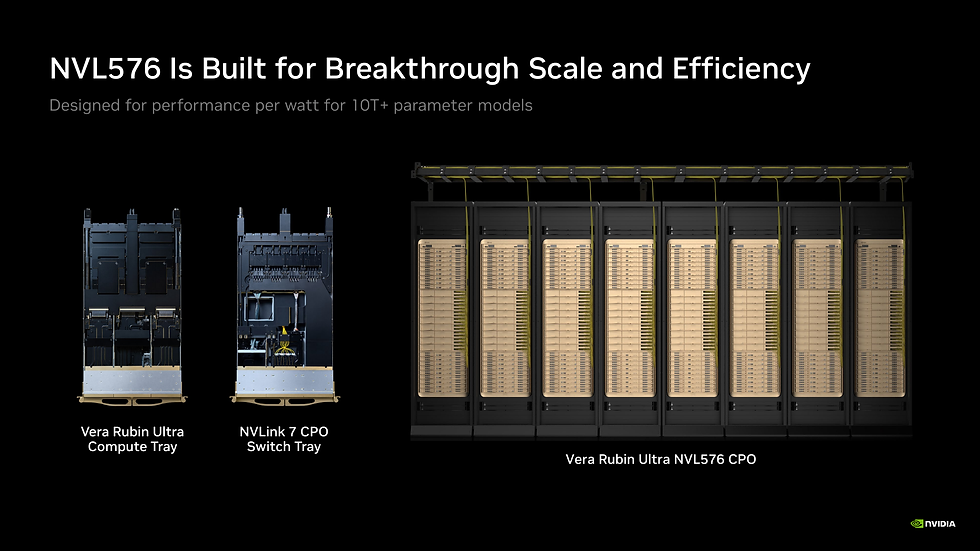
▲ Vera Rubin Ultra NVL576 CPO: Vera Rubin Ultra compute tray and NVLink 7 CPO switch tray (Image source: NVIDIA | 2026 OCP Global Summit presentation (slide 18))
This was the only announcement directly about scale-up optics. On the scale-out side, Spectrum-X Photonics ships this year, claiming 5x power efficiency, 10x MTBI, 40% fewer switches and 2.6 ms fault detection. In other words, CPO on NVIDIA's platform follows a two-step timeline: scale-out in 2026, scale-up in 2027. That contrasts with market worries about NVIDIA shifting to NPO (see Is Nvidia's move from CPO to NPO bad news for the laser supply chain?): at least on the NVL576 slide, the name still says CPO.
7. Risks and Counterarguments
30x and 45x are curve extremes: the baseline is GB300 NVL72 and the figures come from the highest-interactivity region; the typical gap is 2x to 10x.
The V100 rental price is one customer's anecdote: $0.25 rising to $1 per hour has no published source and does not represent the used-GPU market.
One-minute assembly is not rack lead time: tray assembly is faster, but liquid-cooling tests, full-rack validation and facility power can still be the bottleneck.
The open/proprietary boundary will keep moving: rivals such as AMD Helios also use open OCP racks (see Earnings Brief: AMD Q2 FY2026 (Helios)); once mechanics are standardized, scale-up interconnect is the only differentiator left.
NVL576 is barely specified: only the GPU count, CPO switch tray and "next year"; no power, optical engine count or suppliers.
8. What It Means for Taiwan's Supply Chain
ODMs are this year's most certain winners. Among the partners on the Vera CPU MGX rack slide, 12 are Taiwanese: ASRock Rack, ASUS, Compal, Foxconn, Gigabyte, Inventec, MiTAC, MSI, Pegatron, QCT (Quanta), Wistron and Wiwynn. Buck also said Taiwanese factories are building Vera Rubin trays.
ODM value is shifting. With assembly falling from 90 minutes to one, there is less room to differentiate on labor and yield; the competition moves to liquid-cooled rack testing, 800 VDC integration and lead time, and to who can reliably ship thousands of racks a week.
Liquid-cooling and power parts get common specs. MGX 1.2 writes quick disconnects, manifolds, busbars and flow rates (UQD08) into an OCP spec, and 800 VDC follows the OCP architecture; for Taiwanese cooling and power suppliers, that lowers the barrier to a second or third customer but also intensifies price competition.
Optics has to wait for NVL576. Spectrum-X Photonics shipping this year is scale-out; the NVLink 7 CPO for scale-up comes next year and its supplier list is not public. What Taiwanese optics companies can do now is prepare fiber management and connectors, not book revenue.
9. Conclusion
There was no new GPU in this keynote, yet it was NVIDIA's most complete statement to OCP: open the mechanics, cooling, power, data center and transports, so the whole industry builds its racks faster and cheaper. Ninety minutes to one, and thousands of racks a week, show that the bottleneck has moved from "can it be built" to "is there enough power and floor space".
But openness has a boundary. NVLink and the CPO switch silicon are not open, and they are the core of NVL576. Over the next 12 months, watch three things: whether non-NVIDIA platforms such as AMD adopt MGX 1.2, when Visionbay.ai's 800 VDC factory actually goes live, and who supplies NVL576's CPO optical engines and fiber.
NVIDIA hands everyone the factory blueprints and keeps the one key that makes the factory run.
This article is for technology and industry trend analysis only and does not constitute investment advice.


Comments