


2026 OCP APAC Summit | Ethernet Moves Into Scale-Up: Broadcom's Keynote Takes Aim at NVLink
On the surface, Broadcom's Mohan Kalkunte was talking about open standards in his "Open Ethernet Fabrics" talk, but what he actually laid bare was this: all three tiers of AI networking (scale-up, scale-out, scale-across) are being absorbed by Ethernet in one sweep, and the hardest of them, scale-up, has long been territory locked down by proprietary interconnects like NVLink. Broadcom's strategy is clear: open up the "spec layer" (transport, fabric) to grow the ecosystem, and keep the "silicon layer" (Tomahawk, Jericho, Thor Ultra) in its own hands to collect rent. For Taiwan's supply chain, the real signal is not a few more specs, but that scale-up is being pulled out of the rack and into the open world of "Ethernet + CPO + optical interconnect," a whole new layer of optical interconnect demand.
1. AI Cluster Performance Stopped Being About the GPU a Long Time Ago
The talk opened by stating it flatly: the network is the computer.
It sounds like an old slogan, but in today's world of trillion-parameter model training and inference spanning hundreds of XPUs, it is literally true. When a workload is split across thousands of accelerators, what determines "how long training takes (job completion time)" and "how many tokens per second inference produces" is no longer how fast a single chip is, but what the network architecture between those chips looks like. HBM bandwidth on a single XPU has reached tens of TB per second, and this monster-scale data throughput forces the network to deliver three things at once: enough bandwidth, low enough transport overhead, and high enough reliability, because these are transactions that cannot drop packets.
Kalkunte split AI networking into three dimensions, the skeleton for understanding everything that follows:
Scale-up: dozens of XPUs packed into one physical rack, using unified memory as if it were "one giant GPU."
Scale-out: many scale-up racks linked in a leaf-spine topology, often at the 100,000-accelerator scale, filling an entire data center.
Scale-across: connecting multiple data centers and multiple buildings.
His central claim for the whole talk was one sentence: a single technology, Ethernet, can do all three tiers end to end.

2. The Hardest of the Three Tiers Is Scale-Up
Scale-out and scale-across have always been Ethernet's home turf; there is little to fight over. The real battleground is scale-up, the interconnect among the dozens of XPUs inside a rack. This has long been NVLink's domain, the deepest part of Nvidia's moat.
So what the talk spent the most effort on was really "how to get Ethernet into scale-up." And it is not one company pushing it, but a coordinated combination with a clear division of labor:
The transport layer splits into two paths first. Cloud giants (hyperscalers) with the capability each build their own scale-up transport tied to their own SDN, adding features at their own pace; for those without that capability, Broadcom and Arista offer SUE (Scale-Up Ethernet) transport, a lightweight IP that runs directly on the XPU, with the 1.0 spec about to be released.
The fabric layer then converges. Last October a group of companies (led by Meta and Microsoft) formed ESUN (Ethernet for Scale-Up Networking), aiming for "one shared fabric no matter which transport you use." Within four months they produced the ESUN 1.0 spec, adding lossless Ethernet reliability, smaller headers (better header efficiency), and support for multi-hop topologies.
We broke down the significance of this approach in "After Copper Runs Out for AI: Seven Paths to Scale-Up Optical Interconnect" (in Chinese): scale-up bandwidth is approaching its physical limits and copper is about to give out, which is the underlying reason everyone is racing to standardize scale-up and move it to optics. And players like AMD, which ships the entire Helios rack, are essentially betting on the path in "Scale-Up Bandwidth Ultimately Has to Go to Optics" (in Chinese).
3. Broadcom Plays "Open" and "Proprietary" on Two Separate Layers
The most intriguing part of this keynote is how sincerely it talks about "openness," but you need to see which layer is being opened.
What's open is the spec layer. SUE, ESUN, the effort to upgrade RoCE into a next-generation transport protocol, the SAI/SONiC software stack, Open Cluster designs: all of this goes into open bodies like OCP, and the more adopters the better, because it turns "Ethernet can do AI networking" into industry consensus while relatively marginalizing closed ecosystems like NVLink.
What stays in hand is the silicon layer. Broadcom gave away none of the things that actually make money:
Tomahawk 6: a 102.4 Tbps switch chip, with bandwidth said to have grown about 34x over ten years. A single chip can support a 128,000-endpoint cluster in a flat two-tier topology, and in optics it cuts power and latency by about another 40% versus the previous generation (51.2T).
Thor Ultra: billed as the industry's first 800G Ultra Ethernet NIC. Traditional RoCE was not designed for AI (single-path, high overhead, hard-to-tune congestion control); the next-generation Ultra Ethernet Transport answers with multipath packet spraying to saturate the full bisection bandwidth, in-place placement of out-of-order packets, selective retransmission only for dropped packets, SRv6 micro-SID path management, and advanced congestion control under heavy load. Thor Ultra claims to implement all of this, agnostic to XPU, switch, and optical module.
Jericho (Gen4): dedicated to scale-across, the cross-building tier, focused on end-to-end congestion control and already deployed in production by hyperscalers.
In other words, open standards grow the pie, and Broadcom's silicon collects rent on it. That's not a criticism; it's elegant business design, but you have to recognize it. Incidentally, Broadcom is not alone on this path: Cisco is fighting the same battle with Silicon One, as we analyzed in "Cisco Officially Goes From Networking Veteran to Scale-Across Shovel Seller" (in Chinese); and Arista has bet everything on scale-across, see "Arista Raises Guidance Three Times This Year, Betting It All on Scale-Across" (in Chinese).

4. CPO and Optical Interconnect: The Key Step for Scale-Up to Break Out of the Rack
The scale-up domain has been confined to one physical rack because leaving the rack means relying on optics, and optics' power and reliability have always been a problem. The talk's answer is to push two things at once:
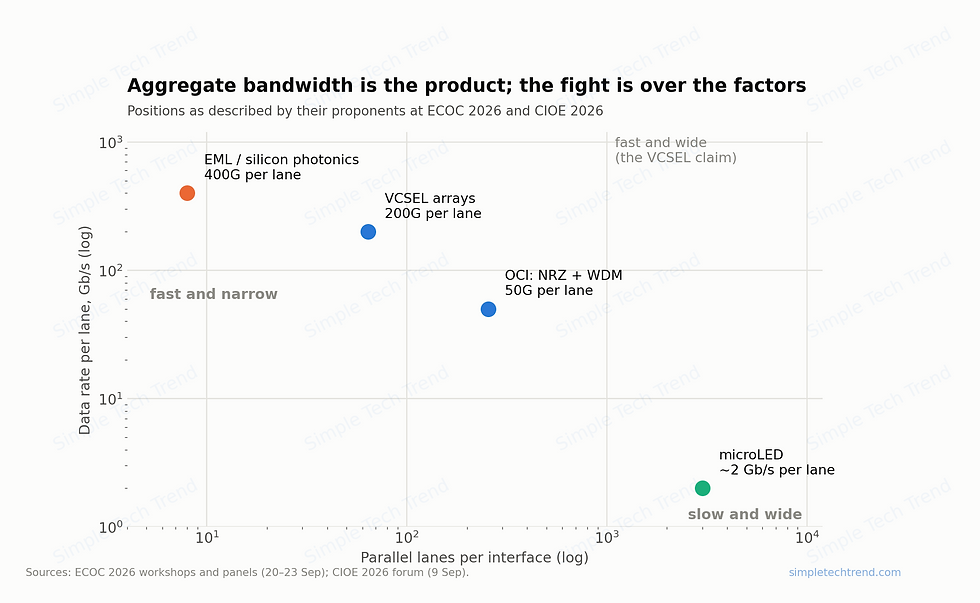
First, the OCI (Optical Compute Interconnect) MSA, an alliance formed by Broadcom, AMD, Meta, Microsoft, OpenAI, and Nvidia, aiming to build an interoperable physical layer that links multiple racks while preserving "copper-grade reliability." The member list itself is a signal: even Nvidia is in it.
Second, CPO (co-packaged optics), which moves optics into the package. Citing Meta's data, Broadcom said that where links once went about one million device-hours without a link flap, that figure is now about fifty million, roughly a 10x reliability improvement, while consuming about 70% less power than pluggable optical modules. They also showed a Tomahawk 6-based CPO solution (Davisson) as a complete, working solution.
For a full scorecard of who stands where on the CPO track, see "CPO Roadmaps of Every Major Player" (in Chinese). The key point here: when scale-up expands from "inside the rack" to "across racks," optical interconnect is no longer just a scale-out concern, but seeps down into the segment closest to compute, the one most demanding of low latency and high reliability. The specs and volume production for this segment are the core of 2026's industry competition shifting to the "supply side"; for context, see "After the $725B Capex Is Locked In, the Deciding Factor Shifts to the Supply Side" (in Chinese).

5. Three Cracks in This Narrative
This was a Broadcom home-turf talk with tight logic, but three areas are worth watching:
Crack one: scale-up over Ethernet has not yet proven it can match NVLink's latency. Putting Ethernet into in-rack interconnect is doable from an engineering standpoint, but what scale-up cares about most is latency and memory semantics, exactly what NVLink has refined over many years. No matter how good the spec looks, there are no public numbers yet confirming that volume silicon can match it on latency.
Crack two: "open" is splintering into a pile of standards. SUE, ESUN, UALink, plus each cloud provider's in-house transport: the scale-up layer now has several "open" options running at once. The flip side of openness is fragmentation, and the end result may well not be "one Ethernet to rule them all" but "you have to support three or four at your customers simultaneously."
Crack three: Nvidia joins the alliance while keeping a fallback. Nvidia appears on the OCI MSA member list, but it is simultaneously pushing external licensing of NVLink Fusion. It can participate in the open ecosystem while protecting its own proprietary interconnect, which means even the industry leader has not gone all-in on Ethernet for scale-up.
Conclusion
Strip away the stage talk, and what this keynote really declares is: Ethernet has formally been upgraded from "the data center network" to "the backbone of AI systems," and the front line has advanced into in-rack scale-up. Broadcom grows the ecosystem with open specs and collects rent with its own silicon; this two-layer play will be the main theme of AI networking for the next two years.
For Taiwan's supply chain, this is not a story about "yet another new standard," but about a new layer of demand taking shape:
Switch and system ODMs: high-end switch silicon like Tomahawk 6 and Jericho4 needs Taiwanese ODMs' volume-production speed to become shipping boxes. Kalkunte himself singled out Taiwan's ecosystem on stage, saying "faster ODM productization drives faster market adoption." That line was aimed at the Taiwanese companies in the audience.
Optical modules and CPO packaging: scale-up leaving the rack means optical interconnect penetrating the segment closest to compute; CPO optical engines, laser sources, FAUs (fiber array units), and advanced packaging/OSAT capacity are all direct beneficiaries.
Connectors and passive components: the "multi-rack interconnect with copper-grade reliability" the OCI MSA wants will require redefining a whole range of connector, cable, and power specs.
What's worth remembering from this talk is not any spec's version number, but that the direction of "pulling scale-up into open Ethernet" is now set. Its challenge to NVLink is real, but within two years the more likely outcome is not replacement but a division of labor: "NVLink holds the most latency-critical scenarios, Ethernet takes all other scale-up demand." Taiwanese suppliers don't need to bet on a winner, because whichever standard prevails, the orders for this extra layer of in-rack optical interconnect will land with the same group of companies. That is this keynote's most concrete message for Taiwan.
This article is for technology and industry trend analysis only and does not constitute investment advice.
Related Reading
After Copper Runs Out for AI: Seven Paths to Scale-Up Optical Interconnect: why everyone is racing to move scale-up to optics, with all seven technology paths explained in one piece.
CPO Roadmaps of Every Major Player: beyond the four giants, a whole row of CPO challengers, and who stands where.
Cisco Goes From Networking Veteran to Scale-Across Shovel Seller: another switch-silicon player fighting the same battle as Broadcom.




Comments