


US Curbs on Chinese Optical Modules Start at 3.2T: Taiwan's Re-sourcing Rally Is a Theme for Now, Revenue Comes After 2028
Over the past week, the market has told "US curbs on Chinese optical modules" as a single Taiwan re-sourcing story. It is actually two different paths.
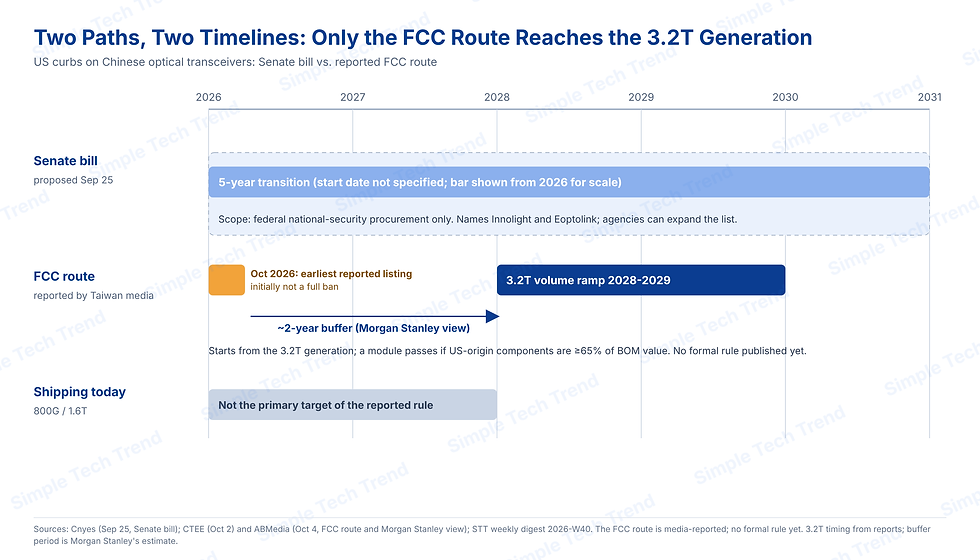
The first is a congressional bill: a bipartisan group of senators proposed barring Chinese optical transceivers from federal national-security systems, naming Innolight and Eoptolink, with a 5-year transition and room for Commerce and Defense to expand the list (Cnyes, Sep 25). The second is the FCC route reported by Taiwanese media: optical transceivers could be added to a restricted list as early as October, though not as a blanket ban at first. The focus is the 3.2T generation, expected to ramp in 2028-2029, and modules whose US-origin components make up at least 65% of BOM value could pass (CTEE, ABMedia). Morgan Stanley sees this leaving the industry roughly a 2-year buffer.
On Oct 2, several Taiwanese names hit limit-up, including LandMark Optoelectronics, EZconn, WIN Semiconductors and GCS. Other potential beneficiaries named in the media include Lianjun (3450), FOCI (3363), Browave (3163) and Luxnet (4979). But the same reports also caution that substantive demand will only form after 2028, and valuations already look elevated.
The point is not that China is being restricted. It is which product generation the rules start from, and by what standard.
What the paid section covers
• Side-by-side comparison of the two paths (bill vs. FCC)
• Timeline breakdown: 3.2T volume ramp and the 2-year buffer
• BOM breakdown: is the 65% threshold a tailwind or a constraint for Taiwan?
• A map of where the six named Taiwanese companies sit (with original chart)
• US suppliers' capacity expansion and the PhotonLink angle
• Eight counter-arguments and five signals to watch
──────────────────────────────
That is the summary of this piece.
STT's full analysis, covering why Taiwan's rally is pricing expectations rather than orders, what the 65% US-BOM line really means for Taiwan, and the five signals to watch, is in the paid section, with 2 original charts.
👉 Read the full analysis on vocus (in Chinese): https://vocus.cc/article/6ac31d16fd897800018a0301
──────────────────────────────
This article is for technology and industry trend analysis only and does not constitute investment advice.


Comments