


ECOC 2025 Tech Focus: OIF on Energy-Efficiency Requirements and Multiple Challenges in AI Applications
Updated: 23 hours ago
Introduction
The explosive growth of AI training and inference is driving rapid evolution in data center networks. Whether in-rack scale-up or cross-rack scale-out, optical and electrical interconnect design faces multiple requirements across reach, latency, reliability, and energy efficiency.
OIF, a cross-industry standards organization with more than 160 member companies, works to advance interoperability, energy-efficiency standards, and architectural coordination. At ECOC 2025, OIF shared its energy-efficiency requirements analysis for AI networks and discussed the trade-offs among CPO, CPC, and different link architectures.
Content
1. Link Types in the AI Compute Pod Architecture
OIF divides the links in an AI pod into five categories:
Compute I/O (e.g., PCIe, CXL, UCI)
Memory Interface (e.g., HBM, CXL over PCIe)
Scale-Up (links within GPUs/accelerators; low latency required)
Scale-Out (cross-pod links; longer reach required)
Front-End Ethernet (connecting to networks outside the data center)
👉 This talk focused on 3. Scale-Up and 4. Scale-Out, because they are the most critical to AI compute and face the toughest power and latency challenges.
2. Reach Requirements
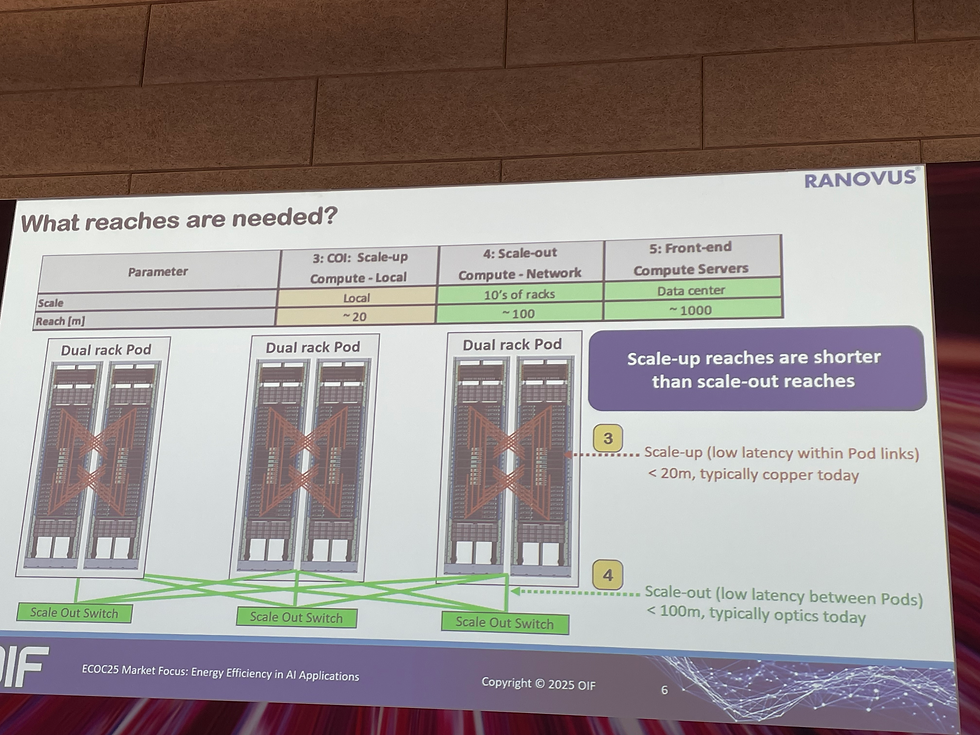
Scale-Up: today mostly within a single rack, primarily over copper. But next-generation AI clusters must span multiple racks, requiring ~20 m reach.
Scale-Out: cross-pod links need reach of ~100 m, which traditional copper struggles to meet — optics must step in.
3. Latency and AI Workload Characteristics
AI compute relies on matrix tiling: each accelerator completes part of the task before results are aggregated.
If some links have excessive latency, overall GPU efficiency drops.
Sources of latency:
Propagation delay
Error detection and retransmission delay
Solution: a very low bit error rate (BER) and an efficient FEC mechanism.
4. Reliability Requirements
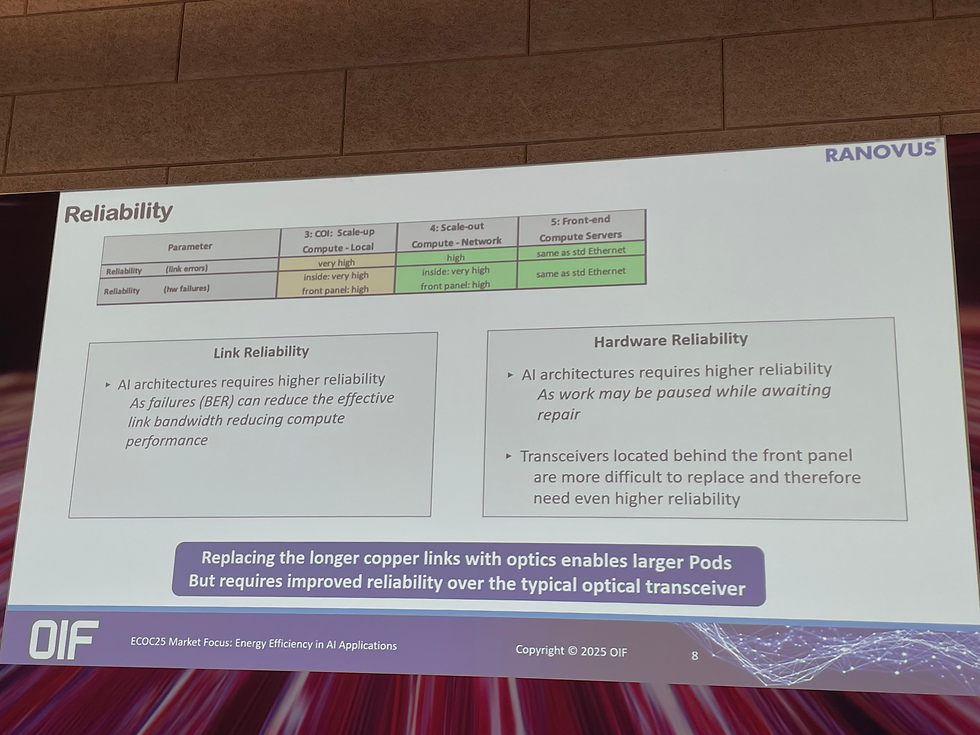
Link reliability: low error rates must be guaranteed to avoid frequent retransmission.
Hardware reliability: if a GPU or link fails, training must restart from a checkpoint, sharply reducing training efficiency.
Pluggable vs. CPO:
Front-panel (pluggable): easy to maintain, but with higher reliability demands.
Co-packaged (CPO): short copper traces and good reliability, but harder to maintain.
5. Bandwidth Density and Energy-Efficiency Targets
Hyperscaler requirements:
>2 Tbps/mm shoreline density.
<4 pJ/bit energy consumption.
Design trade-offs:
CPO: shortest copper traces, best bandwidth density and energy efficiency.
CPC (Co-Packaged Copper): sits between pluggables and CPO.
Pluggable: flexible, but with long copper traces and high loss.
👉 OIF's energy-efficiency map shows: CPO has the most potential in the <4 pJ/bit, high-density region, but deployment must overcome manufacturing and serviceability challenges.
Conclusion
OIF's analysis at ECOC 2025 highlights:
AI networks impose stricter requirements on reach, latency, and reliability, and traditional copper is gradually being replaced by optics.
Scale-Up (20 m) and Scale-Out (100 m) are the key scenarios for future energy-efficient design.
Latency is closely tied to BER: tail latency must be controlled through lower error rates and efficient FEC.
Reliability is becoming key to AI efficiency: MTBF must improve dramatically to avoid checkpoint rollbacks.
CPO is the most energy-efficient, but not the only answer: pluggables, CPC, and CPO will coexist depending on the application.
Overall, OIF's message is: AI factories need new energy-efficiency standards and a system-level design philosophy. It's not just about speed upgrades, but about finding the balance among energy efficiency, reliability, and scalability — which will determine the success or failure of future AI networks.






Comments