


ECOC 2025 Tech Focus: Source Photonics on AI Network Evolution and the Future of 448G/Lane IMDD
Updated: 23 hours ago
Introduction
AI has become the biggest engine driving the optical communications market. From 1.6T module deployment to the move into the 3.2T era, the industry faces multiple challenges in speed, power, and packaging. In its ECOC 2025 talk, Source Photonics analyzed the investment drivers behind AI and optical interconnect demand under scale-up and scale-out architectures, and proposed a viable path and market timeline for 448G/lane IMDD technology.
Content
1. AI Investment Drives Network Growth
Investment scale: global AI infrastructure investment in 2025 reaches the US$1 trillion level.
OpenAI, NVIDIA, Intel, and others are each investing on the order of tens of billions of dollars.
Market trend: over the next five years, AI will be the main growth driver of the optical module market.
2. AI Network Architecture Requirements
Scale-up (GPU interconnect within the rack):
Traditional copper cabling is reach-limited, and the industry is actively exploring replacing copper with optics.
Several startups are focusing on hybrid optoelectronic integration to push optics into short-reach links.
Scale-out (cross-rack / data center interconnect):
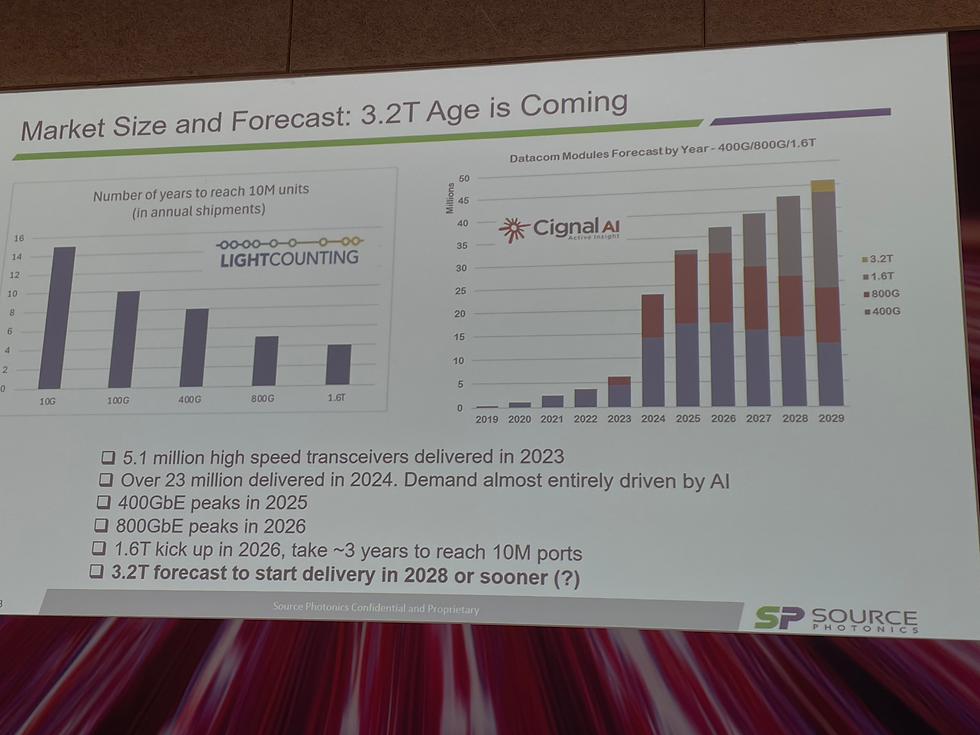
Optics is the mainstream solution, and 1.6T deployment has already begun.
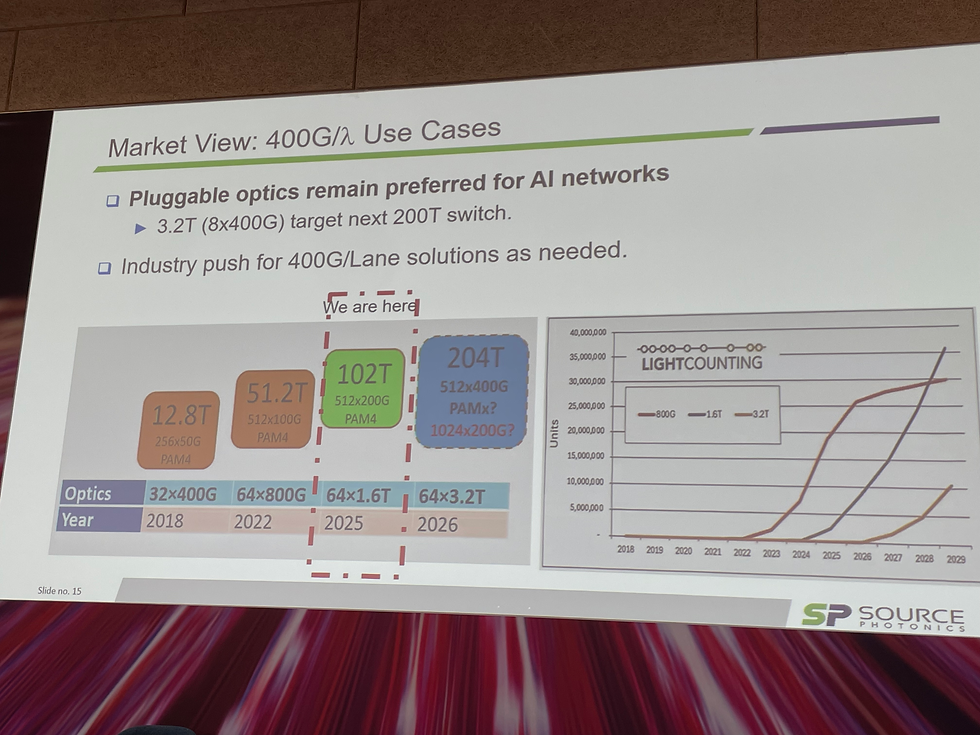
3.2T is expected to enter volume production around 2028.
Module format: currently DR4-based, reaching 3.2T by combining 2×DR4.
3. Technology Comparison: Pluggable, LPO, CPO
Pluggable:
Still the mainstream and the first choice for CSPs.
Easy to maintain and flexible to deploy.
LPO (Linear Pluggable Optics):
Compared with 800G, 1.6T cuts power significantly: 29W → 25W → 12W (second generation).
A clear advantage in energy efficiency.
CPO (Co-Packaged Optics):
Seen as "certain to enter the market," but early share will be limited by volume-production and serviceability constraints.
Will coexist with pluggables over the long term.
4. 448G/Lane IMDD: Challenges and Solutions
Industry consensus: 448G × 4 lanes is the mainstream path toward 1.6T / 3.2T.
Component requirements:
Optical component bandwidth needs to reach the 100 GHz class.
EMLs, silicon photonics, Mach-Zehnder modulators (MZM), and drivers/amplifiers must be upgraded together.
Process node driver:
Moving from 5nm → 3nm → 2nm CMOS nodes drives the evolution from 1.2T → 1.6T → 3.2T.
IMDD for 10 km applications:
Source Photonics stressed that from 100 m to 10 km, IMDD still holds the advantage and there is no need to rely entirely on coherent.
5. R&D and Product Progress
EML technology:
28G, 53G, and 100G EMLs have been launched, with bandwidth approaching 100 GHz.
Differential drive: ~1V drive voltage, with power consumption significantly lower than conventional designs.
Integrated solution:
Developing a single-package integration of EML + SOA + driver to reduce coupling loss and energy consumption.
Outlook:
A 1.6T module was shown at OFC, and a 3.2T module will debut at OFC 2026.
Summary
Source Photonics' view can be summarized as follows:
AI investment drives the market: over the next five years, AI will push optical modules into the 1.6T/3.2T era.
IMDD still has plenty of life: for 100 m–10 km links, IMDD still beats coherent on cost and power.
448G/lane is the key threshold: it requires coordinated upgrades of optical and electrical components, and the industry is pushing hard to break the 100 GHz-class component bottleneck.
Diverse module formats coexist: Pluggable, LPO, and CPO will coexist long term, chosen by use case.
A clear product roadmap: 1.6T is deployed and 3.2T is expected to start around 2028, matching the needs of next-generation AI networks.
Overall, the signal from Source Photonics is that IMDD will not be quickly replaced by coherent; instead, it will extend its value into the 448G/lane era. Future competition will be a system-level contest of energy efficiency, reach, and packaging, not a win decided by any single technology.




Comments