


ECOC 2025 Tech Focus: Huawei on the Opportunities and Challenges of 400G/lane Optical Interconnect
Updated: 22 hours ago
Introduction
AI factories and hyperscale data centers are growing fast, driving massive demand for high-speed optical interconnect. 400G/lane is not just a speed upgrade — it is the key threshold for 1.6T and 3.2T optical modules. In its ECOC 2025 talk, Huawei examined the challenges and future opportunities of 400G/lane across three levels: market investment, technology choices and component development.
Content
1. Market Investment and Demand Background
AI-driven investment:
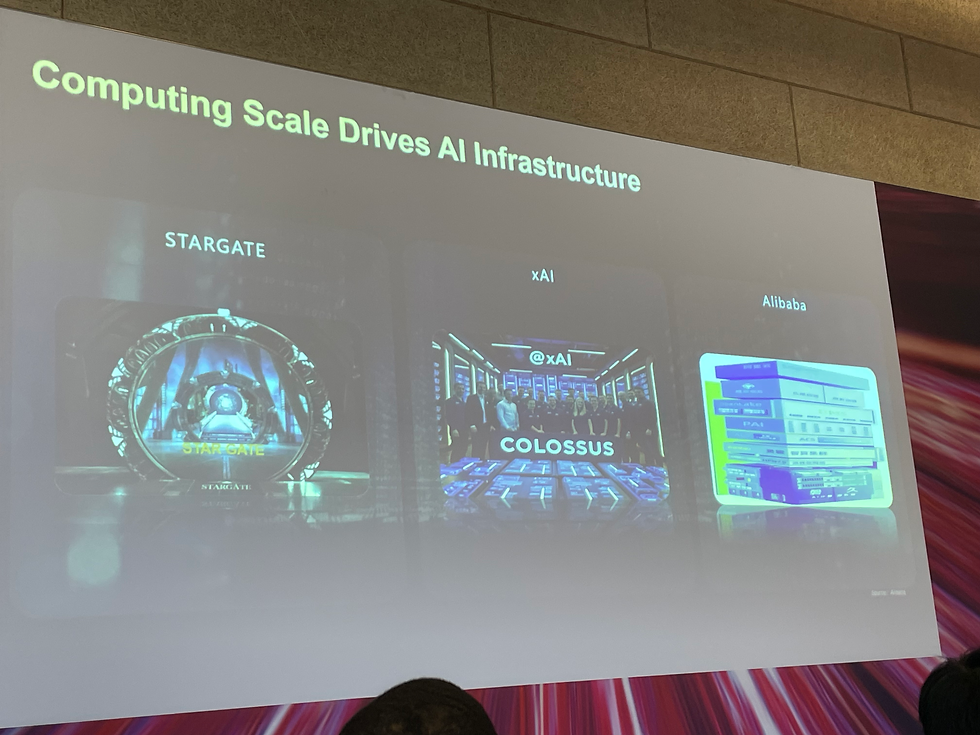
The US announced US$40 billion of AI infrastructure investment over the next four years.
Major Chinese CSPs (e.g., Alibaba) announced RMB 38 billion for AI data centers.
Market size:
The AI data center optical module market will exceed US$20 billion by 2030.
Non-AI data centers add about US$10 billion, for a combined total of more than US$30 billion.
2. 400G/lane Form Factors and Use Cases
Pluggable:
Suited to Scale-Out networks.
Two options:
200G SerDes + 400G optical interface (requires an ODSB acting as CDR).
400G SerDes + 400G optical interface (direct one-to-one mapping).
CPO (Co-Packaged Optics):
Lower power and latency, suited to high-density applications.
Challenge: packaging and serviceability are difficult.
High-density multi-lane approach:
8 × 50G SerDes, achieving 400G through many lower-speed lanes.
Advantage: lowers per-lane drive requirements.
👉 Conclusion: there is no single answer for 400G/lane; the choice depends on the use case (Scale-Up vs. Scale-Out) and packaging requirements.
3. Modulation Format Trade-offs
PAM4: mature and widely used at 200G/lane.
PAM6 / PAM8: lower bandwidth requirements, but higher SNR and FEC demands that add system latency.
Standards discussion: OIF and IEEE are still debating, with no full convergence yet.
4. State of Optical Components
EML (Electro-Absorption Modulated Laser):
The most mature technology.
Huawei showed an EML with >110 GHz bandwidth supporting 400G/lane.
Silicon Photonics (SiPh) + SiN:
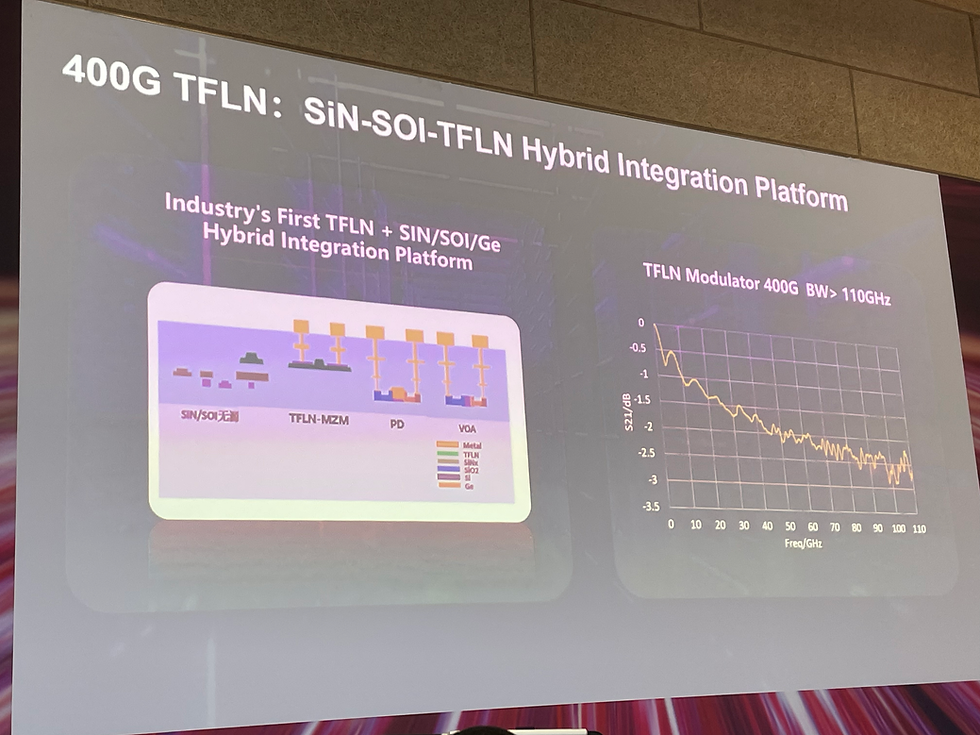
SiN as the passive layer and SiPh as the active layer, pushing bandwidth to >110 GHz.
Suited to high-density integration and DR applications (e.g., 4×400G = 1.6T).
Micro-Ring Modulator (MRM):
Suited to high-density, lower-speed multi-lane applications.
Advantages: small footprint, low power, low cost.
VCSEL:
Traditional strengths: low cost, high density.
New progress: 200G VCSELs have been demonstrated with ~40 GHz bandwidth.
Future direction: combining with external modulators (EML + VCSEL hybrid) to extend speed and reach.
5. Technical Challenges and Outlook
Power and cost: 400G/lane brings higher density, but also pressure on packaging, thermal management and reliability.
Integrated design is required: optics, electronics and packaging must be co-designed; no single technology solves every problem.
Future evolution:
1.6T: mainly 200G/lane, with 400G/lane phased in gradually.
3.2T: fully reliant on 400G/lane, likely requiring multiple technologies to coexist (SiPh + VCSEL + EML + MRM).
Summary
Huawei's view at ECOC 2025 highlights:
AI is driving massive investment: the optical module market will exceed US$30 billion by 2030.
400G/lane is the key threshold, opening up opportunities for both 1.6T and 3.2T.
There is no single technology path: pluggable, CPO and multi-lane approaches will coexist depending on the application.
A wide field of components: EML, SiPh, MRM and VCSEL each have their place, and the best performance may come from hybrid approaches.
The challenge is system-level integration: power, reliability and cost must be optimized together.
Overall, Huawei's message is: 400G/lane is not just a speed bump but a system-level transformation. Future 1.6T and 3.2T optical modules will hinge on multi-technology convergence and system co-design — the next frontier for the optical interconnect industry in the AI era.






Comments