


ECOC 2025 Tech Focus: PhotoniX AI on Scalable Optical Interconnects for AI Compute
Updated: 22 hours ago
Introduction
The rise of AI has not only driven advances in compute chips but also posed unprecedented challenges for data center networks. GPU clusters need higher bandwidth, lower latency and greater reliability, which is moving optical interconnect from the edge to the core.
At ECOC 2025, PhotoniX AI shared its view on Scalable Optical Interconnects, stressing that optics is an indispensable foundation of the AI factory, and laying out a future direction built on chiplets, modularity and flexible architectures.
Key content
1. AI's challenge to the network
Traditional computing: CPU-centric, connected via Ethernet.
AI computing: GPU-centric, and must support both:
Scale-Out: server-to-server and rack-to-rack links, with bandwidth demand 10× that of traditional Ethernet.
Scale-Up: GPU-to-GPU links inside the server, with bandwidth demand 100× that of a traditional CPU bus.
Example figures:
Per-GPU NIC bandwidth: 800G.
NVIDIA GB200 GPU I/O bandwidth: 7.2 Tbps.
👉 Takeaway: traditional copper interconnect (buses / PCB traces) cannot keep up, so the shift to optics is inevitable.
2. Core requirements for optical interconnect
Bandwidth density: multi-Tbps transmission must fit within limited package space.
Latency: every meter of fiber adds ~10 ns, so optical modules and switches must have extremely low latency.
Power: network energy should stay below 10% of total power, or it squeezes the power available to GPUs.
Reliability: unlike telecom's extreme 20-year lifetime standard, data centers must balance reliability against low cost.
3. The gap between optics and electronics
Over the past 10 years:
Optical module speeds rose 20×.
Switch chip capacity rose 100×.
Result: I/O has become the system bottleneck.
Why: optical component manufacturing still relies mainly on manual assembly and lacks large-scale automation, so it advances more slowly than electronics.
4. The way forward: chiplets and modularity
The chiplet concept: split optoelectronic functions into independently operating modules that snap together like building blocks:
They can be co-packaged with GPUs, CPUs and switch ASICs (CPO/NPO).
They can also sit on the PCB as standalone modules.
They can even be made into pluggable optics to preserve flexibility.
Advantages:
3D packaging shrinks size and cuts latency.
Flexible architecture: can be tailored into CPU-, MPU- or GPU-specific versions by application.
Cost efficiency: semiconductor processes and automated assembly lower unit cost.
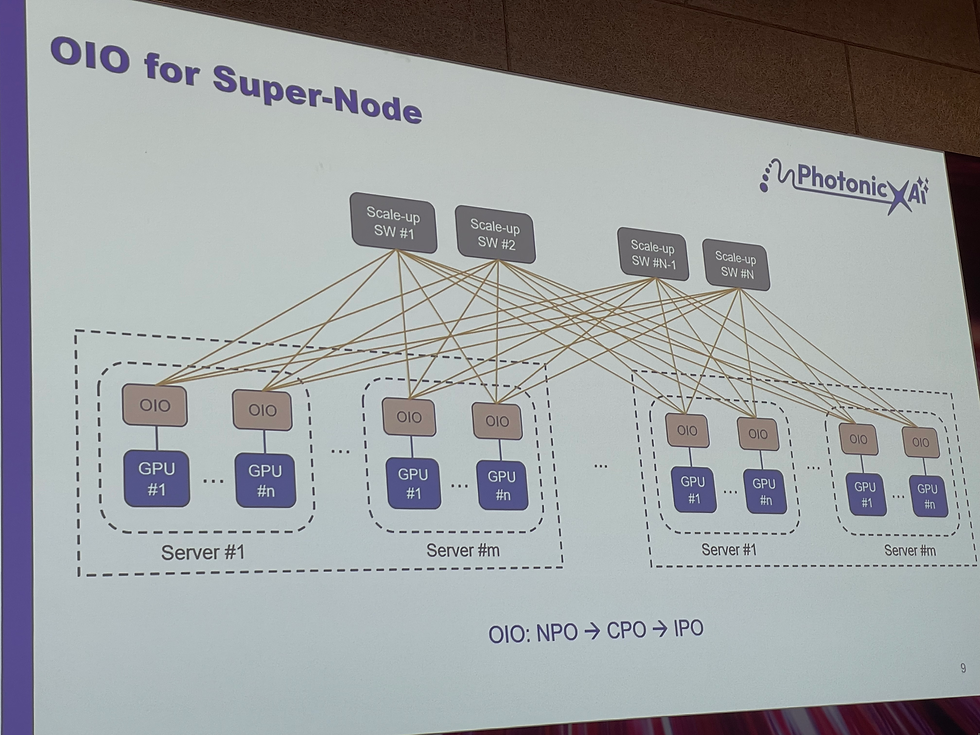
5. Use case: the AI supernode
GPU servers are interconnected through Scale-Up + Scale-Out optical networks so they look like a single giant server.
Optical I/O (OIO): the basic building block between GPUs, supporting ultra-high-speed interconnect.
Flexible design: OIO can be on-board, co-packaged or pluggable, adapted to customer needs.
6. Technical details and design considerations
Interconnect materials and processes:
Silicon photonics (SiPh) suits most scenarios.
Where large pixels (large cores) are needed, VCSELs are an option.
Packaging format:
High-speed needs → monolithic interconnect substrate (interposer).
Fast volume production → conventional PCB combined with SiPh.
Reliability: sufficient lifetime must be maintained at low cost to avoid degrading GPU cluster efficiency.
Conclusion
PhotoniX AI's talk at ECOC 2025 delivered several key messages:
AI makes optical interconnect a necessity: GPU bandwidth demand already exceeds the limits of copper interconnect.
Optics must become more automated: electronics advances faster than optics, and the industry needs semiconductor-style automated assembly.
Chiplets and modularity are the future: they deliver flexible, scalable, low-power optical interconnect solutions.
The application vision is the AI supernode: hundreds of GPUs linked by optical interconnect into a single giant server.
Overall, PhotoniX AI's vision highlights that competition in the AI factory era will hinge on who can achieve true scale, low power and high reliability in optical interconnect.




Comments