


Breaking the AI Compute Bottleneck: OCS and the Optical Networking Revolution of the 1.6T Era
Introduction: An Unexpected Protagonist Reshaping the Data Center's "Speed-of-Light Revolution"
At the just-concluded OFC 2026, the hottest topic on the show floor wasn't only the expected CPO (co-packaged optics), but the previously niche OCS (Optical Circuit Switching).
The shift is anything but quiet. According to TrendForce's latest estimate, Google's Ironwood TPU v7 rack deployments alone will drive demand for more than 6 million high-end optical modules at 800G and above. A counterintuitive truth emerges: once OCS successfully "replaces" traditional electrical switches at the spine layer, it doesn't kill the optical module — it becomes a "super catalyst" pushing module specs upward.
In this article, we dig into the physical boundaries of OCS, explain why it is making WDM and circulators standard features of optical modules, and explore possible paths to higher bandwidth.
OCS vs. Traditional Electrical Switches: Pushing the Limits of the Optical Link Budget
A traditional electrical packet switch (EPS) performs an optical-electrical-optical (O-E-O) conversion at every hop, regenerating and amplifying the signal at each node. OCS, by contrast, is a purely physical, all-optical device. It only reflects light — it does not generate, amplify, or regenerate the signal.
This saves an enormous amount of power, but it introduces a serious physical challenge: rapid consumption of the optical link budget.
The MEMS micromirror array inside an OCS inevitably introduces insertion loss as it steers the beam. To absorb that loss without any amplification, the signal must leave the server side extremely "strong and clean." This directly drives a full evolution of OCS-specific modules: a shift from short-reach DR toward single-mode longer-reach FR/LR, with mandatory higher-power lasers to ensure the signal can punch through every mirror stage to its destination.
The Specialization of OCS Optical Modules: Why WDM and Circulators Are Both Essential
To fit the point-to-point, all-optical direct-connect architecture of OCS, optical modules adopt two core design elements — and these are what separate OCS-specific modules from conventional ones.
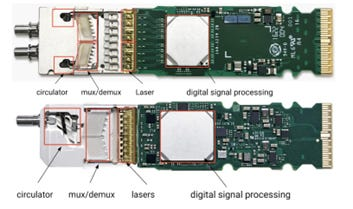
1. WDM (Wavelength Division Multiplexing): Squeezing Every Bit Out of a Single Fiber
How it works: Think of a fiber as a single-lane road. WDM uses a prism-like principle to merge laser signals of different wavelengths (colors) into the same fiber, then demultiplexes them at the far end.
Core value: It multiplies transmission bandwidth (e.g., 800G or even 1.6T) without adding expensive physical fiber. It is the lowest-cost, most efficient way to scale capacity as AI cluster traffic surges.
2. Circulator: The "Soul" of the OCS Module
Conventional optical modules typically use a duplex-fiber design (one transmit, one receive). In an OCS architecture, however, single-fiber bidirectional (BiDi) transmission is an absolute must.
How it works: A circulator acts like a "one-way roundabout" for light. It forces light to circulate in one direction only (Port 1 in → Port 2 out, Port 2 in → Port 3 out), letting transmit and receive signals pass each other cleanly in the same fiber without interference.
The fatal cost of going without a circulator:
Catastrophic fiber-count explosion: Keeping duplex fiber across tens of thousands of nodes would double the fiber count in the data center — not only a cabling nightmare, but also a serious obstruction to airflow and cooling.
OCS port utilization cut in half: OCS micromirror ports are extremely expensive. If each link consumes two ports (one transmit, one receive), the capacity of this very costly switch is effectively halved — unacceptable from a business standpoint. In short, without circulators, OCS equipment cost and deployment difficulty would double.

The Bandwidth Barrier on the Road to 1.6T: IMDD Hits Its Physical Limits
As we push toward 1.6T and even 3.2T, the underlying modulation technology is running into a physical bottleneck. According to Google's research, the two main architectures today are:

IMDD (Intensity Modulation / Direct Detection)
Strengths: Simple architecture and very low cost — the mainstream for today's 800G PAM4.
Weakness (fatal): Very poor tolerance to chromatic dispersion (CD). At 100G it can reach 4 km, but at 400G per lane dispersion severely distorts the signal and reach collapses to just 0.25 km — nowhere near enough for scaling out data centers.
Coherent Optical Communication
Strengths: A performance monster. It encodes information in the intensity, phase, and polarization of light, and uses a DSP for electronic dispersion compensation (EDC) to cancel physical impairments, delivering 10dB higher sensitivity.
Weakness: Overly complex architecture with very high power and cost; historically used only for long-haul and subsea links.
This is exactly the opening for Coherent-Lite (lightweight coherent technology): it aims to keep the advantages of coherent while cutting power and cost through "de-featuring and optimization."
What Is Coherent-Lite? Coherent Technology That Outclasses from Below
Coherent-Lite is optimized for intra-data-center links (< 2 km) and campus networks (2–10 km). Its core philosophy: trade "subtraction" for commercial viability.
1. Breaking the Physical Shackles: Why Coherent-Lite Is Inevitable
When 1.6T per-lane rates collide with the dispersion barrier, Coherent-Lite shows a decisive advantage:
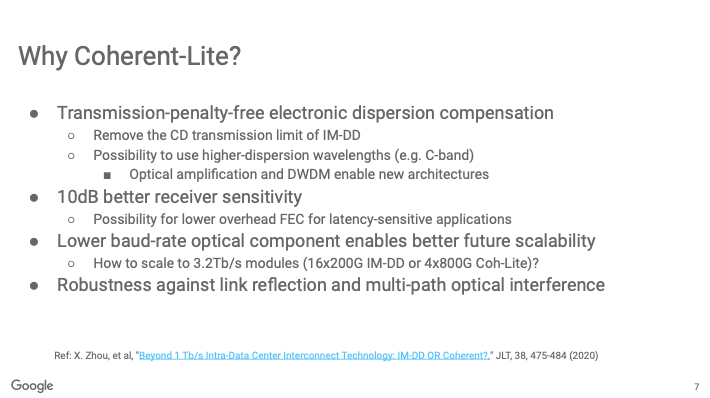
Immune to dispersion limits: It eliminates the pain point of IM-DD, allowing data centers to use wavelengths with higher dispersion but lower loss.
10dB better sensitivity: Signals travel farther and FEC overhead drops, delivering the "ultra-low latency" AI clusters crave.
2. Architecture Showdown: Less in the Optics, More in the Silicon


The traditional IM-DD path (e.g., CWDM4) requires four lasers and modulators, so optical BOM cost scales linearly with bandwidth. Coherent-Lite, using polarization multiplexing, needs only one laser. It shifts the problem from hard-to-shrink optical components onto DSP chips that benefit from Moore's Law.
3. Semiconductor Economics: Riding CMOS's "Sublinear" Scaling Dividend

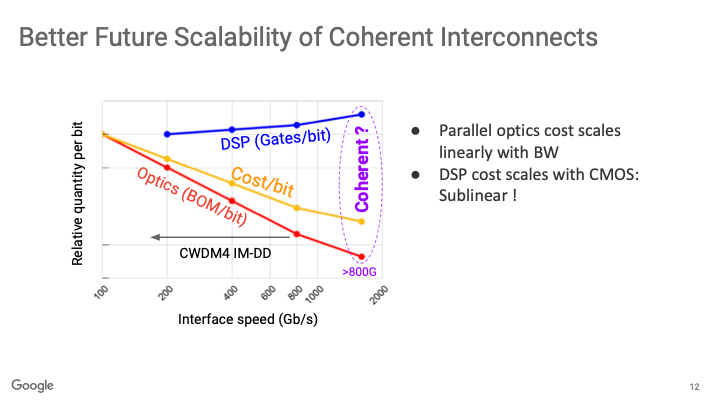
Google's strategy is clear: "simple optics, smart electronics." As process nodes advance toward 3nm, DSP cost and power grow sublinearly — far slower than bandwidth. The higher the data rate, the more dominant Coherent-Lite's cost-performance becomes.
4. The Battle Before Deployment: Analog Components and Drive Voltage Challenges

The challenge lies in **"modulator efficiency."** 16-QAM requires a larger drive swing.


Coherent requires double the drive voltage, which is a challenge in silicon photonics. But if high-efficiency drivers can be achieved, coherent gains up to a 5dB link-budget advantage — exactly the weapon needed to overcome OCS insertion loss.
5. The Ultimate Form: Tailor-Made for the Data Center
To replace conventional modules in the same slot, Coherent-Lite must abandon costly telecom thinking: no full C-band tunable laser, but fixed-wavelength or few-channel WDM lasers instead, with the DSP aggressively slimmed down for power in sub-10 km environments.
Standardization and Real-World Validation: Marvell and Ciena's Coherent-Lite Moves
Industry heavyweights are already bringing Coherent-Lite into real AI infrastructure.
Marvell and Lumentum's Scale-up Revolution (OFC 2026) At OFC 2026, Marvell and Lumentum demonstrated how OCS can be used to build next-generation AI scale-up infrastructure. The demo paired Marvell's Aquila 1.6T Coherent-Lite DSP (optimized for short-reach O-band) with Lumentum's R300 OCS switch. By establishing direct optical paths that avoid OEO conversion, the solution claims up to 98% lower switching latency and more than 65% energy savings in large GPU clusters, breaking through the "network wall" of traditional packet networks.
Ciena's WaveLogic 6 Nano (WL6n) 1.6T Use Cases Optical networking leader Ciena has further defined four core use cases for Coherent-Lite:
1.6T intra-data-center connectivity: Used directly for switch-to-switch links, solving PAM4's reach and power bottlenecks at 1.6T.

High-density AI cluster interconnect: Deployed in the backend network to achieve 1.6T transmission with fewer transceivers, supporting the extreme bandwidth density of large-scale AI training.

Campus connectivity: A dedicated, low-power interconnect with redundant features stripped out, for multiple data center buildings 2–20 km apart.

Standard pluggable evolution: QSFP-DD and OSFP pluggable modules let cloud providers upgrade seamlessly from existing platforms to 1.6T.

Conclusion: From Transmission Pipe to Architectural Reinvention
Optics is undergoing a profound paradigm shift. From circulators and WDM coming to the rescue in OCS architectures to Coherent-Lite outclassing from below, these are far more than spec upgrades.
In the 1.6T era, optics is no longer just a "pipe" between two points — it has become a core "architectural layer" of AI compute infrastructure. By handing physical-layer impairments to powerful DSPs and using OCS for flexible topology switching, we are entering an all-optical networking era in which power, latency, and bandwidth can be brought into balance.


Comments