


SEMICON Taiwan 2025 Silicon Photonics Summit | Broadcom | CPO for AI Scale-Out and Scale-Up
Introduction
As AI models keep scaling, a single server or a single rack can no longer meet the enormous compute demand. As GPU clusters grow larger, the limits of traditional copper interconnect in bandwidth, power and reach are becoming apparent, turning it into a bottleneck for AI infrastructure.
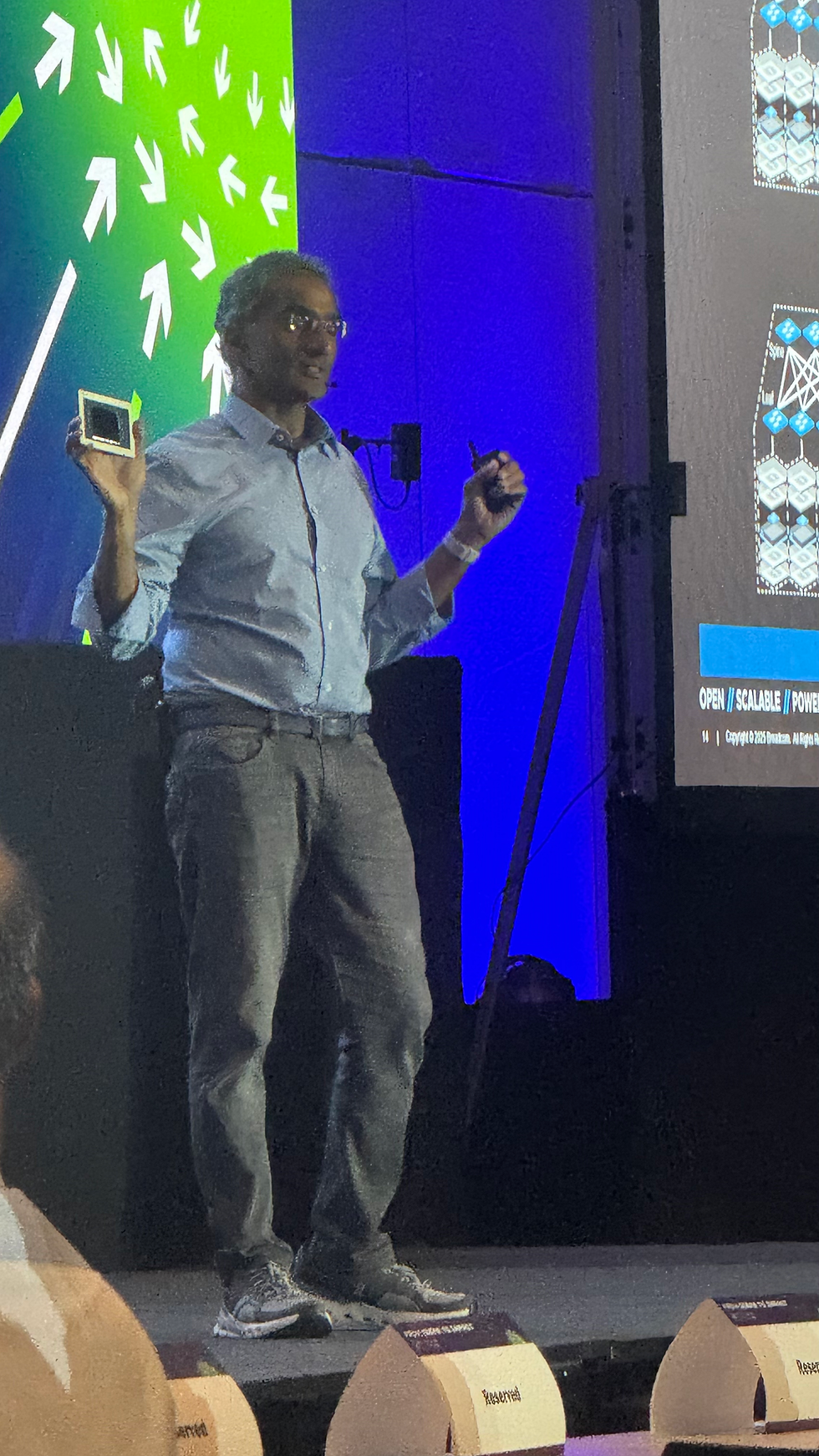
At the SEMICON 2025 Silicon Photonics Summit, Broadcom's speaker pointed out that to support AI training on tens or even hundreds of thousands of GPUs, optical interconnects will replace copper and become the core technology for scale-up and scale-out. The talk focused specifically on the evolution of CPO (Co-Packaged Optics) and explored how to balance cost, power and reliability.
Key Points
1. The Limits of Copper
Where copper interconnect stands today:
100G/lane: supports a reach of about 2 racks.
200G/lane: the rate goes up, but signal integrity degrades; reach extends only to 7 meters, supporting just a few racks.
As speeds increase, copper's power consumption, signal attenuation and cabling complexity rise sharply, making it an obstacle to scaling AI.
2. The Optical Interconnect and CPO Solution
Broadcom's answer is optical engines and co-packaged optics (CPO):
Traditional CPO
Already able to meet some scale-up needs, but adoption is limited.
Intermediate CPO
Lower power and better price-performance, expected to gain adoption faster over the next few years.
Advanced CPO
Further reduces power to below 5 pJ/bit.
Becomes the core technology underpinning next-generation 51.2T switches and large-scale GPU clusters.
Simply put, CPO's evolution path is traditional → intermediate → advanced, progressively lowering power and cost to drive adoption at scale.
3. Cost and Reliability Challenges
Although optical interconnects have advantages in bandwidth and power, large-scale adoption still requires overcoming the following challenges:
Cost: optical modules still cost more than copper, and need to come down through volume production and packaging innovation.
Form Factor: smaller optical engines are needed to support high-density packaging.
Reliability: optical connectors must maintain low insertion loss even under dust, stress and other environmental conditions.
Interoperability: standards must be consistent across vendors and systems to avoid ecosystem fragmentation.
Broadcom specifically highlighted optical connector reliability in dust testing, showing that even in a "Parisian dust" environment, optical connectors stayed within spec. This indicates that the reliability of optical interconnects is gradually reaching the level required for real-world deployment.
4. Outlook: Toward 51.2T and Beyond
Broadcom showed how CPO technology supports 51.2 Tbps switches:
High-density optical engines: supporting 1×8 channel configurations, reducing cabling and power.
Optimized packaging: balancing thermal management and reliability.
New materials and processes: continuing to lower power to below 6 pJ/bit.
These advances will push AI training and inference clusters from a single rack to a scale spanning dozens of racks and even multiple data centers.
Conclusion
In its SEMICON 2025 talk, Broadcom clearly laid out copper's bottleneck and the advantages of optical interconnect, and presented a CPO technology roadmap: from traditional → intermediate → advanced, progressively lowering power and cost to ultimately support 51.2T switches and large-scale GPU clusters.
As cost, reliability and interoperability are gradually overcome, optical interconnect will become a key foundation of AI supercomputers and data centers. Broadcom's strategic focus is to ensure optical interconnect is not merely a technical breakthrough, but a solution that can truly achieve commercial scale and broad adoption.
Comments