


2026 OCP APAC Summit | Data Centers That Can "Swap Chips Anytime": What Google's Fungible Blueprint at OCP Means for Taiwan's Supply Chain
In his OCP (Open Compute Project) keynote, Greg Moore, Google's VP of cloud hardware, appeared to be showcasing Google's data center engineering, but the real signal came down to one sentence: the data center is being rewritten from "a building you construct once and use for ten years" into "a product that gets revised with every chip generation". When a single facility must painlessly absorb every model and generation of TPU, GPU, and CPU, then power (Mt Diablo ±400V DC, native LVDC, solid-state transformers (SST), battery storage (BESS)), cooling (the fifth-generation Project Deschutes CDU, Brazos liquid-cooling retrofits), and facility specs (the Open Data Center spec) all have to be unbundled, standardized, and opened up. The word Moore kept repeating, "fungible," is not an adjective; it is a redistribution of who controls the specs. For Taiwan's power, thermal, CDU, connector, and mechanical supply chain, this is a new game with a higher bar but a bigger share of the pie, and the ticket in is called OCP.
1. Why Now: The "Green Line" of AI Workloads Has Data Centers Backed Into a Corner
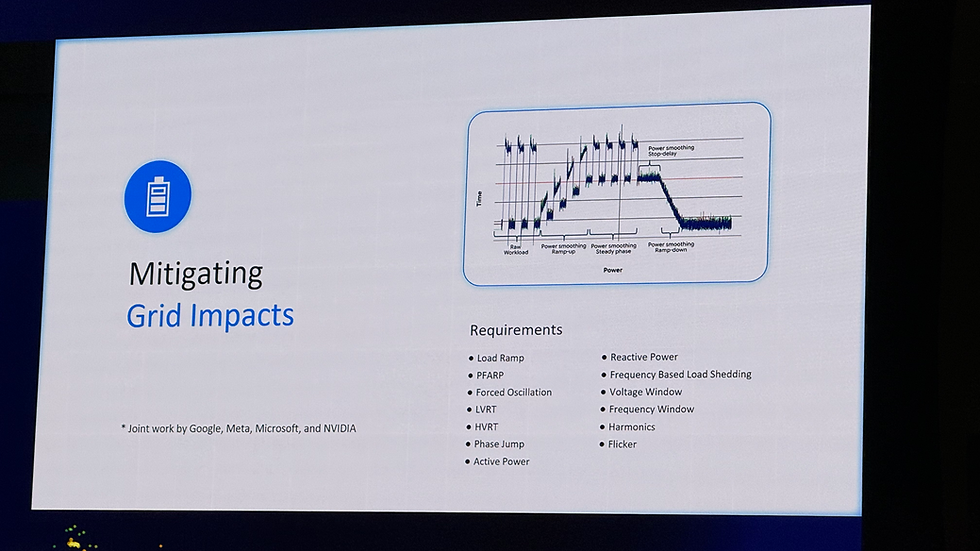
Moore opened with a chart: the blue line is traditional workloads, smooth and predictable; the green line is today's AI training and inference load, swinging violently up and down. That chart is the foundation of the whole talk: AI has pushed data centers from steady-state power into wildly fluctuating power. Google even said it is working with AWS, Meta, Microsoft, and NVIDIA to define how to mitigate the impact on the grid (load ramp rate, forced oscillation, phase jump).

What makes this weighty: when several hyperscalers have to negotiate specs with the grid together, AI data center power has become so large that it is "not your problem, it's the whole grid's problem." Moore's quantitative anchor: Gemini alone processes more than 22 billion tokens per minute via its API (a figure stated on stage by management; verify against the official transcript before citing). Demand is exponential while hardware gets built linearly, and that gap is exactly the hole this whole "fungible data center" agenda is meant to fill.
The power wall that pluggable optical modules ran into is really the other face of the same wall. We break down that context in full in Have Pluggable Optics Hit the Wall? Understand the Wall Before You Understand CPO.
2. Power: Moving From Facility-Level to Rack-Level Power Delivery
Moore spent the most time on power, and he laid out the logic plainly: power is not a single-layer problem; it has to be managed from the chip and the tray all the way up to the row and the entire facility.
The core pain point: as per-rack power heads toward the megawatt class, conventional 48V power delivery hits a wall. The reason is simple: feeding that much current at 48V means stuffing the rack with rows of step-down converters, and the more converters you add, the more of the space meant for accelerators (TPU / GPU / CPU) gets eaten up. You want that space for compute, not for power supplies.
Google's answer is Mt Diablo: integrating power into the rack as a ±400V DC sidecar, co-defined with Meta and Microsoft (the official abstract also marks the roadmap out to ±800 VDC; confirm these voltage figures against the official spec before publishing). The next step Google wants to take is fully native LVDC: eliminating the AC-to-DC conversion at the facility level entirely, and integrating a Battery Energy Storage System (BESS) to absorb the grid fluctuations mentioned earlier.
There is another signal here that is easy to miss but critical for the supply chain: the Solid State Transformer (SST). Google, Microsoft, and NVIDIA jointly standardized the SST interface, and the spec was released through official channels at the end of July. SST plus BESS plus native LVDC all say the same thing: bring power-plant-grade power electronics straight into the data center. For Taiwan's major power suppliers (PSU/power players such as Delta Electronics and Lite-On), this is not an extension of existing orders but a new battlefield where the entire spec level moves up.

3. Cooling: Thermal-First Design, and the Trick That Needs No Plumbing
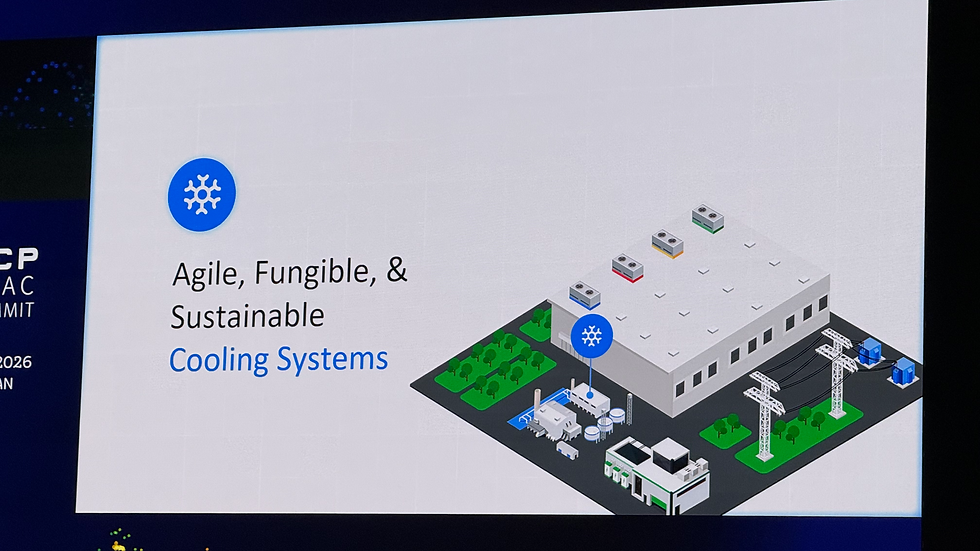
On cooling, Moore raised a concept he recently also presented at a thermal management forum in Taiwan: thermal-first design. It means cooling is no longer the last step of mechanical design but the first: with this much power pouring into chips and racks, how you get the heat out determines whether the whole machine works at all.
Google's offering is Project Deschutes, its fifth-generation Cooling Distribution Unit (CDU), built on four prior generations and a decade of large-scale deployment, and opened up to ten different suppliers to build. This move is very OCP: rather than keeping it to itself, Google puts the design out so a whole lineup of suppliers can mass-produce it together.
\
The really clever move is another project called Brazos. The problem it solves: the world still has a huge installed base of air-cooled data centers that lack the plumbing liquid cooling requires. Brazos is designed so that existing facilities without water connections can still adopt liquid cooling. This expands the liquid cooling market from "new greenfield data centers" to "retrofits of every existing facility," instantly enlarging the TAM by an order of magnitude.
Whether to air-cool or liquid-cool, and at what power density liquid becomes mandatory, is something we quantified in 51.2T NPO Switch Thermals: An 835W ASIC Plus 16 Optical Engines, Air or Liquid Cooling?. For Taiwan's thermal module and CDU supply chain (Auras, AVC, and others), Deschutes' "ten suppliers" and Brazos' "installed-base retrofits" are two very concrete order maps.
4. Facilities and "Fungibility": The Real Keyword of the Talk
With power and cooling unpacked, Moore pulled them back into a single word: fungible (swappable/interchangeable). To that end, Google also contributed its server hall design to OCP, aiming to give the whole industry a shared blueprint for how to build a data hall. And Google was blunt about it: it is using the blended density of its own 2027 and 2028 TPUs as the baseline to argue that "the industry should plan to this spec now," and is working with AMD and Meta to push the spec to version 1.0 later this year.
The commercial essence of fungibility: data centers are no longer built for one particular chip. The same facility can host TPUs this generation, GPUs the next, and CPUs alongside, with power, cooling, and mechanical interfaces all shared. This echoes Google's most underrated move of recent years: using Optical Circuit Switching (OCS) to build TPU clusters into a reconfigurable network. We take this whole "one architecture for many generations" approach apart in detail in Google Takes Apart Its Own TPU, and the Hidden Hero Called Optical Circuit Switching.
Just how extreme the capital intensity behind all this is shows up in Google's own financials; the full numbers are in Alphabet FY2026 Q2: Capex Surges to $205 Billion, and the Next Optical Interconnect Battleground Is "Across Data Centers". When a company commits capex on the order of $200 billion, it naturally has every incentive to turn its data centers into products that can keep being revised without being torn down and rebuilt.
5. The Real Intent Behind Open Standards, and the Side Worth Viewing Soberly
Moore's theme throughout was "working together": the OCP Open Data Center open letter has more than 50 signatories, Google has made more than one hundred contributions, and he said OCP lets them quickly reuse 80% of what they need and run execution specs at "product speed." Sustainability is bundled in too: four pillars (heat/energy/water consumption, carbon-smart lifecycle analysis, clean backup power, low-carbon materials), plus a Data Center Innovation Initiative with Amazon and Microsoft.
But STT wants to tap the brakes here. Open standards are a double-edged sword. The upside: specs are public, there are multiple suppliers, and mass production is fast; as long as Taiwanese suppliers can get inside the OCP spec circle, they can win orders across operators and generations instead of being locked into one customer's proprietary spec. The sobering side: control over the specs is highly concentrated in the hands of Google, Meta, Microsoft, NVIDIA, and AMD. Mt Diablo was defined by Google+Meta+Microsoft, SST by Google+Microsoft+NVIDIA, and server hall 1.0 by Google+AMD+Meta; behind every spec are the same few names. The role of Taiwanese suppliers is that of the executor who builds to this blueprint, cheaply and reliably, not the definer.
The other downside risk is timing. Much of what Moore described is roadmap (2027/2028 densities, native LVDC, the 1.0 spec later this year); these dates and hard numbers such as voltages and investment amounts should be checked against official documents before formal reporting, rather than treating keynote figures as final. Regulation is also closing in: he himself noted that data center rules are taking shape in APAC, India, and North America, and falling short on sustainability will only bring more restrictions.
Conclusion
What Taiwan's supply chain should really remember from this keynote is not project code names like Project Deschutes or Mt Diablo, but the structural shift behind them: competition in AI data centers is sinking down from "whose chip is faster" to "whose data center can be revised along with the chip." Power electronics (SST, BESS, ±400V/±800V power delivery), liquid cooling (CDUs, cold plates, quick disconnects, retrofit kits for existing facilities), and mechanicals and connectors, once seen as mere facility accessories, are being pulled one by one onto the spec negotiating table by OCP and turned into the core value chain of AI infrastructure.
Taiwan's opportunity is clear: thermal (Auras, AVC), power (Delta Electronics, Lite-On), and rack-system ODMs (Foxconn, Quanta, Wistron) already sit on this chain, and Deschutes' ten suppliers, Brazos' installed-base retrofits, and the new SST spec are each a door to claim a position. But the bar is just as clear: whether you can get into the OCP spec circle and keep pace with the "ready by 2027/2028" timeline decides whether you capture this round's upside or only pick up leftover contract-manufacturing orders after the specs are set. To hyperscalers, "fungible" means flexibility; to the supply chain, it means a filter: this round, a ticket into the spec circle is worth more than capacity.
This article is for technology and industry trend analysis only and does not constitute investment advice.








Comments