


Marvell Investor Day 2026: An $80B Bet on Connectivity, With Scale-Up Optics the Only Variable Starting From Zero
Marvell set its FY31 revenue target at $70–90B (midpoint $80B), 10x the $8.2B it booked in FY26; the EPS target is above $30, which management calls "30 in 30."
This is not an ASIC story. It is a connectivity story: at the FY31 midpoint, Interconnect is ~$37.5B, Switching & Storage ~$10B and Custom ~$30B, so connectivity-related revenue far outweighs compute.
The most important line came in the Q&A: scale-up optics revenue is "virtually zero" today, starts ramping to hundreds of millions of dollars next year, and carries "thousands of dollars" of optical content per XPU. It is the only piece of the blueprint starting from zero, and the one most likely to decide whether Marvell lands at $70B or $90B.
For Taiwan's supply chain, the point is not who wins Marvell orders but the cadence: NPO first, CPO in parallel. That pulls demand for lasers, FAUs, advanced packaging and substrates forward by a generation.
1. Why Now: Marvell Rewrites Its Ceiling in the Same Hotel, Again
In April 2024, at The Pierre in New York, Marvell called for $15B of FY29 data center revenue. FY24 was only $2.2B, and the market treated the 7x target as a joke. In June 2025 it was raised to $18B. This time, FY28 total company revenue was raised to about $20B (the August earnings call had guided $18B), with data center at roughly $18B, hitting the original FY29 target a full year early.
From FY24 to FY28, data center revenue compounds at about 70%. Management's FY31 range for data center growth is 55–70%, which means the most optimistic case simply holds today's pace, and the conservative case is a slowdown. That is the smartest piece of framing at the event: the numbers are big, but the assumptions are not aggressive.
We broke down the $18B guide and the Google warrant in Earnings Call Highlights: Marvell (MRVL) | Q2 FY2027; this Investor Day takes that guidance one step higher and three years further out.


2. Breaking Down $80B: Connectivity Is the Main Act, Compute the Supporting Role
Matt Murphy opened by positioning Marvell as a "connectivity first company", splitting semiconductors into three: the big three in compute, the big three in memory, and connectivity as "the next defining unlock." Of FY26's $8.2B, about 30% came from compute and 70% from connectivity; as XPU attach ramps, Custom will look more and more like a connectivity business.

The FY31 midpoint breaks down as follows:
Interconnect (electrical and optical): ~$37.5B in FY31; CY30 TAM ~$65B, ~65% CAGR
Switching & Storage: ~$10B in FY31; CY30 TAM ~$85B, ~40% CAGR
Custom (XPU + XPU attach): ~$30B in FY31; CY30 TAM ~$235B, ~55% CAGR
Comms & Other: ~$2.5B in FY31; CY30 TAM ~$15B, low-single-digit growth

Interconnect's target share is close to 60%, Custom only about 13%. What Marvell really wants to own outright is electrical and optical interconnect.
Interconnect is the fastest-growing TAM in the table (~65%), and the one where Marvell believes it needs no new customers, just to "hold share and grow with the market." Scale-out has doubled every year for the past few years, 1.6T is only just entering volume and 3.2T is still ahead, with ASPs stepping up each generation.
3. The One Variable Starting From Zero: Scale-Up Optics
Dave Lazovsky (former founder of Celestial AI) boiled his whole talk down to one line: every XPU interconnect inside the rack today is 100% copper. At 200G/lane, copper reach is down to about 2.5 meters, and 448G will be shorter still, while inference, MoE and KV cache need multi-rack scale-up domains of 512, 576 XPUs or more. Copper cannot hold, so optics has to come in.

Management gave three key numbers:
Scale-up accounts for 85% of total data center traffic (Marvell's own estimate), so saving a few pJ/bit frees power to generate tokens.
A latency target of about 200 nanoseconds, close to local HBM access; pluggable modules are an order of magnitude behind on bandwidth, power and latency.
Scale-up optical content runs to "thousands of dollars" per XPU, and both ends of the link (XPU side and switch side) need optics.
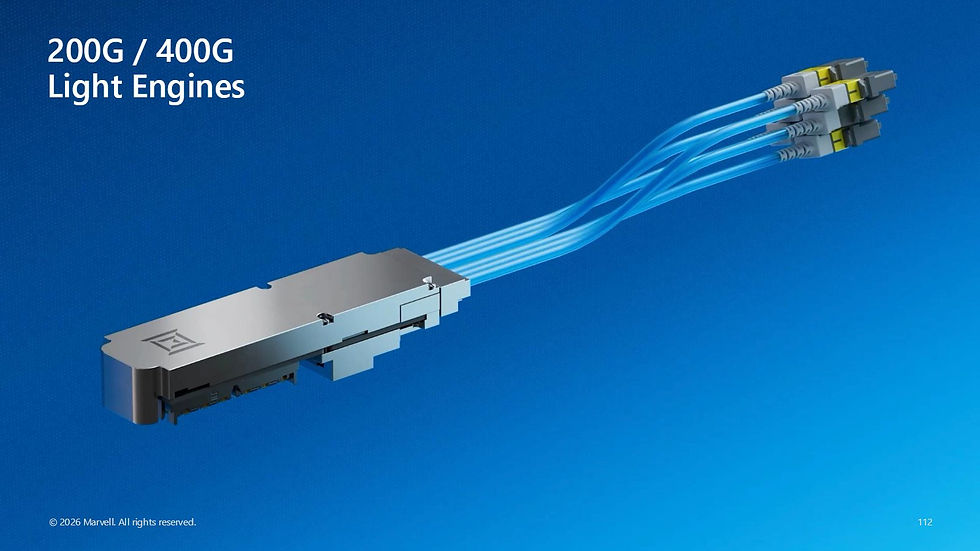
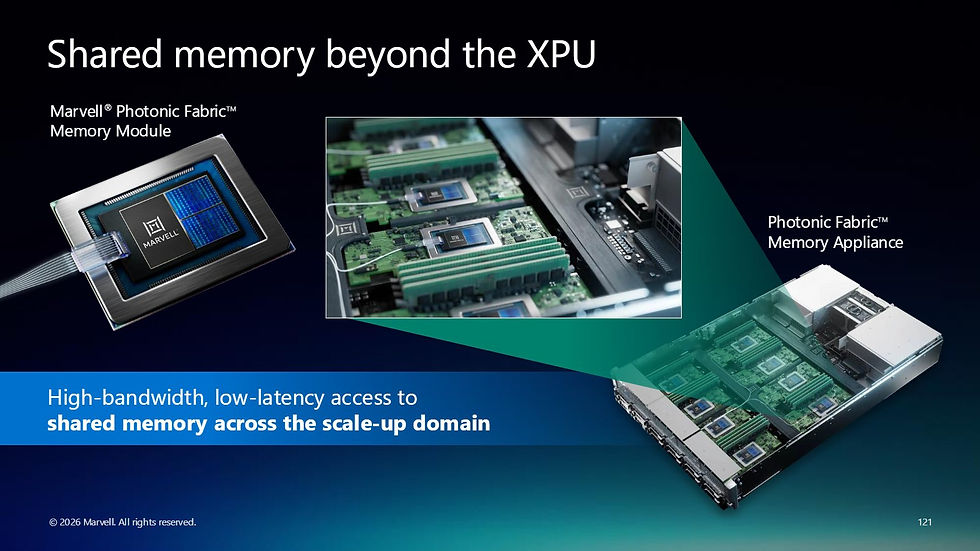
The product line has three tiers: drivers and TIAs for module makers; 200G-to-400G/lane fast pipe light engines (DSP plus MZI silicon photonics); and flat pipe engines built for scale-up, which drop the DSP for analog equalization (including an OCI MSA standard version and Celestial's Photonic Fabric). All three have won sockets. For background, see Celestial AI Explained: The $3.25B Marvell Paid to Put Light Inside the Chip.
The most important signal was Matt's stance on NPO vs. CPO: not a relay from NPO to CPO, but both in parallel. NPO is "a train that will definitely run," built on light engines module makers already have ready; CPO is advancing in parallel on specific platforms at some customers. That matches our view in NPO Is Not CPO's Appetizer: serviceability and yield are becoming architecture choices, not transitional compromises.

4. The Other Three Engines: Switching, DCI and XPU Attach
Switching: scale-out switching passes $1B next year (the first full year of 51.2T), and the newly announced Teralynx T100 is the industry's only single-chip 100T switch, fitting 512 200G SerDes into a reticle-size die with about 20% lower latency and power than competitors. Scale-up switches support UALink (U115/U230/U460), Ethernet (E115/230/460) and NVLink Fusion: a bet on all three protocols, which means not betting on the standards war at all.
DCI (scale-across): revenue goes from about $0.5B in FY26 to more than $1B in FY28; global demand for coherent pluggables rises from under 1 million units this year to more than 3 million by CY30. Direct links between AI clusters across buildings carry 15x the bandwidth of traditional DCI.
Custom: the FY29 target was raised from >$10B to >$12B, and the FY31 midpoint is about $30B, split evenly between XPU and XPU attach. XPU attach (custom NICs, CXL memory expansion, SSD controllers, new AI infrastructure management processors, inference accelerators) carries an ASP of about $1,000 per socket, with one or two per XPU. Google's 6.5-year, $120B TPU-adjacent opportunity is only "partially" included in the FY31 model.
5. The Bear Case: Where This Blueprint Is Most Likely to Break
Capex assumptions: the model assumes data center capex compounds at 35% from 2025 to 2030, slowing to about 20% at the tail. If AI spending enters a real digestion phase after 2028, the $90B upper end disappears first.
Customer concentration: the top four US hyperscalers support most of the target. Marvell stresses "hundreds of products and more than 35 sockets," but the end budgets still come from the same handful of buyers.
Scale-up optics starts from zero: it is the biggest upside and the biggest uncertainty. If ramps stall on laser reliability, fiber-coupling yield or liquid-cooling integration, a one-year delay wipes out billions in revenue.
Margin structure: FY31 gross margin is guided at 56–59%, and Custom outperforming would pull margin toward the low end. Management calls this a "natural hedge," but it also means revenue and margin will not look great at the same time.
6. What It Means for Taiwan's Supply Chain
The blueprint sends Taiwan three direct signals:
Process and packaging: Marvell already ships 1.6T DSPs on 3nm, has shown 3.2T on 2nm, and has taped out IP on 1.4nm. XPU and switch substrates are going from 100mm to 150mm per side, and 3.5D stacking and CPO will both draw on advanced packaging capacity at TSMC, ASE and others, raising area and layer-count pressure on ABF substrates.
Light sources and coupling: NPO going first means demand for external lasers, CW light sources and FAU fiber coupling does not have to wait for CPO to mature. A meaningful share of the thousands of dollars of scale-up optical content per XPU is light sources and passive coupling parts, the best entry point for Taiwan's compound semiconductor and passive optics makers. For the technology paths, see Seven Paths for Scale-Up Optical Interconnect.
A long-term option in scale-in: Xi Wang described using microLED/microPixel for in-package optical I/O chiplets. Management acknowledged it will not be meaningful revenue before FY31, but a full team and customer projects are in place. If this path works, the winners are Taiwan's microLED epitaxy and mass-transfer supply chain, not traditional lasers.
7. Conclusion
The most valuable thing about this Investor Day was not the $80B number, but how Marvell concentrated the uncertainty in one place: scale-up optics. Scale-out follows the 1.6T/3.2T cadence, DCI follows cross-building bandwidth, and Custom already has sockets in hand, so all three are fairly predictable. What really decides whether Marvell lands at $70B or $90B is how fast copper turns into optics inside the rack.
Three things to track next: first, whether scale-up optics really starts at "hundreds of millions of dollars" next year as management says; second, when Teralynx T100 and UALink U115 reach volume at the first hyperscaler; third, NPO light-engine shipments at module makers, the earliest signal Taiwan's supply chain will see.
Compute decides how fast AI can think; connectivity decides how big AI can grow. Marvell just bet the whole company on the latter.
This article is for technology and industry trend analysis only and does not constitute investment advice.
Related Reading
Earnings Call Highlights: Marvell (MRVL) | Q2 FY2027: the original breakdown of the $18B FY28 guide and the Google warrant
Celestial AI Explained: where flat pipe and Photonic Fabric come from


Comments