


NPO Is Not CPO's Appetizer: China Treats Serviceability and Yield as Architecture Choices - Where Does Taiwan Fit In?
CPO is the endgame and NPO is a stopgap; once packaging matures and yields climb, the optical engine will move inside the ASIC package.
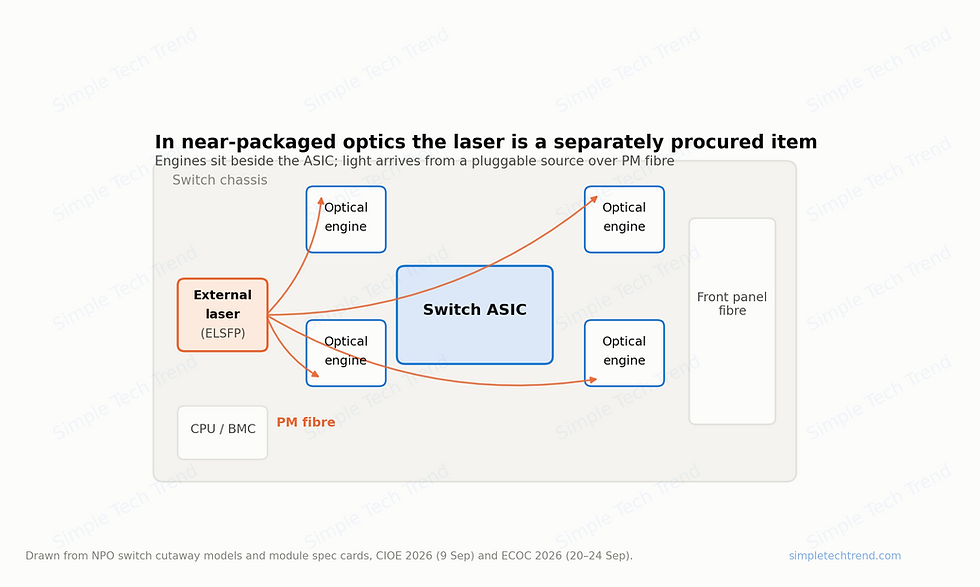
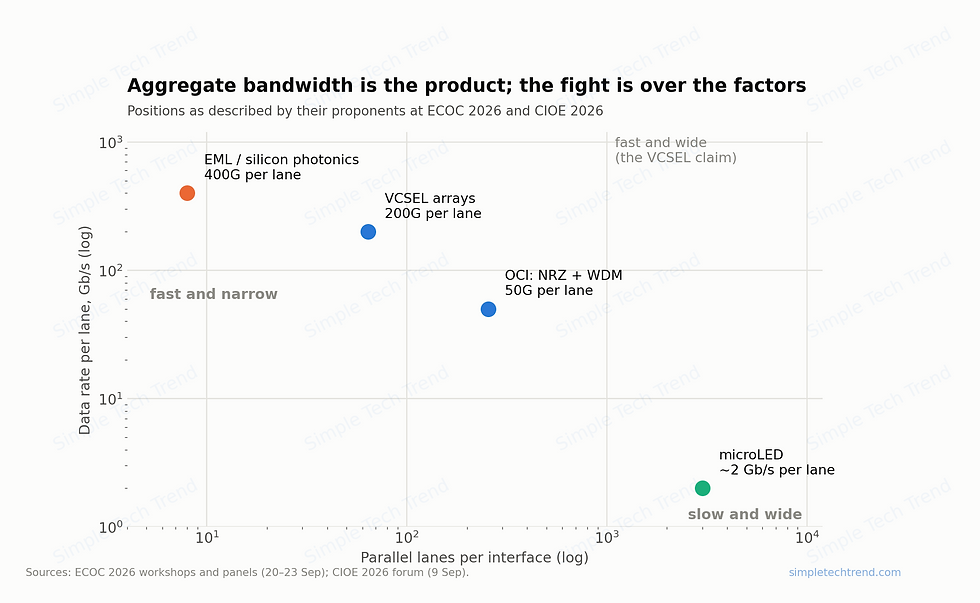
The entire 芯·光論壇 at CIOE 2026 was spent taking that narrative apart. Huawei said flatly, "we firmly believe NPO is a hop that has to happen," and the reason is not technical preference but industrial reality: without access to advanced process nodes, compute has to be stacked up with supernodes, and connecting thousands of chips is more than electrical links can handle - optics is the only way. Tencent pushed the question from "can NPO be built" to "can it be deployed," and gave a timeline: deploying a 512-card NPO supernode between the end of this year and early next year. On the show-floor spec cards, the 3.2T module runs 100G/lane at <23 W, and the 6.4T module runs 200G/lane at <28 W, both listed at 1310 nm; on an NPO switch teardown model, the External Light Source is a separately labeled zone. Three weeks later at ECOC, Huawei defended NPO across four dimensions and said publicly that yield drops to 3x% once optical engines are co-packaged; the live audience poll found that, three years from now, optics is most likely to land in NPO, with CPO second.
What this means is not about US-China competition but about architecture: separable architectures create component markets.
Premium Section Contents
The full chain of reasoning: lacking process nodes → stacking supernodes → optics as the only option → open decoupling becomes a must
Five dimensions - power, yield, serviceability, ecosystem, timeline: which one CPO wins and which four NPO wins
Channels, power and wavelengths of the 3.2T / 6.4T / 7.2T modules, and three implications for light-source suppliers
LGA compression, PCB warpage, port-to-port drive variation - these are system problems, not module problems
What it tells us that the same OE shows a two-to-three order-of-magnitude BER gap between domestic Chinese and overseas systems
The CPO camp's strongest reliability data, and what it ends up proving instead
Taiwan's supply chain: which segments it can get into, and which it cannot
Eight counterarguments (including the full case from the only company on site arguing the other side), and six signals to watch
The above is a summary of this article's key points.
STT's full analysis - why this is happening, and which segment Taiwanese suppliers can actually capture - is covered in depth in the premium section, with 3 original charts.
👉 Subscribe to the STT premium section and read the full analysis on vocus (in Chinese): https://vocus.cc/article/6ab4ed7dfd8978000167efe5


Comments