


ECOC 2026 | Huawei Scores CPO vs NPO and NPO Leads 4:2 - But the Real Signal Is That "Serviceability" Now Ranks Ahead of "Power Savings"
Huawei's Pan Cao did something at the ECOC 2026 Market Focus that few in the industry are willing to do in public: score Near-Packaged Optics (NPO) and Co-Packaged Optics (CPO) item by item across five dimensions. The result: NPO wins on serviceability, yield, ecosystem and packaging maturity, while CPO leads only on power and density. But what this article really wants to highlight is not the score - it is the ranking. With supernode scale set to hit 4,096 accelerators in 2027, "can it be swapped when it fails" is placed ahead of "how many pJ per bit it saves" for the first time. This is an operating-cost judgment, not a physical-performance judgment.
1. Start with the Driver: Model Parameters Keep Pushing Cluster Scale Up
The speaker did not start with technical definitions, but with a parameter curve.
2024 brought LLaMA 3 at 70B, then DeepSeek V2 at 236B and LLaMA 3.1 at 405B; 2025 jumped to DeepSeek V3 at 671B; 2026 has KIMI K2 at 1T, LLaMA 4 Behemoth at 2T and DeepSeek V4-Pro at 1.6T; by 2027, KIMI K3 is at 2.8T, and the estimate for GPT-6 is marked at 5T or more.
As parameters keep climbing, the unit that carries compute is forced to jump up too: from a single die, to chiplets, to a single rack, to multiple racks, and finally to large-scale cluster networks. Every step up this path trades "electrons" for "photons."

2. Supernodes Are the Real Premise of This Debate
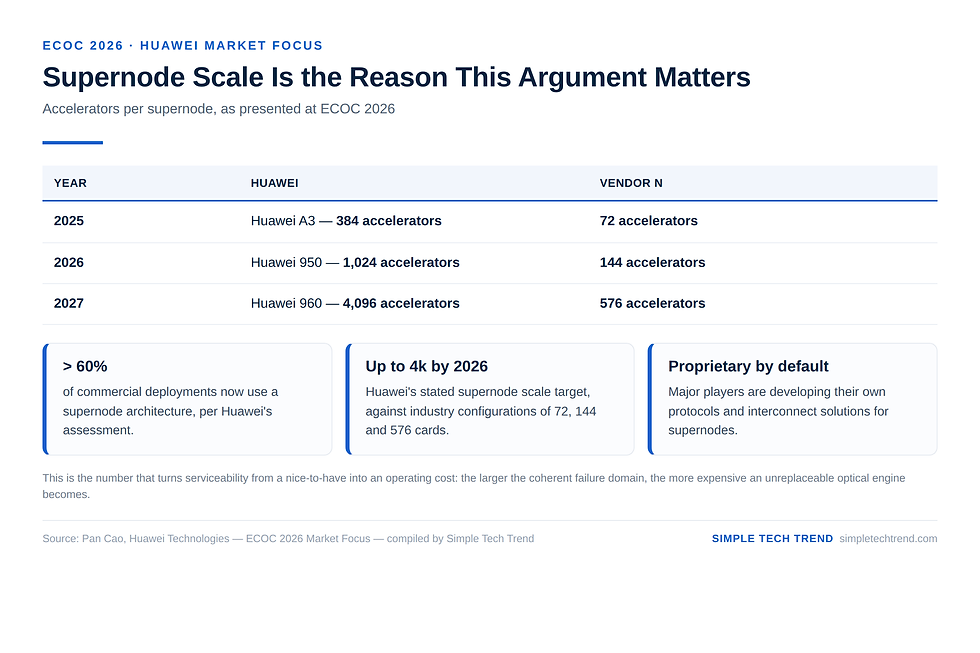
What truly forces the issue is the supernode scale curve, and the numbers on this slide are very concrete:
2025: Huawei A3 has 384 accelerators; another industry vendor (labeled Vendor N on the slide) has 72
2026: Huawei 950 has 1,024; Vendor N has 144
2027: Huawei 960 has 4,096; Vendor N has 576
The slide offers three further judgments: supernode architectures already account for more than 60% of commercial deployments; the industry already has 72-, 144- and 576-card configurations, while Huawei aims for the 4k class in 2026; and all major players are developing their own protocols and interconnect schemes for supernodes.
Stack those three statements and they add up to one thing: the bigger the supernode, the larger the blast radius of a single point of failure. That is why "serviceability" ends up ranked first later on.
3. Why Optics Must Move Inward from the Front Panel
Next comes the chart that compresses the whole evolution into one view: on the left, electrical signaling moves from 25G NRZ, 50G PAM4 and 100G PAM4 to 200G PAM4, with a question mark hanging over 448G; on the right, form factors move from QSFP, QSFP-DD and OSFP to OSFP-DD, with rates going from 200G (4×50G), 400G (8×50G) and 800G (8×100G) to 1.6T (8×200G).
The key is distance. In the speaker's words: at 200G/lane, electrical signals over copper are left with roughly one meter of reach; at 400G/lane it gets even shorter. This means the territory optics must cover is not just extending outward, but eroding inward across the board - in-rack interconnects once handled by DAC and ACC are starting to become optics' turf.
So on-board optical engines split into two paths:
NPO: the optical engine moves from the front panel onto the PCB, next to the ASIC. The slide lists 32 / 36 lanes, with players Huawei, Alibaba and Tencent.
CPO: the optical engine moves further in, onto the substrate. Lane counts are 16 / 32 / 64 lanes, with players NVIDIA and Broadcom.
This slide is itself a map of the camps. The East-West split in roadmaps is not about anyone being technologically behind - it reflects different judgments about "when to give up serviceability."
What does moving inward buy? Three hard numbers:
RF loss: about 20 dB → about 7-13 dB
Power: 15-18 pJ/bit → 3-6 pJ/bit
Bandwidth density: about 50 Gb/s/mm → 400-1000 Gb/s/mm
Power cut to roughly a third and bandwidth density up by an order of magnitude - that is why the entire industry is willing to give up the luxury of "front-panel pluggability."

4. Scoring Five Dimensions Item by Item: NPO 4, CPO 2
The most valuable part of the talk is that it breaks the never-ending "is NPO or CPO better" argument into five engineering questions that can be judged separately.
Serviceability - what can be replaced when something fails in the field? NPO's three attributes are stated plainly: modular design, relatively independent; socket connection, removable; a failed optical engine can be replaced directly. The CPO side has just two terms: integrated, tightly coupled - plus "larger failure impact." The speaker put up Winner 1:0 right on this slide. The demo product is StarMatrix's Hi-ONE 7.2T NPO optical engine, which the speaker described as the highest-bandwidth NPO available today.
Yield. NPO optical engines can be tested and replaced independently; CPO package yield is the product of optical engine yield and ASIC yield - a single bad optical engine scraps the entire package, including that most expensive ASIC. NPO wins this one.
Ecosystem - who can make deployment faster? NPO: open interfaces, standards support, multiple vendors, a robust supply chain. CPO: a closed ecosystem, only a few players can get in, and the ASIC and optical engine must be co-designed. The slide concludes: "NPO: Broader standards support. Multi-vendor, decoupled ecosystem."
Packaging - is the technology ready for volume production? NPO: mature technology, mostly already proven in pluggable modules; optical engines sit on the PCB around the ASIC with ample room. CPO: larger substrates, the thermal challenge of optical engines sitting right next to a hot ASIC, and an extremely tight RF pitch. The conclusion: "NPO: Easier to engineer for thermal management, I/O, and flexibility."
Power & Integration - how much integration do we really need? This is CPO's only win, but also its hardest one. CPO: millimeter-scale traces, higher density, and low power earned through system-level co-design. NPO: centimeter-scale RF paths bring higher RF loss and additional RF degradation, and the optical engines take up relatively more area. The conclusion: "CPO: Relatively higher density and lower power per bit."
The final Key Takeaways nail down the score: NPO is the near-term choice (better serviceability, high manufacturing yield, a multi-vendor ecosystem, mature packaging); CPO challenges remain (though it keeps two advantages: lower power and higher density). The closing line of the talk:
Winning the Near Term with NPO, Shaping a Coexisting Future.

5. Where This Scorecard Should Be Discounted
To be fair: this is Huawei's scorecard, and Huawei is in the NPO camp.
The slide itself spells it out: the NPO 32/36-lane camp is Huawei, Alibaba and Tencent; the CPO 16/32/64-lane camp is NVIDIA and Broadcom. Four of the five dimensions (serviceability, yield, ecosystem, packaging maturity) are natural home turf for an "incremental approach," while the one dimension that belongs to the "aggressive approach" - power and density - is listed last. The choice of dimensions is itself a position.
Two other points worth noting:
First, "near term" is never defined. NPO is the near-term choice, but whether near term means 18 months or 5 years leads to completely different investment decisions. The talk gave no timeline.
Second, the coexistence assumption has conditions. "Shaping a Coexisting Future" sounds safe, but coexistence only holds if the power-budget gap between the scale-up and scale-out domains is large enough to justify sustaining two supply chains. If CPO's yield and serviceability are solved within two years, coexistence will collapse into a single path. Broadcom is already moving on this - we previously took apart CPO's third-generation report card: Broadcom switches its pitch from "saves power" to "doesn't break", which is exactly the CPO camp shoring up its weakest cell on this scorecard.
6. Conclusion
Put Huawei's talk back into the broader ECOC 2026 context and it fills in an important piece of the puzzle: the CPO vs NPO contest has shifted from "which technology is more advanced" down to "which technology can ship reliably first."
For Taiwan's supply chain, there are three concrete takeaways:
First, NPO's opportunity lies in "the optical engine as an independently tradable component." This is NPO's biggest structural difference from CPO - decoupling the optical engine from the ASIC means it can be designed, tested and sold on its own. StarMatrix's Hi-ONE 7.2T is exactly that shape. Vendors making optical engines, OSAs, optical coupling and FAUs form a layer with independent bargaining power on the NPO path; on the fully integrated CPO path, that bargaining power gets absorbed by packaging houses and ASIC vendors. For related progress at the spec level, see Tearing down Open CPX 1.0: CPO finally gets a standard socket.
Second, betting on "serviceability" is a business in itself. Sockets, removable connections, field replacement - behind those three terms are connectors, alignment mechanisms and repeatably mateable optical interfaces. When supernodes reach 4,096 accelerators, the value of serviceability is not an engineering preference but an operating cost. This is a market almost ignored in the CPO narrative, yet ranked first in the NPO narrative.
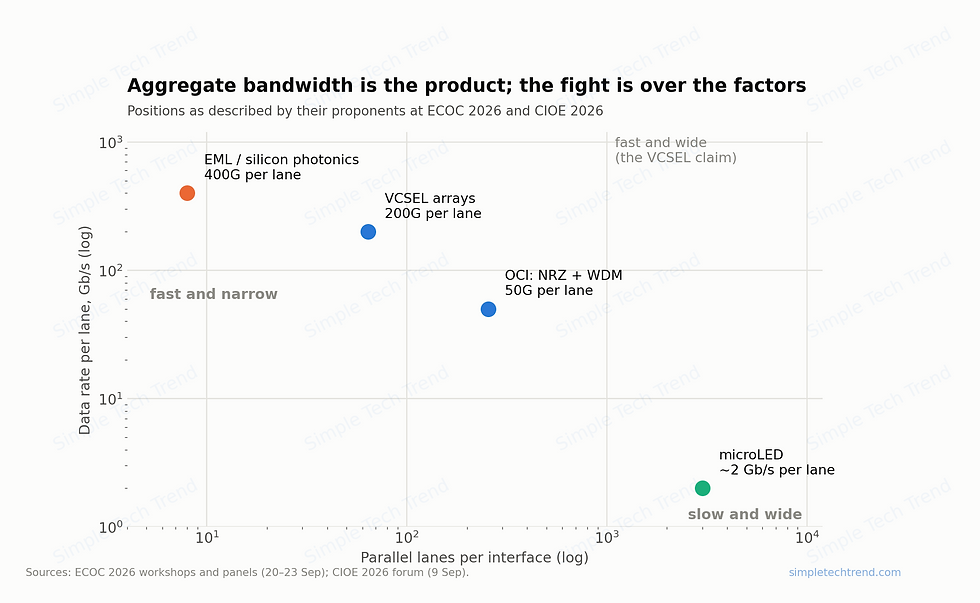
Third, track the 448G question mark. After 200G PAM4, the slide marks "448G?". If 448G/lane materializes, the usable reach of electrical signals over copper will shrink again, forcing a larger share of in-rack interconnect onto optics, and both NPO and CPO benefit; if 448G stalls, the life cycle of 200G/lane gets extended, and the "near term" in NPO's "near-term choice" becomes very long. This is the same thread we discussed in ECOC 2026 | Fast-and-narrow vs. slow-and-wide argued for three hours, and nobody defined "slow" first.
Verdict: This is not a CPO vs NPO technology-roadmap war, but a timing bet of "integration speed" against "supply-chain resilience." Huawei's answer: ship the current generation with NPO first, then let the two coexist. That answer is actually good news for Taiwan's supply chain - because it leaves a layer of components that can compete independently.
This article is for technology and industry trend analysis only and does not constitute investment advice.
Related Reading
Standing in the Light: All eleven sessions of the CIOE 2026 芯·光論壇 decoded - why NPO is no longer a transitional solution: the Chinese camp's complete narrative on NPO positioning, a counterpoint to this talk
2026 OCP APAC Summit | CPO / NPO / XPO three-way panel: not a roadmap war, but the 409.6T bottleneck 18 months out: another way to break down the same set of trade-offs, from the OCP stage


Comments