


ECOC 2026 | Single-Vendor CPO's Real Risk Is Selling the ASIC and Interconnect as One Product: Ciena's Open CPX Turns the 6.4T Optical Engine Back into an Off-the-Shelf Part
: Ciena's Karen Liu showed no new performance records in this talk, but she moved the CPO debate from technology to business structure. Her three-column paradigm-shift slide made it clearest: going from "ASIC with front-panel retimed optics" to "single-vendor co-packaged optics," the technology row improves from second-best to best (retimers removed, power down), but the supply chain row slides from "efficient" to "at risk," with a single line of explanation: the ASIC and interconnect are sold as one unit, reducing buyer power and narrowing the supply chain. The third column, the "open ecosystem," exists to get the best technology and an efficient supply chain at the same time, and its vehicle is the Open CPX MSA: six founding members, 50+ contributors, and under six months from formation to published spec. The key design choice in the spec: CPO/NPO optics and co-packaged copper plug into the same PCB socket.
1. Twenty-five years of pluggables gave two answers that hold at once
The speaker opened with a "what has worked so far" slide, and the point lies in reading its two charts side by side.
Left chart: SFP, QSFP and OSFP versions vs. year, drawn from 2001 through 2027: SFP → SFP+ → SFP28 → SFP56/112 → SFP112; QSFP → QSFP+ → QSFP28 → QSFP-DD; OSFP 1.0 → 3.0 → 4.0 → 5.x. Stack the three lines and you get more than twenty years of uninterrupted spec iteration.
Right chart: front-panel pluggable optics ports shipped (LightCounting "Ethernet Optics Forecast," March 2026), climbing from near zero in 2018 to about 85 million ports in 2026. Two annotations sit on the chart: around 2023 was "high agility," and 2024 through 2026 was "high volume."
The conclusion underneath is a single line: twenty years of innovation, and a scale-up in volume.
The chart answers an objection. The speaker said she expected a third of the room to think "it's too early to talk about standardization," and her reply was: standardization does not mean innovation stops. The version-evolution line is the evidence: behind every later version is a large body of engineering work completed jointly by many teams, and it is exactly that focus that let innovation keep pace with what the industry needed.
2. The three-column paradigm shift: the risk sits in the supply chain row
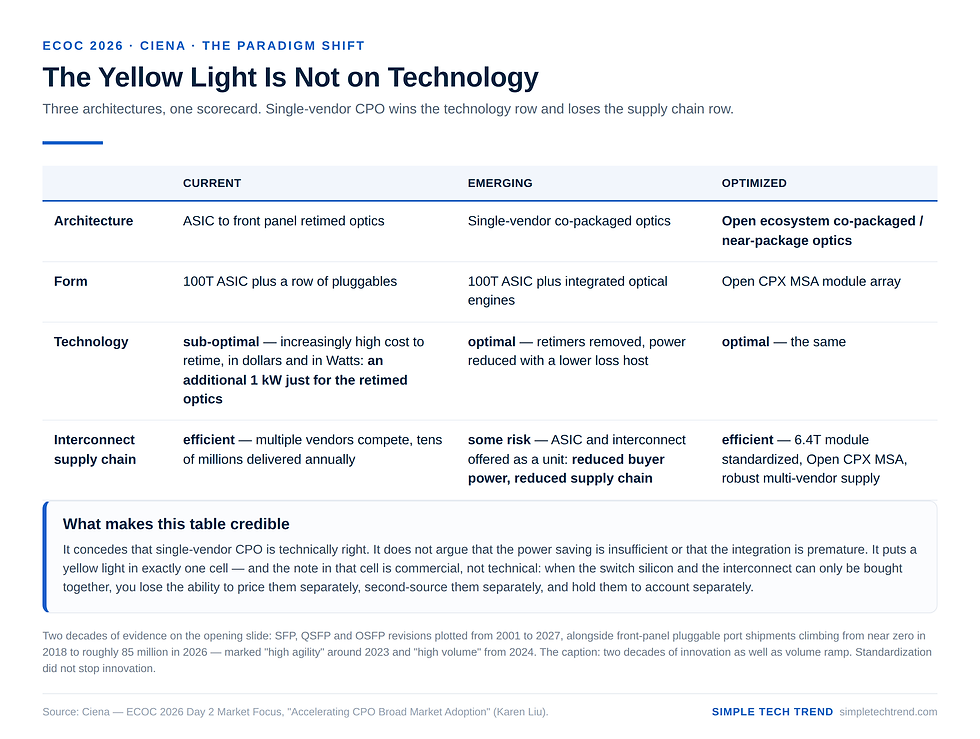
This is the most important slide of the talk, because it scores three architectures side by side against the same criteria.
Architecture: Current: ASIC with front-panel retimed optics; Emerging: single-vendor co-packaged optics; Optimized: open-ecosystem co-packaged / near-packaged optics
Form: Current: 100T ASIC + a row of pluggable modules; Emerging: 100T ASIC + integrated optical engines; Optimized: Open CPX MSA module array
Technology: Current: second-best — retiming is getting ever more expensive in both dollars and watts; retimed optics alone add 1 kW; Emerging: best — removing retimers and lowering host loss cuts power; Optimized: best — same as above
Interconnect supply chain: Current: efficient — multiple competing suppliers delivering tens of millions of units a year; Emerging: at risk — the ASIC and interconnect are sold as one unit, reducing buyer power and narrowing the supply chain; Optimized: efficient — standardized 6.4T modules, the Open CPX MSA, and a robust multi-vendor supply
The most valuable thing about this table is that it concedes single-vendor CPO is right on the technology. It doesn't say CPO is bad or that the power savings fall short; it only puts a yellow light in the supply chain cell, with a remarkably restrained note: ASIC and interconnect sold as a unit, reduced buyer power, reduced supply chain.
In plain industry terms: when the switch chip and the optical interconnect can only be bought together, you lose the ability to negotiate separately, switch suppliers separately, and hold each accountable for quality separately. And the "extra 1 kW" figure explains why the current column can't stay either: the cost of retiming has grown large enough to force an architecture change.
3. Four inflection points happening at once
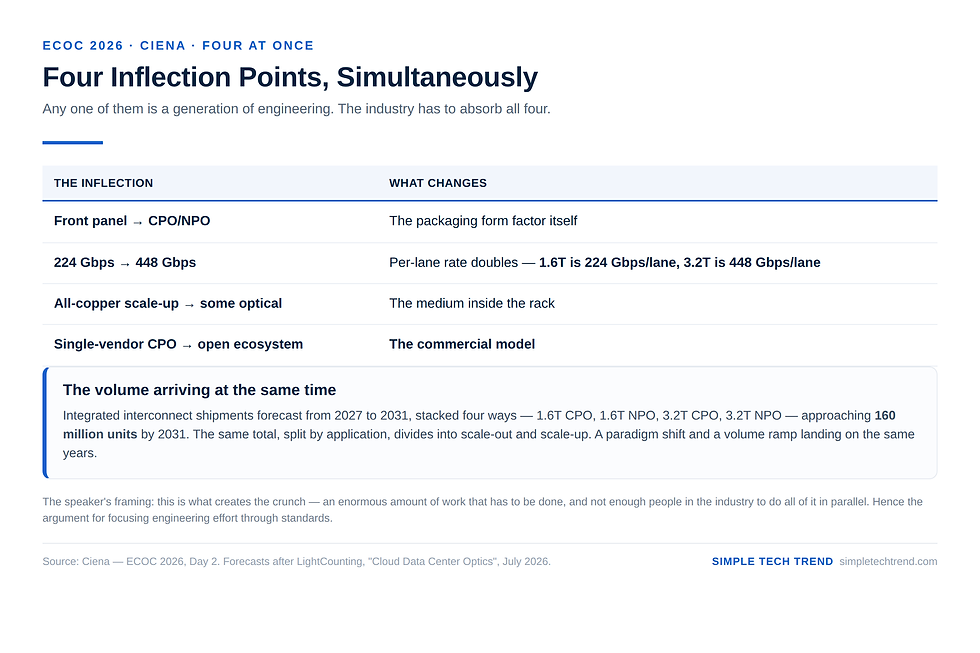
The second chart is about difficulty: two forecasts from LightCounting's "Cloud Data Center Optics" (July 2026), both spanning 2027 to 2031:
By speed and packaging: 1.6T CPO, 1.6T NPO, 3.2T CPO and 3.2T NPO stacked in four layers, approaching by 2031 a total of 160 million units
By application: scale-out and scale-up in two layers, same total
The chart carries a handy conversion: 1.6T = 224 Gbps/lane; 3.2T = 448 Gbps/lane.
The four "Inflection Points" boxes underneath are what the slide is really about:
Front panel → CPO/NPO | 224 Gbps → 448 Gbps | all-copper scale-up → partly optical | single-vendor CPO → open ecosystem
All four are happening at once. The packaging form is changing, per-lane speed is doubling, the scale-up medium is changing, and the business model is changing too. Any one of these alone is a generation's worth of work, and the industry has to swallow all four together.
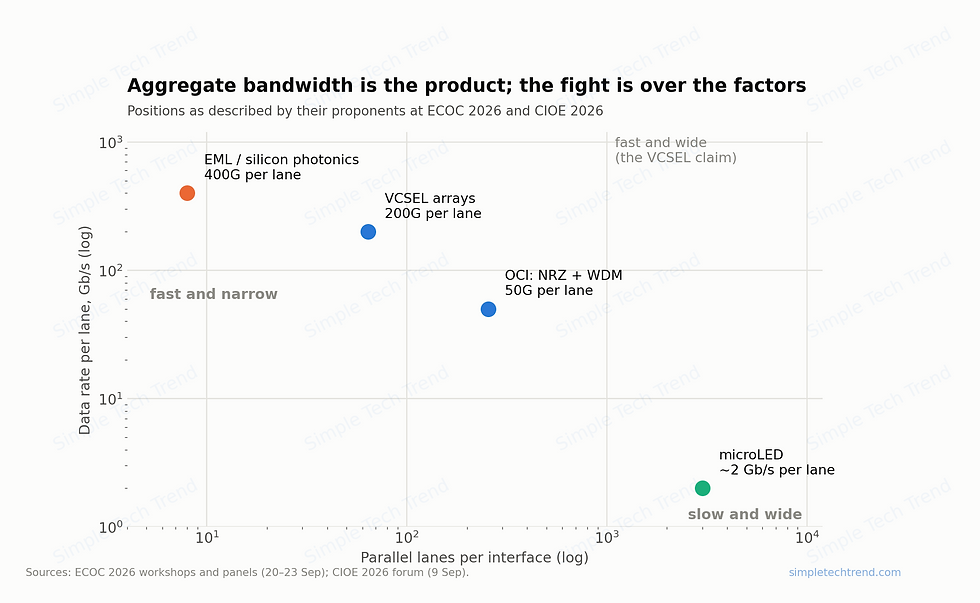
The speaker put it bluntly: this creates a squeeze in which "a huge amount of work has to get done." Why the 448G inflection is the starting point of every architecture decision is broken down in full in ECOC 2026 | Three hours of fast-narrow vs. slow-wide, and nobody defined "slow" first: the real watershed is 448G.
4. Three things to preserve, and what suppliers themselves get
Ciena states its goal for the NPO transition plainly: preserve the three benefits of pluggables through the transition:
Interoperable
Pay-as-you-grow
Serviceable
Then she added a footnote, and that footnote is the turning point of the whole argument: these three oft-cited benefits accrue to end customers (hyperscalers) and to some extent integrators (system OEMs); but the MSA-based pluggable model also benefits the technology suppliers themselves.
This was aimed at the component makers in the room. Suppliers' traditional instinct about standardization is that it is good for customers and bad for them, since it hands customers leverage to compare prices and switch vendors. Her rebuttal had three points:
Engineering efficiency: under this wave of innovation pressure, engineering resources must be focused. Ten companies don't each need to work out how to build a QSFP cage or housing. That isn't the important technology; the mechanicals should be locked down and reused, the supply chain already knows how to make them, and you just buy them. This is the "commercial off-the-shelf (COTS)" idea other industries talk about. Spend engineering effort on what is genuinely new.
Cumulative shared learning: a competitor won't tell you its best practices just because you ask; but if you are reviewing documents together in the same MSA, that's more eyes on the problem: more chances to catch mistakes, more chances for someone to say "this is good, but could we change this part?" Many of the changes that made pluggables succeed were small things like "round this corner a bit more," but small things often take a lot of effort to discover. At today's scale, the industry can't afford the time cost of finding them one by one through trial and error.
Shared supply chain scale: use standardization to leverage the operational strength of the whole industry, and operational efficiency brings economies of scale.
She condensed the three points into one causal chain: many companies reviewing together → high quality → faster time to market.
5. Open CPX MSA: six founders, 50+ contributors, under six months
The argument lands as an organization.
The pluggable, standards-based Open CPX delivers the benefits of CPO/NPO while preserving the key attributes of front-panel pluggables.
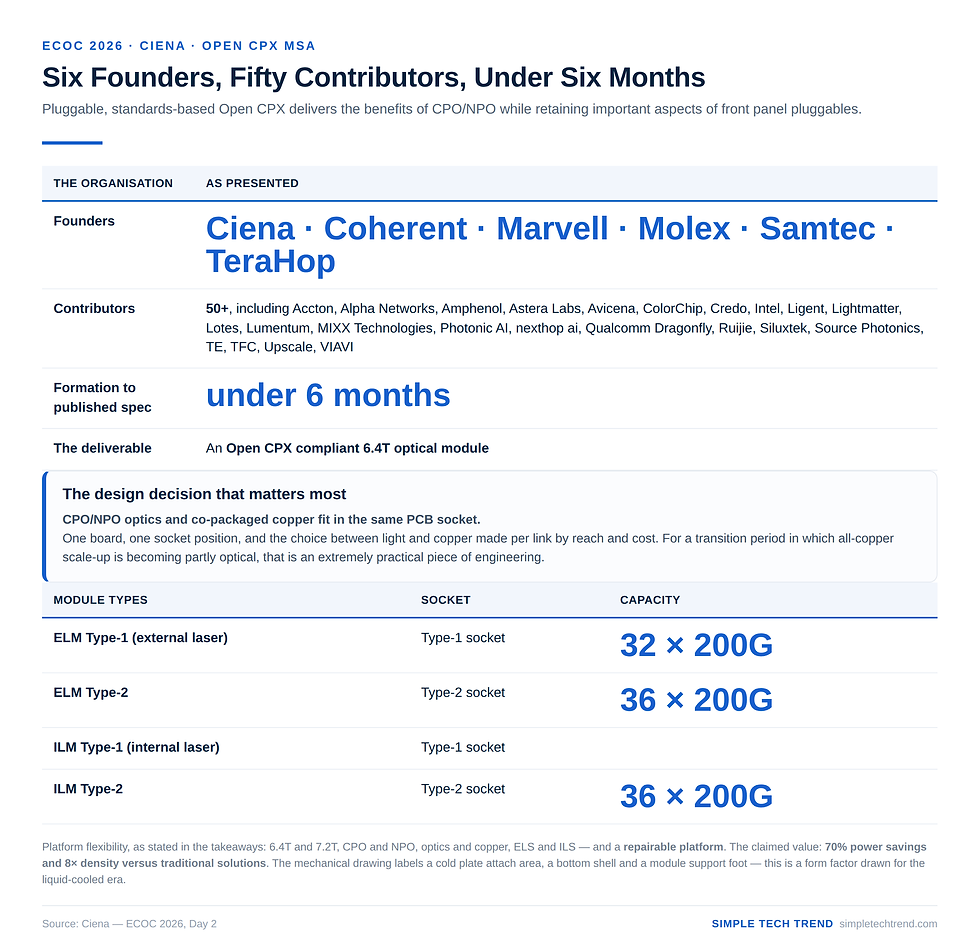
Six founding members: Ciena, Coherent, Marvell, Molex, Samtec, TeraHop.
50+ contributors; those listed on the slide include Accton, Alpha Networks, Amphenol, Astera Labs, Avicena, ColorChip, Credo, Intel, Ligent, Lightmatter, Lotes, Lumentum, MIXX Technologies, Photonic AI, nexthop ai, Qualcomm Dragonfly, Ruijie, Siluxtek, Source Photonics, TE, TFC, Upscale and VIAVI.
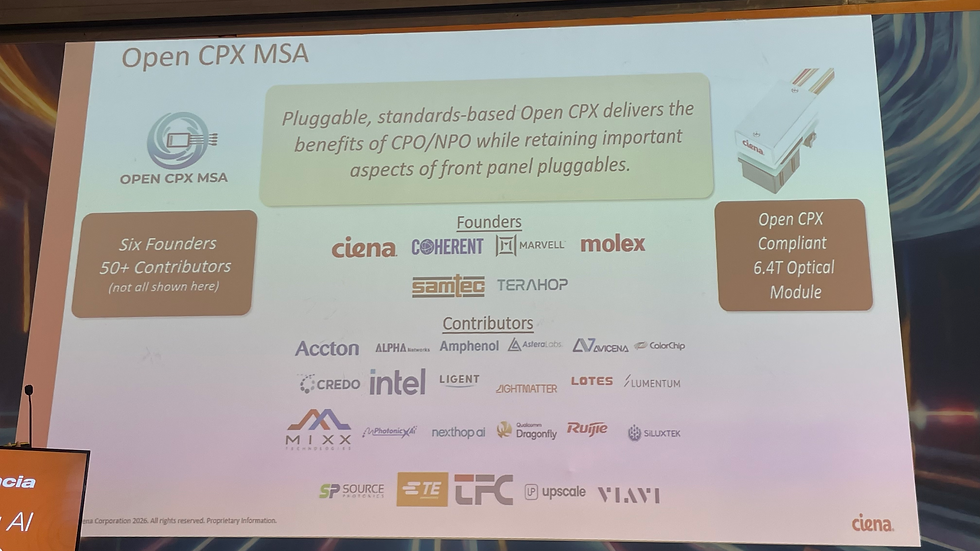
The number the speaker emphasized: from formation to published spec in under six months, which she believes is probably an industry record.
Taiwanese suppliers should read this list line by line. Accton, Alpha Networks, Lotes and TFC are all on the contributor list, which means Taiwan has already secured a place in the definition phase of this ecosystem in two segments, ODM and connectors/sockets, rather than waiting for the spec to come out before taking orders. Qualcomm Dragonfly's presence is also worth noting: at the same show it also appeared on the partner list for Lumentum's chiplet demo.
6. What the spec looks like: one socket for both optics and copper
The technical spec page has just one key sentence, but it is a clever piece of design:
CPO/NPO optics and co-packaged copper fit the same PCB socket.
This means system vendors can decide, on the same mainboard and in the same socket position, whether to plug in optics or copper based on reach and cost, without drawing two boards for two media. For a transition period in which "all-copper scale-up is partly moving to optics," this is a very practical design.
Module types are defined in a two-dimensional table:
ELM (external laser module) and ILM (internal laser module) each come in Type-1 and Type-2
Type-1 sockets take ELM Type-1 and ILM Type-1; Type-2 sockets take ELM Type-2 and ILM Type-2
Capacity: Type 1 ELM is 32 × 200G; Type 2 ELM is 36 × 200G; Type 2 ILM is 36 × 200G
Details on the mechanical drawing also reveal that it was designed for the liquid-cooling era: cold plate attach area, bottom housing, module support legs, Type-2 CPX socket.
On the takeaway slide, platform flexibility is summed up in one line: 6.4T/7.2T, CPO/NPO, optics/copper, ELS/ILS, and a serviceable platform.
"Serviceable" is the political stance of the whole spec. It amounts to saying: we don't accept that a failed optical engine means replacing the whole switch. And the quantified value proposition: 70% power savings and 8x density versus conventional solutions.
7. Vesta 200: reuse existing standards to cut time to market
This section is a concrete demonstration of "don't reinvent the wheel." The slide title says it outright: "Open CPX MSA shortens time to market by reusing existing standards":
Host interface options: CEI-224G-LINEAR-PAM4, OIF 224G-RTLR, 802.3dj C2M
Line-side optics: 802.3dj – DR, 1310 nm parallel single-mode
Optical connectors: GR-468-CORE, GR-1435-CORE
The speaker added that the control plane largely reuses existing pluggable management specs, with some additions for the higher channel count. Optical standards are unchanged, and optical connectors are unchanged.
Ciena's own product, Vesta 200, a 6.4T CPX optical engine, is a sample of this philosophy:
PIC (photonic integrated circuit): silicon photonics. Mach-Zehnder modulators: high thermal stability and narrow geometry for density; photodetectors: high responsivity
EIC (electronic integrated circuit): silicon germanium (SiGe). TIA: low noise, high transimpedance gain; laser driver: high bandwidth, low return loss; electrical interface: equalization up to 20 dB
Host interconnect: substrate (CPO) or PCB (NPO)
Two details are worth Taiwanese suppliers' attention. First, the EIC is SiGe, not leading-edge CMOS, which is what "reuse mature technology" means in practice. Second, the electrical interface can equalize up to 20 dB. That number directly determines how far the module can sit from the ASIC, and therefore where the line between CPO and NPO is actually drawn.
8. Conclusion
First, a position that wasn't emphasized in this talk but that I think matters: the speaker deliberately did not distinguish between CPO and NPO. Her reasoning was that "CPO and NPO are a continuum," and the industry's definitions of the two terms have since exploded: some split them by "pre-integrated or not, closed ecosystem or not," some by "density of the electrical interface," and some by whether it sits directly on the mainboard, goes on the package, or needs an interposer. During Q&A someone offered a good analogy: Ethernet's physical layer has kept changing for forty years, yet the word "Ethernet" has not gone away.
For Taiwan's supply chain, three takeaways.
First, the contributor list is an opportunity list, and the door is already open. Accton, Alpha Networks, Lotes and TFC are already in. Open CPX explicitly defines mechanicals, sockets, thermal interfaces and management as the parts that "should be reused, not reinvented," and that is exactly where Taiwanese suppliers are strongest. The speaker herself said "ten companies don't each need to figure out how to build a cage"; the flip side of that line is: whoever builds the cages, sockets and cold-plate attach structures will, thanks to standardization, get the volume of the whole ecosystem rather than a single customer's.
Second, "serviceable" will become a hard requirement, and it is a mechanical problem, not an optical one. When the spec explicitly writes repairable into its takeaway, and the NPO trade-off is defined as "front-panel serviceable or open the chassis" (the exact wording on Acacia's seven-step ladder chart at the same show), serviceability turns from an operations complaint into a design specification. Whoever can build mechanics that "can be removed and replaced while still guaranteeing thermal contact and optical alignment afterward" has an opening.
Third, don't just watch whose optical engine performs best; watch whose bargaining position is deteriorating. The real signal from this talk: the industry now realizes the problem with single-vendor CPO is not power, but that the ASIC and interconnect are bundled into one product. If Open CPX succeeds, optical engines become off-the-shelf parts and value shifts toward "who can reliably deliver compliant modules in volume"; if it fails, switch-chip vendors will swallow the optical interconnect segment as well. These two outcomes mean opposite things for Taiwanese suppliers, and it is not yet decided, so taking part in the definition pays better than waiting on the sidelines.
Verdict: this talk set no new technical records, but it was the clearest read on business structure at this entire ECOC. It concedes that single-vendor CPO is right on technology, then points at the supply chain cell and says: this is where the problem is. And its answer is not a better component, but a spec produced in under six months and a socket that lets optics and copper share the same slot. When an industry starts locking down its mechanicals before the technology is settled, that isn't conservatism; it means it already knows it has no time to waste.
This article is for technology and industry trend analysis only and does not constitute investment advice.
Related Reading
ECOC 2026 | Three hours of fast-narrow vs. slow-wide, and nobody defined "slow" first: the real watershed is 448G: why the 224G-to-448G inflection forces changes in both packaging form and business model
After copper can't keep up with AI: seven paths for scale-up optical interconnect, and two ways to live with the bottleneck each one hits: seven possible routes for the "all-copper scale-up moving partly to optics" inflection
ECOC 2026 | Data centers need billions of lasers, yet the bottleneck is the 5 minutes it takes to "attach" them: why "locking down mechanicals for reuse" matters so much for capacity


Comments