


IPEC Webinar - From the CPO Vision to the NPO Reality: Technology Paths and Industry Dynamics of Near-Packaged Optics in AI Compute Clusters - Tencent, Alibaba, Ranovus, Coherent, Ciena, Huawei
Introduction
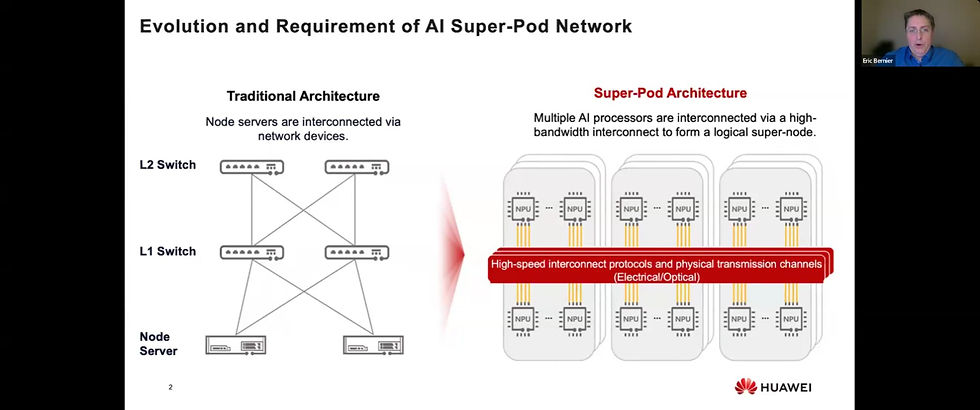
As AI models scale toward trillions of parameters, compute-cluster architecture is undergoing a dramatic shift from single servers to the "Supernode." When a single rack must support 72 or even 512 GPUs working in concert, traditional PCB traces and copper interconnects have reached their physical limits in bandwidth density, power and thermals. Against this backdrop, Near-Packaged Optics (NPO) has become the most practical path for large-scale deployment in today's AI scale-up networks, thanks to its "sweet spot" balance of performance, cost and thermal compatibility. This IPEC webinar brought together cloud giants and supply-chain leaders to define the new optical communications game beyond the 200G/lane era.
Core Technologies and Data Deep Dive: Every Company's View on Record
1. Tencent - Sidong Fu: NPO Is the Most Cost-Effective Choice for AI Interconnect
Core position: In hyperscale AI clusters, NPO offers the best balance between performance and ecosystem openness. Unlike CPO's closed supply chain, NPO lets operators maintain a multi-vendor strategy.
Key technical metrics:
Bandwidth density: The optical-electrical (OE) density of NPO and CPO can reach 10x that of traditional pluggable modules.
Insertion loss: At 200G, pluggable modules see insertion loss as high as 20 dB, while NPO brings it down to 10 dB and CPO to about 5 dB.
Volume timeline: Tencent has released its 3.2T NPO engineering spec. Sidong Fu confirmed that 3.2T NPO trial deployment is expected to begin in Q4 2026, with priority given to silicon photonics (SiPh) technology.
Roadmap: 200G/lane NPO standardization is underway, with forward-looking research on next-generation 400G/lane (2.4T/4.8T NPO), which is expected to require micro-ring modulators and 3D stacking.


2. Ranovus - Hojjat Salemi: Learning from Telecom History to Drive 200G SiPh Engines
Core position: AI networking is retracing the path telecom equipment took 40 years ago: vertical integration, high reliability and customization. Ranovus focuses on high-capacity optical engines that help customers break through the bandwidth limits of Moore's Law.
Technical data:
Demonstrated a 200G per lambda silicon photonics engine with low latency and low bit error rate (BER).
GA timeline: Expected to reach general availability (GA) by the end of 2026.
Thermal solution: As liquid cooling becomes standard in AI racks, NPO can benefit directly from cold-plate cooling and even support laser integration.


3. Alibaba Cloud - Qin Chen: From the CPO Vision Back to the NPO Reality
Core position: Alibaba defines NPO as "the only realistic path right now." CPO performs well, but the tight coupling of ASIC and optics leads to vendor lock-in and development delays.
Technical definition: Proposed the UPO (Ultra Performance Optics) concept, compatible with both NPO and IPO (Interposer-based Optics).
Key progress:
3.2T NPO: In February 2026 Alibaba lit up the world's first OIF-compliant 3.2T NPO, with a pilot run expected in Q3 2026.
6.4T UPO: Standardization project established at ODCC, targeting system development and Alpha samples by September 2026.
Hardware details: Recommends placing the TX side close to the ASIC to optimize the optical eye at TP2. Partners include optical module maker Accelink and switch maker Ruijie Networks.


4. Coherent - Vipul Bhatt: Balancing Modularity and Integration
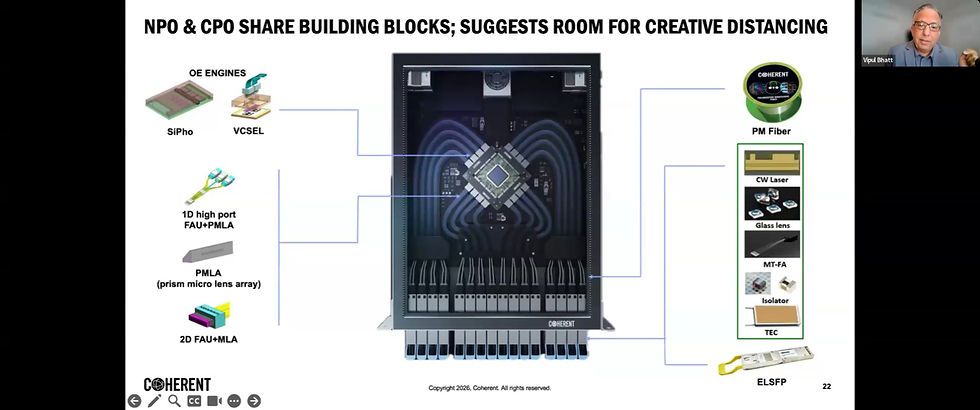
Core position: Warned the industry against "marketing myopia" and urged starting from customer needs (e.g., ease of maintenance vs. performance). NPO is not a transitional technology but a "durable architecture" with openness and serviceability.
Experience: Has supplied NPO solutions to IBM and Fujitsu. He stressed that adding sockets to NPO is feasible, but serviceability is still significantly lower than with traditional pluggables.





5. Ciena - Matt Bolig: Ecosystem Expansion of the OpenCPX MSA
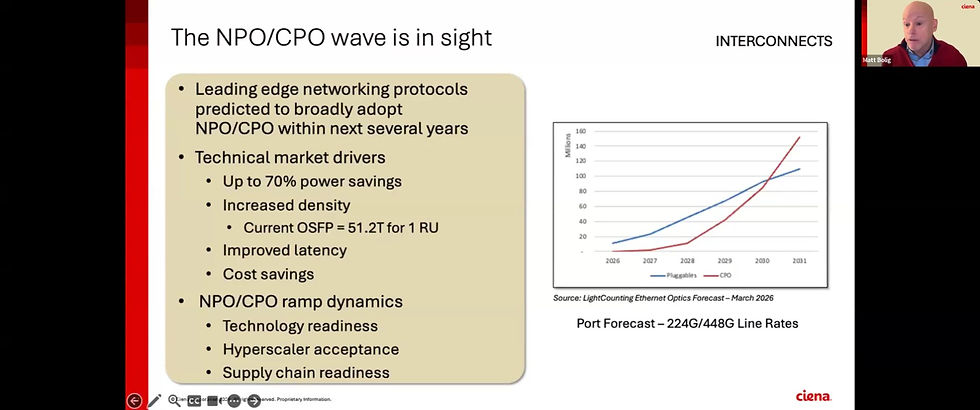
Market forecast: Expects CPO/NPO market share to cross over with pluggable modules around 2030-2031.
Industry news: Announced that Intel, TE Connectivity and Accton have joined the OpenCPX MSA.
Technical advantages: OpenCPX uses a soldered socket approach rather than press-fit, supports system bandwidth up to 102T, and has an evolution path toward 400T.




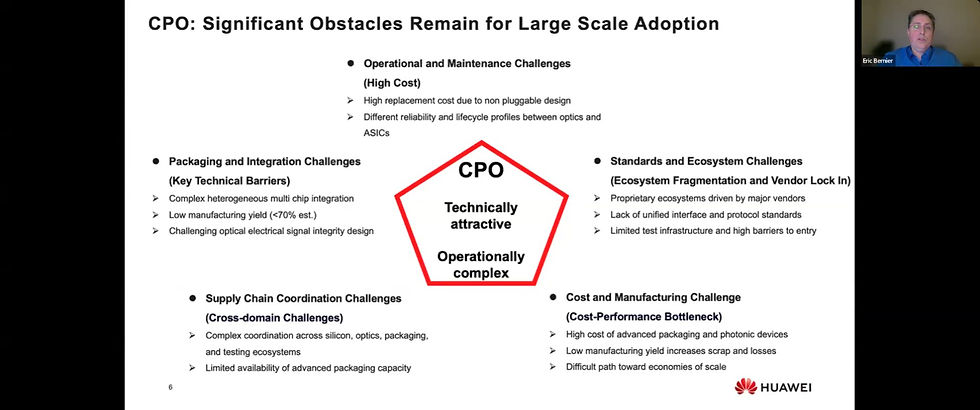
6. Huawei - Eric Bernier: 7.2T NPO Aligned with GPU Evolution
Core position: Called on the industry to return to international standards platforms such as IPEC to avoid ecosystem fragmentation.
Key data: Proposed a 7.2T NPO spec requirement. The reason: next-generation GPUs (such as NVIDIA's Vera chip) each need 3.6T of interconnect, so a dual-GPU module aligns exactly with 7.2T of bandwidth, an architectural advantage over the traditional 6.4T.
Power advantage: At 224G, NPO electrical insertion loss is only 7-9 dB, well below the 22 dB+ of pluggables.





Consensus and Divergence
Consensus:
AI scale-up is moving to optics: After NVL72, copper has reached its limits in reach and speed; full optical scale-up networking is inevitable after 2026.
NPO is the best near-to-mid-term solution: Given supply-chain maturity, test yield and an open ecosystem, NPO beats today's 3D CPO.
Liquid cooling as a catalyst: The spread of liquid cooling solves the thorniest thermal-management problem for NPO/CPO.
Divergence:
Laser source location: Alibaba and Huawei strongly advocate integrated lasers to simplify the system and eliminate PM fiber maintenance headaches; but vendors such as Coherent remain concerned about laser reliability at high temperatures and lean toward ELS (external laser source).
Package bandwidth standard: There is a 6.4T vs. 7.2T standards battle. 7.2T fits the GPU ecosystem better, but 6.4T maps more smoothly onto current Ethernet standards.
Spec fragmentation: Multiple standards bodies exist today, including OIF, ODCC and OpenCPX, and vendors have yet to fully unify I2C interfaces and pin definitions.
Supply Chain and Market Impact
TSMC and the packaging supply chain: The "step-down" adoption of NPO instead of CPO keeps 2.5D packaging demand running hot in 2026. TSMC's COUPE platform will be at the core of SiPh engine adoption.
Transceiver vendors: Under the NPO trend, traditional module makers must transform into "optical engine suppliers." Chinese vendors such as Innolight and Accelink, backed by Tencent and Alibaba, have a head start in NPO.
Connector makers: TE Connectivity and Molex joining the MSA signals that high-density NPO sockets will become a key profit pool after 2026.


Comments