


OCP Global Summit 2026 | Microsoft | Reynold D'Sa | Intelligence Infrastructure: Scaling AI for the Frontier Era
1. Why Microsoft Delivered Its Keynote as a Spec List
D'Sa opened with Microsoft's "frontier firm" thesis: every company has human capital, and now it must also build token capital, with the two forming a continuous learning loop.
The real claim came next: there is no frontier firm without frontier infrastructure. The slide calls it "the yield imperative": producing useful intelligence from every watt, every byte, every chip and every dollar. The answer is co-design across the stack, from datacenter, power and cooling up through silicon, memory, networking, orchestration software, models and agentic harnesses, all optimized together for faster deployment, lower operating cost, stronger governance and dependable performance at scale.
The talk followed a fixed rhythm: first what Azure built internally, then which part has already become an open spec. For the supply chain, the second half matters more, because only what becomes a spec grows multiple suppliers.
2. Breaking Down Compute: Maia 300 Leads, CPU and DPU Support
D'Sa said Microsoft announced Maia 300 "yesterday". The slide is titled "Inference-First AI System" and carries only two hard numbers: up to 7x generation-over-generation inference performance, 40% more tokens per MW than the rest of the fleet when deployed, plus "scaling to multi-GW deployments starting in 2027".
The slide lists no chip specs. From Microsoft's public announcement the day before:
Item | Maia 200 | Maia 300 |
Process | TSMC 3nm | TSMC N2P (compute chiplets) |
Packaging | Single large die | Multiple chiplets + 8 HBM4 stacks |
HBM | 216 GB HBM3e | 288 GB HBM4 |
Memory bandwidth | 7 TB/s | 18 TB/s |
Power per chip | 750 W | 950 W |
Rack | Not disclosed | 96 chips, 167 kW |
Slide efficiency claim | Up to 70% more tokens/W vs rest of fleet | 40% more tokens/MW vs rest of fleet |
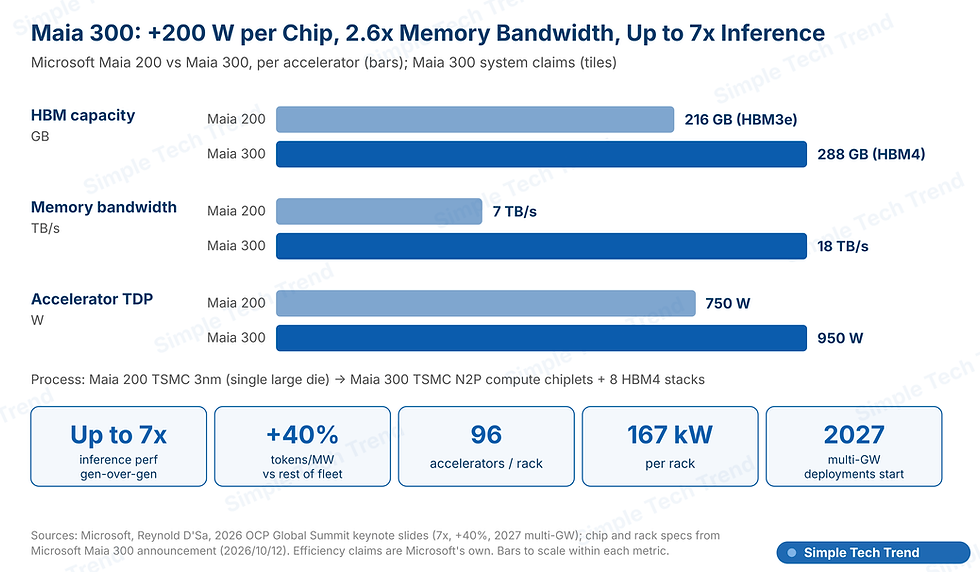
▲ Maia 300 adds only 200 W per chip while memory bandwidth grows 2.6x; the slide claims up to 7x inference performance over the previous generation, scaling to multi-GW from 2027 (Image source: Simple Tech Trend original, data from Microsoft 2026 OCP Global Summit presentation and Maia 300 public announcement)
The key line in this table is power: only 200 W more per chip, yet 2.6x the memory bandwidth. Maia 300 is designed around the memory bottleneck of inference. The other detail is the baseline: both Maia generations are measured against "the rest of the fleet", not a specific GPU model.
Three supporting chips share the same slide:
Cobalt 200: which D'Sa calls an "agent native CPU", delivers 50% better performance gen-over-gen, 33% lower agent call latency and 23% higher throughput on agentic workloads. Orchestration, data retrieval, memory management and service calls in agentic workloads all land on the CPU.
Boost DPU: offloads storage compression, networking transactions and security functions to dedicated silicon, with 4x more performance and 3x less power.
Azure Integrated HSM: an in-house security chip in all new datacenter servers.
Microsoft's in-house silicon now spans the whole server, not just the accelerator.
3. Breaking Down the Network: Two Tiers for 100,000+ GPUs
D'Sa split AI networking into three levels: low-latency scale-up, high-performance scale-out, and connections across clusters and datacenters.
The scale-out answer is MRC. The slide shows a multi-planar fabric with 8 planes, each with 256 T1 switches (512 ports) and 512 T0 switches (256 ports up, 256 ports down), plus packet spraying across all paths. By STT's math, each plane supports about 131,000 GPU ports, consistent with D'Sa's spoken claim of "more than 100,000 GPUs on two network tiers". Synchronous training is bound by its slowest link, and a single link failure can disrupt a job, so MRC is designed to route around failures. Partners are Microsoft, AMD, Broadcom, Intel, NVIDIA and OpenAI. One fewer switching tier means one fewer tier of optics and switches.

▲ MRC multi-planar architecture: 8 planes, each with 256 T1 and 512 T0 switches, with packet spraying to route around failures (Image source: Microsoft | 2026 OCP Global Summit presentation (p. 14))
For scale-up, Microsoft is backing two paths at once:
OCI MSA: which D'Sa called "the first optical specification for multi-rack scale-up systems", aims for open, interoperable optical interfaces and a multi-vendor supply chain; the first spec was released this year and is open for industry feedback. Members on the slide are AMD, Broadcom, NVIDIA, Meta, Microsoft and OpenAI. We covered its line-side spec in Meta, Broadcom and AMD Define the OCI 200G Line-Side Spec.
Ethernet scale-up: the open Ethernet scale-up spec effort announced at last year's OCP Global Summit now has more than 175 organizations; for context see OCP APAC Summit 2026: Ethernet Starts Eating Scale-Up.
D'Sa's point was that the challenge is not just connecting more GPUs, but turning massive distributed compute into "one efficient, resilient system". Optics took only one segment of this talk, but the direction matches ECOC 2026: Microsoft Writes Down the Optical I/O Spec Sheet: define the interface first, then let suppliers compete.
4. Breaking Down Power and Cooling: Specs Run Ahead of Silicon
Power. The slide splits the power chain in two. The 2026 path runs through LV transformers, UPS, PDUs and AC distribution, ending at Mt. Diablo; the future path is solid-state transformers (SST) feeding an 800 V DC busway directly, skipping multiple AC/DC conversions. On the grid side there is a Hyperscaler and Utility Grid Interface Specification, whose first version was released last month.
Mt. Diablo is Microsoft's disaggregated high-voltage architecture that separates power conversion from the compute rack so compute and power scale independently; it outputs ±400 V or 800 V, scaling from 100 kW to beyond 1 MW, and has been contributed to OCP. Set against the 167 kW Maia 300 rack, the power architecture is designed for the next two to three rack generations, which is why it had to become an open spec first.

▲ Microsoft's grid-to-chip power path: the 2026 path ends with Mt. Diablo, and the future path moves to solid-state transformers plus 800 V DC busways (Image source: Microsoft | 2026 OCP Global Summit presentation (p. 17))
Cooling. The third-generation heat exchanger unit Mt. Atlas delivers about 2x cooling capacity in the same footprint. At the datacenter level Microsoft is moving to zonal cooling, with explicit temperatures for both paths:
Liquid-cooled heat rejection: 20–40°C water supply, with the coolant distribution unit (CDU) supplying GPU racks at up to 45°C.
Air-cooled heat rejection: 20°C water supply, with the air handling unit supplying air-cooled racks at 30°C.

▲ Mt. Atlas delivers about 2x the heat rejection in the same footprint; zoned cooling supplies GPU racks with liquid at up to 45°C and air-cooled racks with 30°C air (Image source: Microsoft | 2026 OCP Global Summit presentation (p. 19))
The 45°C supply temperature is the key: the higher it is, the less load on chillers. Next-generation Azure halls are not "all liquid", but a mix of liquid and air cooling with multiple temperature zones.
5. Security and Operations: Tessera and the Self-Managed Fleet
On security, Microsoft recalled its roles in the Confidential Computing Consortium, Caliptra (the open-source silicon root of trust) and OCP S.A.F.E., then announced Tessera Integrated HSM: with Marvell and Oracle, it evolves the Azure Integrated HSM into an open-source initiative through OCP. The rationale: AI raises the speed and scale of cyberattacks, while quantum computing shifts the cryptographic risk horizon. Two lines on the slide matter: keys never exposed in memory and keys never leave the HSM boundary. D'Sa said Marvell's HSM has adopted the open protocols and interoperates with the Azure HSM.
Operations had two parts: standardizing RAS, debug and diagnostics, firmware updates and manageability through OCP, with silicon and platform intercepts at design time; and a self-managed fleet that uses AI to prevent, predict and act on failures, aiming for more nodes in service with less manual effort.
Sustainability numbers came in one segment (spoken): carbon negative, water positive and zero waste by 2030; low-carbon concrete pathways cutting emissions by more than 50% per cubic yard; more than 90% of datacenter capacity on closed-loop liquid cooling; tens of GW of renewable energy contracted across 24 countries; 35% lower server energy when idle; and more than 90% of servers recycled or reused after first deployment.
6. Risks and Counterarguments
The 7x and 40% baselines are opaque: 7x is "gen-over-gen" and 40% is versus "the rest of the fleet"; both are Microsoft's own framing, with no third-party data yet.
"Multi-GW" is not broken down: the talk did not say how much of the multi-GW deployment from 2027 is Maia 300 versus Maia 200. N2P and HBM4 capacity is also a bottleneck shared with peers.
Open specs are not open supply: the first OCI spec has only just opened for feedback, and the 175 Ethernet scale-up members count participation, not shipments; whether other clouds adopt MRC remains to be seen.
Optics were deliberately downplayed: the talk gave no CPO or NPO timeline, and there is still no public answer on when scale-up optics enter Maia racks.
Sustainability metrics vary in scope: the 90% closed-loop figure is measured by "datacenter capacity", not every site, and whether these numbers hold under fast AI growth will show in future annual reports.
7. What It Means for Taiwan's Supply Chain
Advanced process and packaging are the certain winners. Per Microsoft's public data, Maia 300 compute chiplets use TSMC N2P with multi-chiplet packaging and 8 HBM4 stacks; multi-GW deployment from 2027 is a clear increment for TSMC N2-family and advanced packaging capacity.
Power is the most direct generational test. Mt. Diablo is already an OCP spec, and its ±400 V / 800 V, 100 kW to 1 MW range will become a common design baseline for power racks and rack power; the future SST plus 800 V DC busway will rewrite the whole hall's power distribution. The talk named no power suppliers, so the opportunity for Taiwanese power makers depends on who qualifies first.
The difficulty in liquid cooling is "mixed" and "hot". Up to 45°C supply, multiple temperature zones and the roughly 2x Mt. Atlas raise new specs for CDUs, quick disconnects and controls; the opportunity for Taiwanese thermal and mechanical vendors is system integration, not just cold plates.
Optics hinges on OCI's multi-vendor clause. OCI explicitly makes a "multi-vendor supply chain" a goal, which is an entry ticket for Taiwanese optical component and module makers, but the spec is still in its feedback phase and will not be a main revenue driver before 2027.
8. Conclusion
This keynote had no single dramatic breakthrough; its value is that it laid out Microsoft's AI infrastructure as a spec map you can check against: networking has MRC and OCI, power has Mt. Diablo, SST and the grid interface, cooling has Mt. Atlas and zonal cooling, and security has Tessera. Each one tells the supply chain the same thing: Microsoft wants replaceable, interoperable parts, not a single vendor's full stack.

▲ The in-house components and open specs Microsoft mapped layer by layer in its keynote: compute, networking, power, cooling, security and operations (Image source: Simple Tech Trend original, data from Microsoft 2026 OCP Global Summit presentation)
Be clear on timing: 2027 is the start of Maia's multi-GW deployment, power and cooling specs are already in place, and scale-up optics are still at the spec stage. Over the next 12 months, watch three things: the deployment scale of the first Maia 300 racks, the first qualified power suppliers for the Mt. Diablo spec, and when the first OCI spec is finalized.
The silicon belongs to Microsoft, but the interfaces that scale it to multi-GW, Microsoft has chosen to hand to the whole industry.
This article is for technology and industry trend analysis only and does not constitute investment advice.


Comments