


OCP Global Summit 2026 | Oracle | Mark Filer | From Package to DCI: OIF Enablers in Oracle Cloud
1. Why Oracle Came to OIF With This Talk
Oracle formally joined OIF this year as a contributing, voting member. Filer's goal was simple: map every optic in Oracle's network back to the OIF work behind it.
The backdrop is the scale of OCI's AI clusters. Filer said Oracle's AI clusters were around 16k GPUs when it entered AI infrastructure about five years ago; today a multi-plane scale-out topology connects 131,000 GPUs contiguously in one cluster, and multiple buildings can be tied together across a campus.
Multi-plane means each 100G lane of an 800G optic on a GPU NIC lands on a different fabric plane. The slide lists the 1.6T breakouts: 8x200G, 4x400G, 2x800G, 1x1600G, with DR, FR and LR all in scope. The network gets flatter, with fewer switches and transceivers; the price is three challenges:
RDMA is lossless and sensitive to disruption, so every link flap means rolling back to a checkpoint
At 131k-GPU scale, connections run into the millions and even low-probability events become frequent
At Zettascale, network power is no longer negligible
Filer boiled the selection process down to one thing: TCO, resting on reliability, power and CapEx. Every watt saved in the network is a watt for compute, and compute is what Oracle monetizes; network hardware spend relative to compute keeps rising year over year, which he called "not a sustainable trajectory."

▲ Oracle's optics choices from 800G to DCI and the matching OIF specs; at every layer it picks the lowest-power option that has a spec (Image source: Simple Tech Trend original; data from Oracle 2026 OCP Global Summit presentation)
2. Breaking Down 800G: LPO Saves Power and Runs More Stable Links
Oracle deploys LPO at scale at 800G. Filer compared identical T0↔T1 links at one Stargate data center, using the 24-hour maximum pre-FEC BER:
Metric | LPO–LPO | FRO–FRO |
Links in sample | 156,591 | 202,042 |
Median pre-FEC BER | 1.1E-11 | 1.4E-11 |
p99 pre-FEC BER | 5E-10 | 3E-8 |
Links with at least one down transition | 3.244% | 5.681% |
The medians are close; the real gap is in the tail, where p99 differs by almost two orders of magnitude, and FRO links flap 1.75 times as often as LPO. Filer attributes the tail to DSP-to-DSP interop penalties.
Filer flagged two caveats himself: short, medium and high-loss ports need one-time equalizer tuning on the switch, and while the optical DSPs come from several vendors, the switch ASIC is the same everywhere, so an LPO link carries only one DSP. His words: correlated, not necessarily causal.
3. Breaking Down 1.6T: LPO Falls Short, So Oracle Moves to LRO
At 1.6T Oracle wanted to keep the LPO benefits, but concluded LPO cannot comfortably meet signal-integrity and interop requirements at the higher baud rate. It chose LRO, which OIF calls RTLR (Retimed Transmit, Linear Receive):
26 dB channels at 16 W (about 10 pJ/bit), which Filer said is roughly 10 W below FRO at the same baud rate
Equal performance over short, medium and long channels, since the transmit side is retimed and no per-channel calibration is needed
Supports DR4+ (4 dB link budget), with FR4 in the upper tiers
Interop already shown across multiple suppliers and multi-vendor 3nm DSPs; 2nm and LRO-optimized DSPs should cut power further
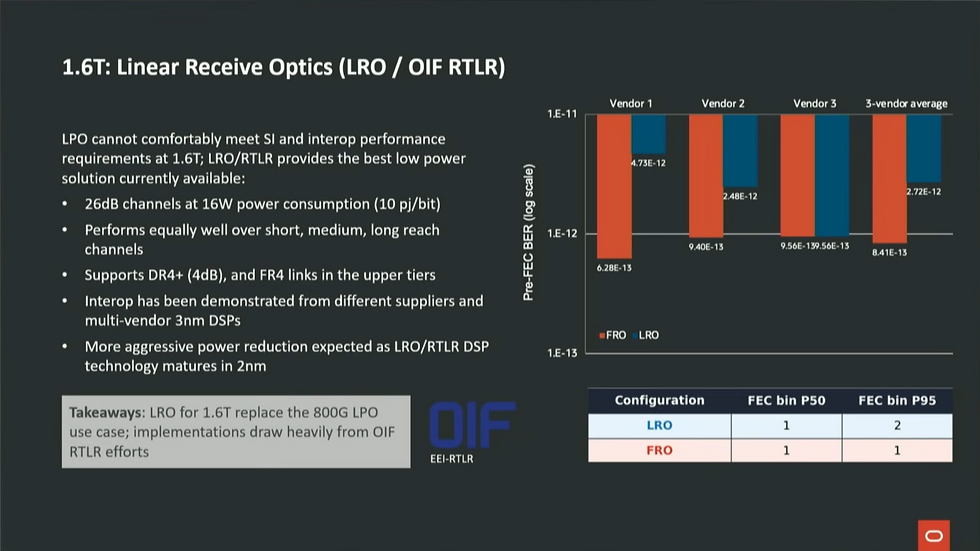
▲ Oracle 1.6T validation data: pre-FEC BER for LRO and FRO from three suppliers is all below 1E-11, with LRO at 16 W (Image source: Oracle | 2026 OCP Global Summit presentation (10:30))
Read this chart closely. LRO's BER is actually worse than FRO's: the three-vendor average is 8.41E-13 for FRO and 2.72E-12 for LRO, about 3x apart, and at P95 LRO occupies FEC bin 2 versus bin 1 for FRO. Both sit below 1E-11, and Oracle calls the difference not measurable. Trading roughly 3x BER for about 10 W is, in Oracle's judgment, worth it.

▲ Measured 800G link-flap ratio: LPO 3.244% vs. FRO 5.681%; 1.6T LRO trades about 3x BER for about 10 W of power (FRO at ~26 W is STT's estimate from verbal remarks) (Image source: Simple Tech Trend original; data from Oracle 2026 OCP Global Summit presentation)
Filer was candid about timing: CPO and NPO solutions are arriving in the same window, but the decision had to be made a year ago for deployment in the next few months, and LRO is the lowest-power option available today. The slide's takeaway: 1.6T LRO replaces the 800G LPO use case, with implementations drawing heavily on OIF's EEI-RTLR work.
4. Breaking Down CPO and NPO: What Oracle Wants Is Flexibility
Oracle sees 448G per lane as inevitable, so it wants to pipe-clean the CPO/NPO ecosystem at 224G; if the technology proves viable at scale, it could displace some planned 1.6T pluggable deployments.
The slide lists three CPO benefits:
Reliability: mishandling of transceivers is a primary failure mode, and CPO removes humans from deployment and operations. The slide says system FIT is "expected higher"; Filer corrected this on stage as a typo for lower, citing Meta's OCP 2025 data
Power: up to 50% savings versus an equivalent fully retimed pluggable system in the 200G/lane generation
Cost: a theoretical 30%+ saving, assuming volume deployment
But Oracle names three problems with today's CPO: proprietary implementations, supply-chain constraints and inflexible configurations (all-DR only). The related OIF work is EEI-ELSFP for external lasers.
NPO addresses exactly these: a multi-vendor optics ecosystem, easier RMA for switch OEMs and ODMs by swapping a socketed module instead of a whole MCM, and late binding of PMDs. Filer used Oracle's own case: its back-end tier-1 switch faces DR southbound and FR northbound, which today's CPO cannot mix but NPO can; the slide also mentions flyover cables to faceplate pluggables such as ZR.

▲ Oracle sees NPO solving three CPO problems: multi-vendor supply, easier RMA, and late binding of DR/FR (Image source: Oracle | 2026 OCP Global Summit presentation (14:58))
Implementations backing NPO include the Open CPX MSA (covered in ECOC 2026 | Ciena Turns 6.4T Optical Engines Back Into Shelf Parts With Open CPX), OIF's newly launched 12.8T NPO and EEI-COI; Filer also mentioned IPEC NPO activity aimed at the China market. There is one condition: NPO must prove reliability and power on par with soldered CPO. That matches our view in NPO Is Not a Stepping Stone to CPO.
5. Breaking Down DCI: Coherent Pluggables Across Every 60 km Span
Outside the data center, Oracle runs a large distributed footprint worldwide, all needing DWDM interconnect. An Oracle Cloud region consists of POPs, AD hubs and data centers over spans of about 60 km or less, all built on DCI-optimized coherent pluggables and line systems, moving 400ZR → 800ZR → 1600ZR.

▲ DWDM interconnect architecture in an Oracle Cloud region, with spans of about 60 km and coherent pluggables moving from 400ZR to 1600ZR (Image source: Oracle | 2026 OCP Global Summit presentation (16:54))
Oracle's two workstreams at OIF:
Participating in the 1600ZR, 1600ZR+ and 1600CL implementation agreements for future DCI and campus needs
Initiating a PLUG working group project for MACsec in 1.6T coherent pluggables, so shallow-buffer switches can drive coherent optics out of the data center while meeting customer encryption requirements
The key point is on Filer's final slide: DCI growth comes from the traditional front-end network and also from the AI scale-out back end that links buildings across a campus. Once AI clusters span buildings, coherent optics is no longer just a metro business. The DCI momentum we saw in Earnings Highlights: Fabrinet (FN) | Q4 FY2026 now has demand-side confirmation from Oracle.
Beneath all of these optics is one more layer: CMIS, C-CMIS and CMIS-Sec. Oracle depends on CMIS for module management and lifecycle operations across every module type, including active copper, IMDD and coherent.
Layer | Oracle status | OIF work listed on slides |
1.6T pluggable | LRO deploying in coming months | EEI-RTLR |
CPO/NPO | Pipe-cleaning at 224G | EEI-ELSFP, EEI-12.8T NPO, EEI-COI |
DCI and campus | 400ZR → 800ZR → 1600ZR | 400ZR, 800ZR, 1600ZR(+), 1600CL |
Module management | Every module type | CMIS, C-CMIS, CMIS-Sec, PLUG |
This table lines up with the EEI framework we covered in OIF Draws an Official Map for AI Interconnect: EEI lets end users set the requirements, and this talk is the end user's answer sheet.
6. Risks and Counterarguments
LPO stability is correlation, not causation: the data come from one data center and one switch ASIC; a different ASIC or ODM may not reproduce it.
The LRO data are qualification samples, not deployment data: three-vendor qualification results are not comparable with the 150,000-link field data at 800G, and LRO's BER really is about 3x worse than FRO's.
The roughly 10 W saving is only a spoken figure: the slides do not list FRO's comparison power.
CPO/NPO has no timeline: Oracle only says it is validating at 224G and "could" displace some 1.6T pluggables, with no volume or year.
NPO sockets come at a cost: compression sockets and HDI add loss and height, and there is no public data yet on matching soldered CPO.
MACsec for 1600ZR has only just started: the spec has not taken shape and products are some way off.
7. What It Means for Taiwan's Supply Chain
The talk named no suppliers. The 1.6T data show only Vendors 1–3 and the coherent module image is credited to Acacia, so Taiwanese firms have to read opportunities from the architecture, not from a vendor list.
1.6T LRO is the nearest order shape. Oracle deploys in the next few months, follows OIF RTLR and uses a DR4+ 4 dB budget; Taiwanese module and optical component makers aiming at OCI's 1.6T must deliver RTLR designs with proven interop across multiple 3nm DSPs.
NPO flexibility favors Taiwanese component makers and ODMs. Oracle states that one NPO benefit is easier RMA and rework for switch OEMs and ODMs; the Open CPX MSA's public member list includes Taiwanese firms such as Accton, BizLink, LOTES and Foxconn Interconnect. But Oracle's condition is that NPO must match CPO first, and that bar has not been cleared.
CMIS firmware is the entry ticket. Oracle relies on CMIS to manage active copper, IMDD and coherent modules, so for Taiwanese cable and module makers, firmware and management-interface completeness matter as much as hardware specs.
8. Conclusion
Filer showed no new product; the value is a complete procurement map: LPO at 800G for more stable links, a step back to LRO at 1.6T for interop, CPO under observation with NPO as the preferred shape, DCI marching to 1600ZR, and CMIS on every module. The common thread: without an OIF spec, Oracle will not buy at scale.
Separate the timelines. What is certain is 1.6T LRO deployment in the next few months and continued DCI growth; CPO/NPO is only being validated at 224G, with no year attached. Over the next 12 months, watch three things: field BER and flap data from 1.6T LRO at scale, progress on the OIF 12.8T NPO spec, and when the 1600ZR MACsec project becomes an implementation agreement.
For Oracle, the best optic is not the fastest one; it is the one with a standard, a second source, and no trouble across a million links.
This article is for technology and industry trend analysis only and does not constitute investment advice.


Comments