


OFC 2026 - The 1.6T Boom and the 3.2T Roadmap: Pluggables vs. Silicon Photonics vs. CPO - OFC Panel (Broadcom, Marvell, Ciena, Source Photonics, OpenLight, Inpho)
Updated: 15 hours ago
Introduction: AI Compute Enters the First Real Year of 1.6T
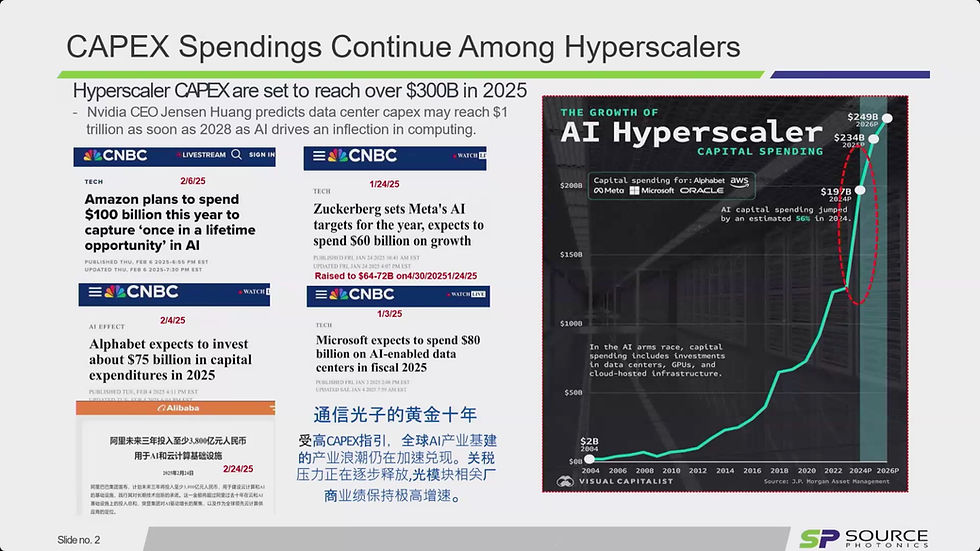
At the OFC 2026 MW2 panel, the world's optical-communications leaders reached a clear consensus: AI compute (AI Factories) has become the sole core driver of optical technology evolution. With hyperscaler capex in 2026 expected to exceed $500B, the importance of optical components — the "blood vessels" of compute clusters — is on another level entirely.
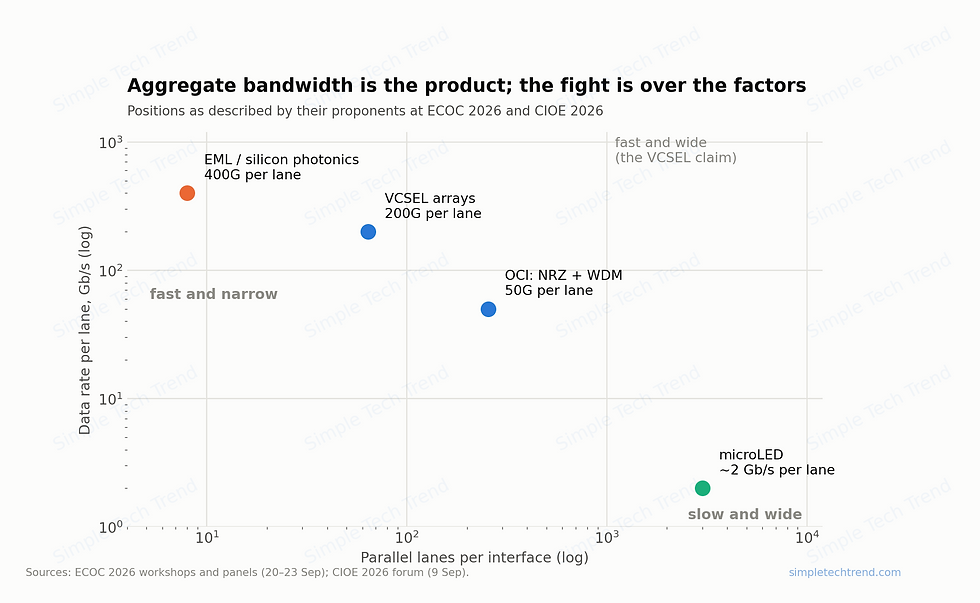
This panel marked the formal entry of 1.6 Tbps (200G/lane) into large-scale deployment (2026 shipments expected to reach 5–6 million units), while the major players began squaring off in earnest over the technology path to 3.2 Tbps (400G/lane). Below is a breakdown of the core technologies from key players across the supply chain.
Core Technologies and Company Perspectives
1. OpenLight: Commercializing Heterogeneous Integration
OpenLight CEO Adam Carter noted that the traditional optics manufacturing model can no longer cope with the explosive demand of the AI era.
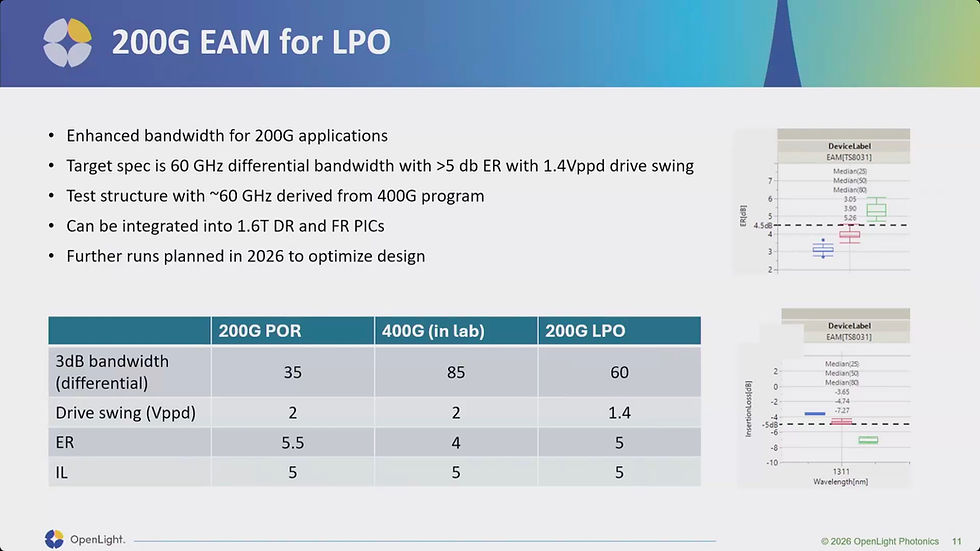
Specs: showed a 5x7 mm 1.6T PIC that integrates 4 DFB lasers, 8 SOAs and 8 200G EAM modulators on a single silicon platform.
Key advantage: using Tower Semiconductor's silicon photonics process, indium phosphide (InP) devices are bonded directly onto silicon wafers, achieving >90% coupling efficiency.
Future path: successfully developed a 400G/lane modulator only 100 µm long, and has already produced 3.2T DR8 prototype chips.



2. Source Photonics: The Case for Longer-Lived Pluggables
CTO Frank Chang firmly believes pluggable modules still have a very long life cycle.
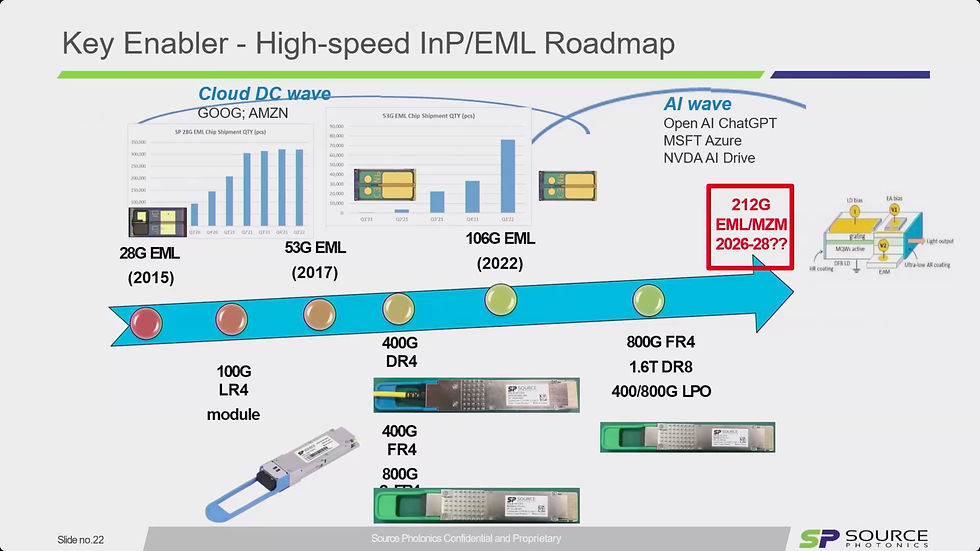
1.6T today: first-generation 1.6T draws about 30 W; the second generation on a 3nm DSP is down to 25 W. 200G/lane is highly mature, with excellent TDECQ, even achieving near error-free performance at 1E-12.
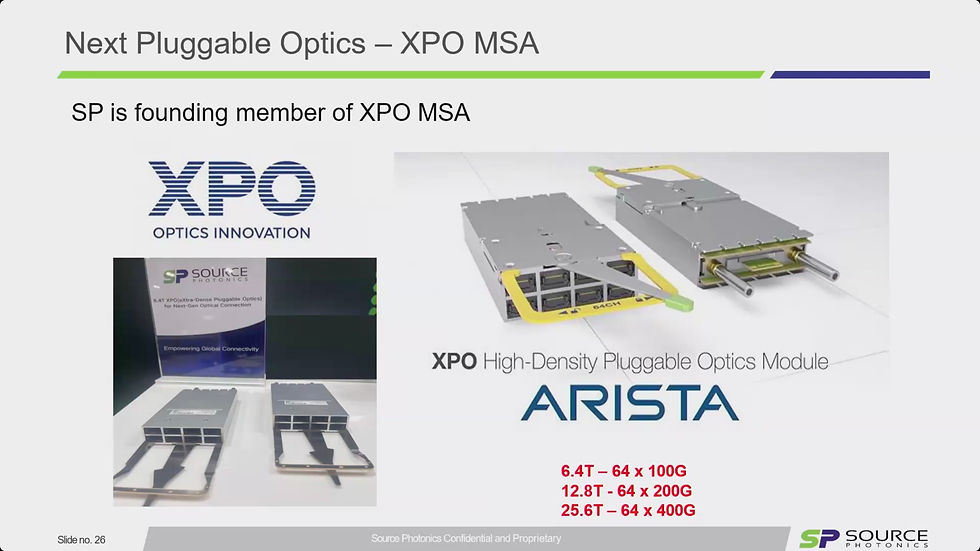
The role of the XPO MSA: with new form factors such as XPO and OSFP-XD, pluggables can scale to 3.2T. CPO will take share, but it won't replace pluggables in the near term.
Supply-chain warning: EML lasers face a severe shortage in 2026, which will push vendors to accelerate toward architectures with fewer components.







3. Inpho (InP specialist): Monolithic Integration of Electronics and Photonics
Alex Guichard stressed that in the 400G/lane era, the trade-off between photodetector (PD) bandwidth and responsivity will be the biggest challenge.
Performance breakthrough: developed a PD with 100 GHz bandwidth while keeping responsivity at 0.95 A/W, improving link budget by >2 dB over the industry standard.
Low-power drive: its EAM modulator with integrated driver needs only <1V peak-to-peak to reach a 5 dB extinction ratio (ER), with total power (including the laser) below 1 pJ/bit.


4. Broadcom: CPO Field Data and the New OCI Ecosystem
The Meta field data presented by Rajiv Pancholy was the highlight of the panel:
CPO reliability: Broadcom's CPO systems have logged 50 million device hours with no link flaps.
OCI MSA: together with Meta, Microsoft, OpenAI, NVIDIA and others, Broadcom launched the OCI (Optical Compute Interconnect) MSA, aiming to bring optics directly into the chip package (scale-up) and break the distance limits between racks for good.
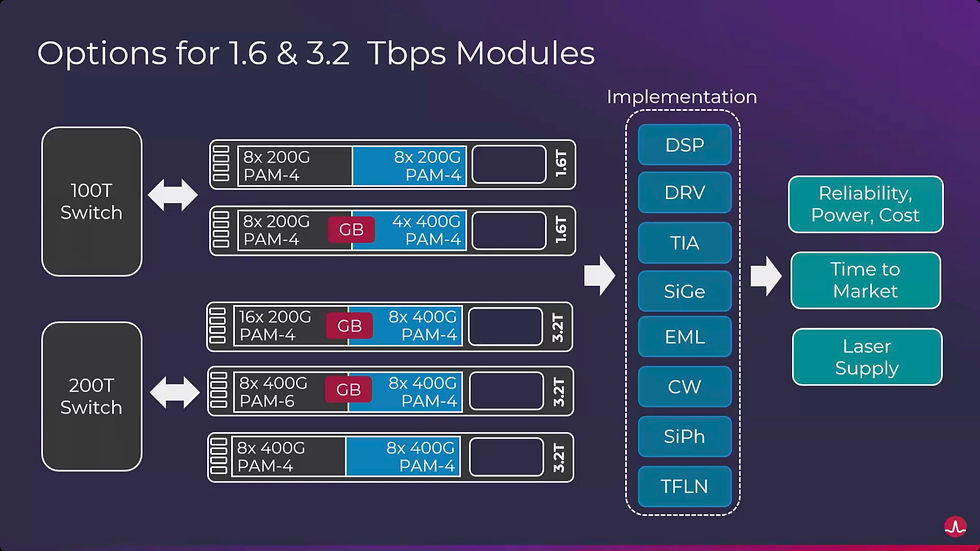
DSP and EML: announced the first DSP supporting 400G/lane, along with a matching differentially driven EML.





5. Marvell: Coherent Technology Expanding in Both Directions
Bo Zhang explained how coherent technology is moving from long-haul transport into the data center.
1.6T ZR/ZR+: built on the 2nm CMOS node with baud rates raised to 240-260 GBaud, coherent has firmly established itself in the 1.6T era.
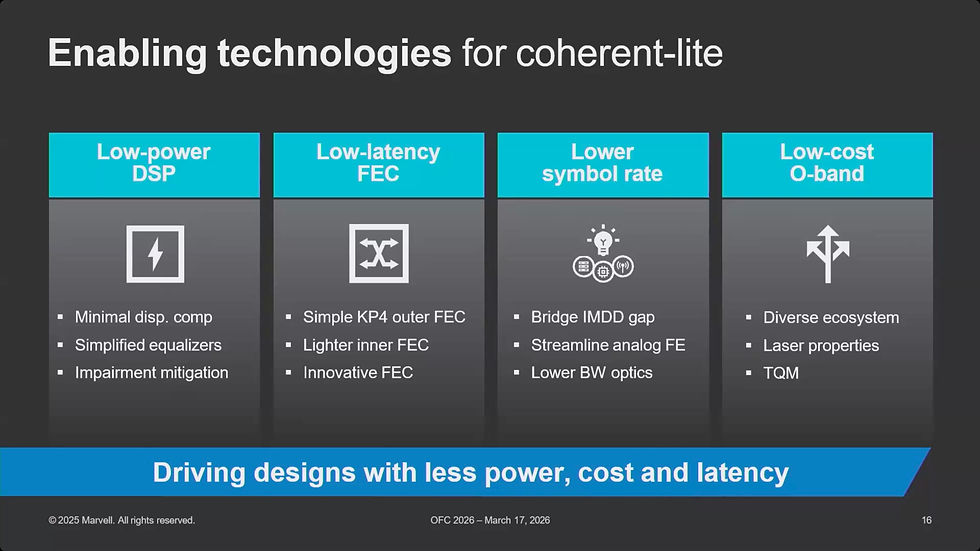
Coherent Lite (CL): targeting 2–10 km campus networks, the OIF 1600CL project is hotly debating whether to redesign from the ground up to cut cost and power, challenging traditional IMDD technology.



6. Ciena: A Transport Revolution Measured in Fibers
Robert Keys introduced a new concept for DCI — the Full-Spectrum Transponder (FST).
Integration: integrates 32 wavelengths (C+L band) in a single unit, for a total capacity of 51 Tbps.
Simpler operations: for hyperscalers, the unit of transport is no longer 1.6T but the capacity of "one fiber."


Consensus and Divergence
Dimension | Industry consensus | Divergence |
Mainstream data rate | 1.6T is entering its boom phase; 3.2T is the next R&D focus. | Still debated whether 3.2T should use 4x800G or 8x400G. |
Form factor | Pluggable lifespan extended by XPO. | CPO deployment timing: Broadcom says now, Source Photonics says N+2 years. |
Materials path | Traditional InP EML supply is tight. | Whether thin-film lithium niobate (TFLN) and BTO can integrate cleanly with CMOS processes. |
Short-reach technology | IMDD faces bandwidth challenges above 800G. | Whether Coherent Lite can bring power down to a level competitive with IMDD. |
Supply Chain and Market Impact
DSP vendors (Marvell/Broadcom): benefit from the 2nm node transition and the 400G/lane technology barrier; their lead will widen.
Laser chip suppliers: the EML shortage will give vendors with heterogeneous integration capability (SiPh + InP), such as OpenLight, more pilot-production opportunities.
Module and packaging houses: the arrival of the XPO MSA means vendors strong in pluggables (such as Innolight and Source Photonics) still have a battlefield in the 3.2T era, rather than being forced to pivot to CPO immediately.
Simple Tech Trend's View:
OFC 2026 sent a strong signal: the optical communications industry is shifting from "selling components" to "system-integration solutions."
We believe the key thing to watch over the next 18 months is 400G/lane yield. As baud rates push past 200 GBaud, the physical limits of traditional materials are close at hand. If Broadcom's OCI ecosystem succeeds, it will fundamentally reshape AI server architecture, making "optical I/O" no longer an option but standard equipment on par with HBM.


Comments