


Paper Analysis | Breaking the CPO Coupling Bottleneck: AuthenX Uses Meta-Lenses to Reach +/- 18 um Alignment Tolerance
Introduction: Why Does CPO Need Detachability and High Tolerance?
As AI and high-performance computing drive bandwidth demand through the roof, CPO packages optical and electrical components together in pursuit of maximum power efficiency. But coupling optics to a fiber array unit (FAU) has traditionally demanded extremely tight alignment: drift by a few microns and the signal is gone. That makes high-volume manufacturing (HVM) hard, and it has kept a detachable interface out of reach.
AuthenX's answer is to place a meta-lens on both the chip side and the fiber side, converting the diverging beam into a collimated beam roughly 70 um in diameter, which dramatically relaxes alignment requirements.
Reference
Title: Meta-lens for co-package optics and fiber array unit coupling
Authors: Sheng-Fu Lin, Hong-Shen Chen, et al.
Affiliation: AuthenX Inc. (Zhubei, Taiwan)
Venue: OFC 2026
Figure-by-Figure Analysis
1. System Architecture and Hardware (Fig. 1)

Coupling mechanism: The system uses two meta-lenses. The bottom meta-lens is mounted on the photonic integrated circuit (PIC) and collimates the light emitted by the grating coupler (GC); the top meta-lens is attached to the FAU and focuses the collimated beam into single-mode fiber (SMF).
Components: The PIC supports multi-channel O-band I/O, while the 2D FAU used for testing has 36 channels (12 across by 3 down), mixing SMF and polarization-maintaining fiber (PMF).
Microstructure: SEM images show the meta-lens is an array of nanopillars on a substrate, which is what shapes the phase distribution.
2. Design and Phase Profile (Fig. 2)

Design optimization: By simulating the transmittance and phase shift of individual nanopillars, the team optimized a precise phase profile.
Automated layout: Once the phase profile is set, the flow automatically generates a GDS layout for lithography. Fig. 2(a) shows the ring-shaped phase profile of the FAU-side meta-lens, which is key to focusing the beam accurately.
3. Beam Quality Measurement (Fig. 3)

Collimation quality: This is the number we care about most. The measured beam quality factor is M^2 = 1.2, meaning the collimated beam is very close to an ideal fundamental Gaussian mode.
Stability: In a cross-section measured at 2.7 mm, the fit to a Gaussian curve reaches R^2 = 0.99. The meta-lens beam diverges very little (half-divergence angle of just 1.2), which favors alignment over longer distances.
4. Alignment Tolerance Test (Fig. 4)
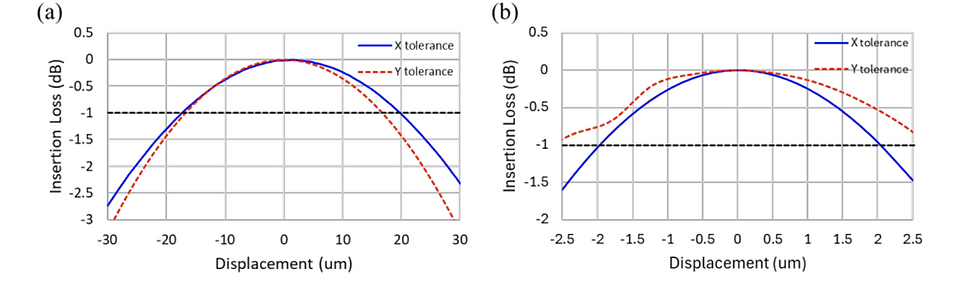
Wide tolerance: When the PIC and FAU are coupled, the 1-dB alignment tolerance reaches +/- 18 um. Compared with conventional micron-level requirements, this is like going from threading a needle to rolling a bowling ball, a big win for detachable interfaces.
Assembly tolerance: The tolerance for attaching the meta-lens to the PIC is +/- 2 um, within the capability of today's high-speed die bonders, which supports manufacturability.
5. Multi-Channel Uniformity (Fig. 5)
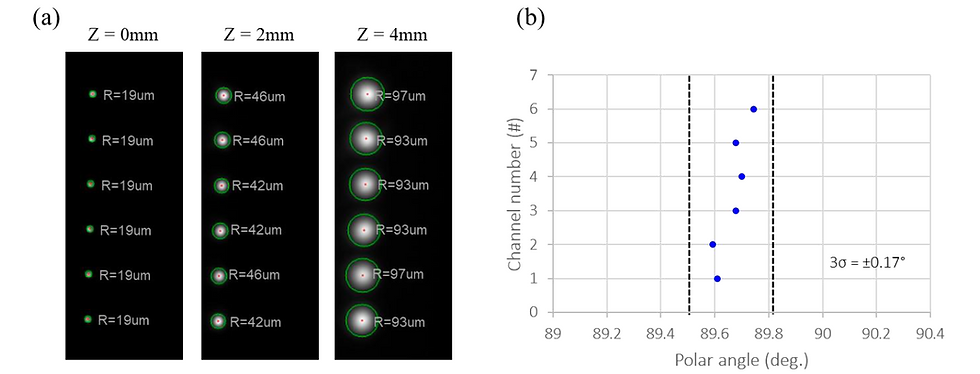
Array uniformity: Across 6 tested channels, all collimated beams point in nearly the same direction, with a mean polar angle of 89.7 deg and a three-sigma spread of only +/- 0.17 deg. That keeps coupling efficiency stable across every channel in a large CPO module.
Conclusion
AuthenX's work matters because it addresses three roadblocks keeping CPO in the lab rather than the factory: manufacturability, serviceability, and stability.
Scalability: With 1-dB tolerance pushed to +/- 18 um, packaging no longer needs extremely expensive active alignment systems, cutting cost significantly.
Detachability: High tolerance makes detachable fiber connectors practical. In an AI data center, if a channel fails you can swap the fiber array instead of scrapping an expensive ASIC.
Technology maturity: M^2 = 1.2 shows the meta-lens optical design has reached industrial grade, not just a scientific demo.
In short, this work showcases Taiwan's strength in micro/nano-optics manufacturing and offers a key interconnect solution for next-generation AI computing infrastructure.


Comments