


OFC 2026 - TFLN Hits Its Inflection Point: Volume Scaling and the 1.6T/3.2T Deployment Path - HyperLight, Broadcom, Ciena, Eoptolink, Jabil
At this high-profile OFC 2026 panel, thin-film lithium niobate (TFLN) formally declared its move from lab "technology demos" to the inflection point of large-scale commercialization. As AI compute pushes bandwidth and power to the limit, TFLN's ultra-high bandwidth and low drive voltage make it the key material for overcoming silicon photonics (SiPh) performance bottlenecks in the 1.6T and even 3.2T generations.
Core Technical View: From Academic Breakthrough to Industrial Volume
Harvard professor and HyperLight co-founder Marko Loncar reviewed TFLN's history, noting that the technical key was overcoming redeposition during the etching process.
Loss performance evolution: labs reached a low loss of 3 dB/m in 2017, the current lab record is 1 dB/m, and the material's limit on certain vendors' oxide platforms is about 0.1 dB/m.
Wavelength compatibility: TFLN has a wide bandgap covering the visible through near-infrared bands. Below 1 µm, its Vπ efficiency improves sharply, scaling inversely with the square of wavelength.


Full Panel Recap by Company: Strategic Positioning for the 1.6T Generation
1. Ciena: Coherent Optics' Absolute Craving for "Low Loss"
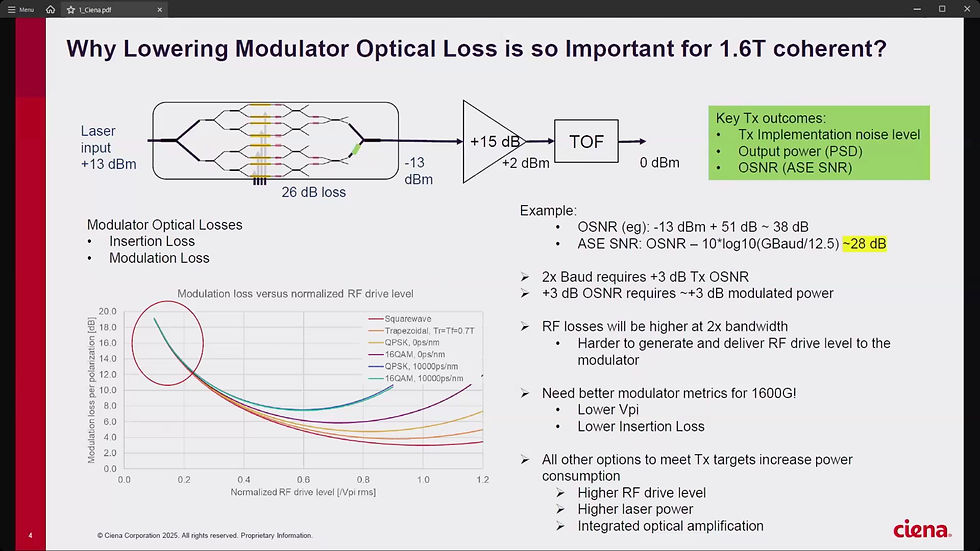
Ciena pointed out that the coherent driver modulator (CDM) is TFLN's immediate product opportunity.
Pain point: modulation loss: in a typical coherent transmit chain, modulator loss reaches as high as 26 dB, severely limiting optical signal-to-noise ratio (OSNR).
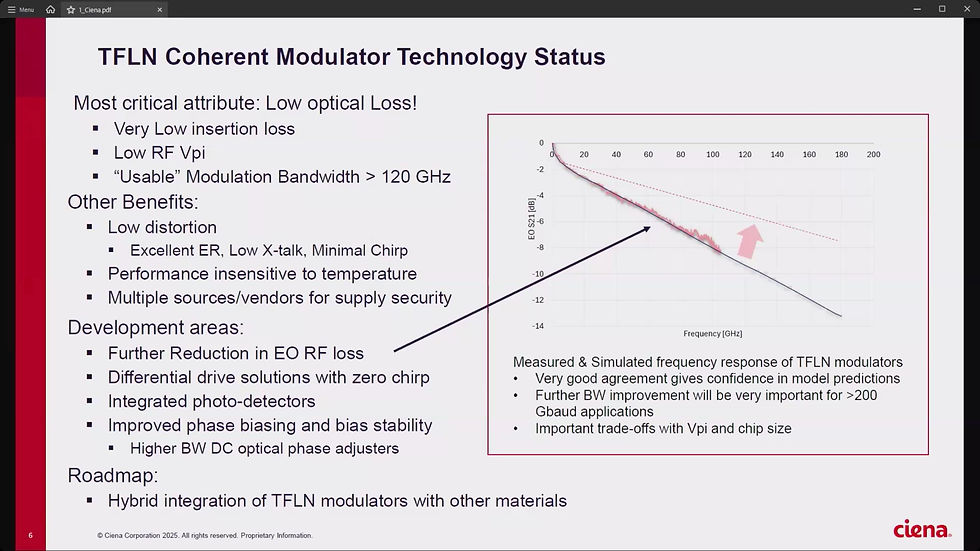
The 1.6T challenge: moving to 1.6T doubles signal bandwidth and cuts SNR by 3 dB. TFLN's low Vπ and high bandwidth (measured at only 6–8 dB roll-off at 100 GHz) can offset this degradation.
Direction for improvement: TFLN today is mostly single-ended drive; Ciena hopes to see it evolve toward differential drive to save power.




2. Broadcom: The "Physics First" Principle for the 425G Single-Lambda Era
Broadcom just launched its Taurus-generation 400G DSP.
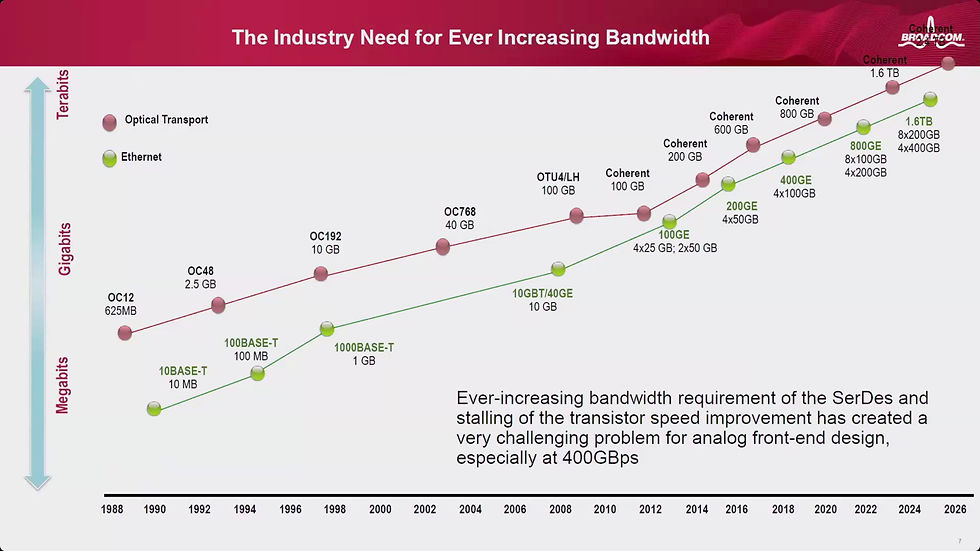
Fix the physical layer instead of leaning on the DSP: Vasu stressed that the DSP is no cure-all. CMOS scaling improves analog front-end (AFE) bandwidth by only about 5% per generation, so jitter and crosstalk must be solved at the signal source.
The FEC gain trap: powerful forward error correction (FEC) brings huge overhead and power. If TFLN improves physical link quality, there is no need to rely on overly complex FEC.




3. Eoptolink: Measured 1.6T/3.2T Module Performance
Eoptolink showcased a 1.6T DR4 module based on Broadcom's Taurus DSP.
Direct drive: the DSP output can drive the TFLN modulator directly, eliminating the cost and power of an external driver.
Key data: at 425 Gbps per lambda, direct drive achieves an extinction ratio (ER) of 3.5 dB and TDECQ of 2–2.5 dB, with a bit error rate (BER) of 1E-6 at -1 dBm received power.


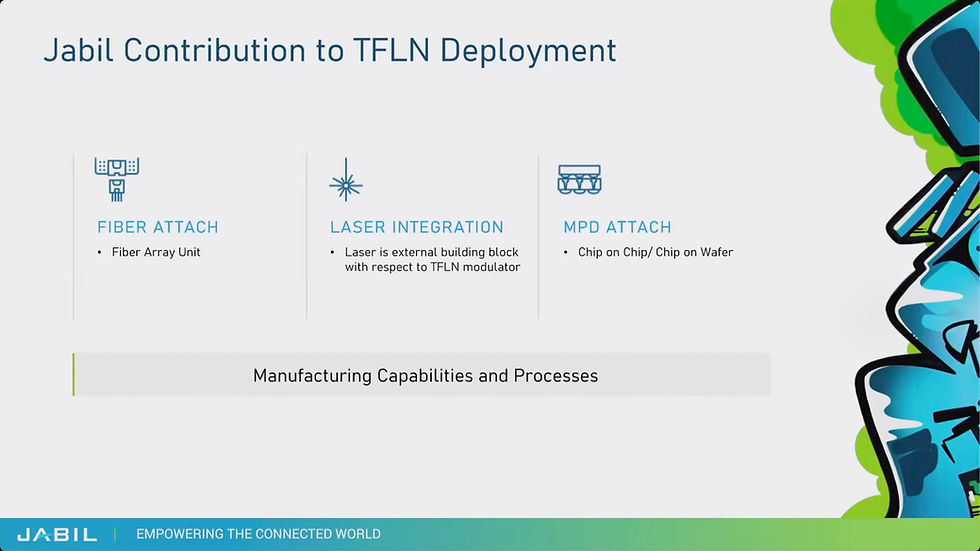
4. Jabil: Getting Manufacturing Ready for "Industrialization"
As a major manufacturer, Jabil assesses that TFLN is now ready for large-scale volume production.
Compatibility: TFLN packaging flows (such as fiber coupling and wire bonding) are highly compatible with existing silicon photonics (SiPh) and indium phosphide (InP) infrastructure.
Power benchmark: Jabil's measured 1.6T LRO (linear receive optics) module consumes only 11.5 W.



5. HyperLight: Supply Chain Stability and Yield Breakthroughs
HyperLight is focused on turning R&D into production capacity.
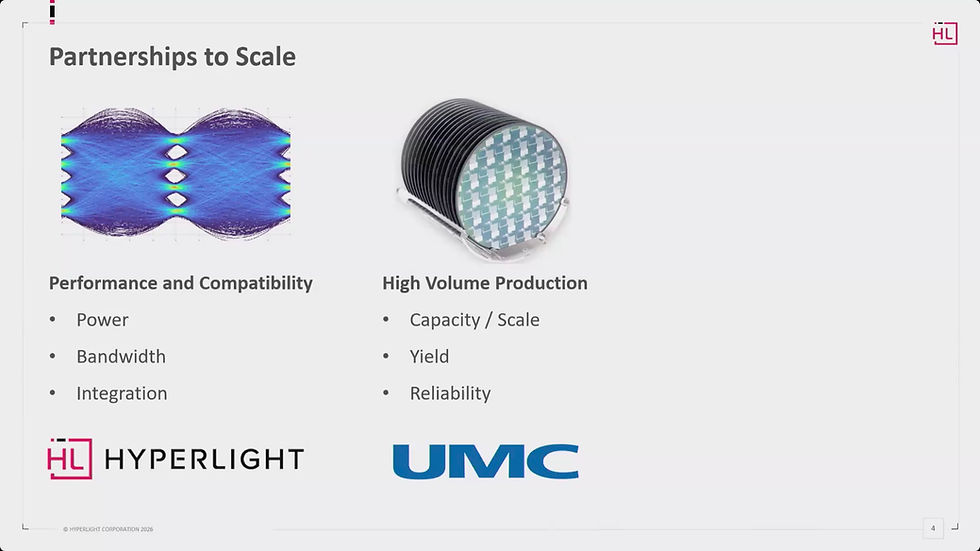
Foundry partnership: in deep collaboration with UMC, the 6-inch line has entered volume production with annual capacity of 1 million known-good dies (KGD); the 8-inch line is in the final stage of pilot production.
Yield and reliability: end-to-end yield has reached 90%, and the devices have passed Telcordia GR-468 reliability qualification.
Power advantage: a 1.6T fully retimed module consumes roughly 20–21 W.




Consensus and Points of Divergence
Dimension | Industry consensus | Potential divergence / challenges |
Performance value | TFLN is the only technology at 1.6T and above that balances bandwidth with low voltage. | Silicon photonics modulators are still evolving; TFLN must keep proving its cost advantage. |
Drive architecture | Moving to differential drive is an inevitable trend to cut power further. | Mainstream products are still mostly single-ended; PCB design needs to be rethought. |
Integration | TFLN needs to integrate more components (such as photodetectors, PDs). | Stray light and control complexity from integrated PDs remain unsolved. |
Market timing | The 400G single-lambda standard is just getting started, with a breakout expected in 2027. | Early deployments may bridge with gearbox solutions rather than pure single-lambda designs. |
Simple Tech Trend View: TFLN Holds a "Generational Lead"
This panel shows that TFLN is no longer far-off exotic technology. STT's editor-in-chief sees three factors shaping the landscape over the next two years:
AI-driven power dividend: HyperLight says about 1 billion 1.6T-equivalent ports will be needed by 2028. TFLN can save roughly 20% of system power, a decisive financial consideration for gigawatt-scale data centers.
Ecosystem maturity: UMC joining as a foundry and Jabil's manufacturing assurance remove Tier 1 customers' doubts about "supply stability." This stands in sharp contrast to BTO and polymer modulators, which are still in R&D.
Packaging is the key: TFLN's performance may be unbeatable, but its integration with the DSP (e.g., 3D packaging, differential drive) will decide the ultimate winner.
As the 425G-per-lambda standard firms up toward the end of 2026, TFLN will be first to take mainstream share in high-end 1.6T/3.2T pluggable modules, and from 2027 will begin to threaten the position of traditional EML and silicon photonics.


Comments