


OFC 2026 - DCI and Scale Across in the AI Era: A Full Breakdown - Meta, Google, Zayo, Lumen, Nokia
At the OFC 2026 Data Center Summit, this panel on DCI (Data Center Interconnect) and Scale Across was easily one of the most strategically important discussions of the year. As AI training demand outgrows the physical limits of a single data center, network architecture is shifting from "data synchronization" to "active workload coordination." With power now the ultimate bottleneck for data center expansion, using optical communications to interconnect "gigawatt-scale" clusters has become a shared challenge for hyperscalers and carriers alike.
Core Technologies and Views: How Five Giants Line Up
1. Meta (Jeff Rahn): Defining the New Era of "Scale Across"
Meta drew a clear line between traditional DCI and the emerging Scale Across:
From synchronization to collaboration: Traditional DCI mainly handles replication and synchronization tasks; Scale Across connects active compute units across data centers (e.g., GPU to GPU), letting multiple sites jointly complete a single AI training job.
The critical 10km to 100km range: Meta prefers short-reach gray optics, but power constraints are forcing it to deploy data centers over a wider area. Beyond 10km, IMDD can no longer keep up, and high-capacity transport must rely on DWDM.
A standardized ecosystem: Meta stressed that the 800ZR generation must rely on standardized interfaces and open line systems to ensure multi-vendor interoperability and support the flexibility of upgrading site by site.



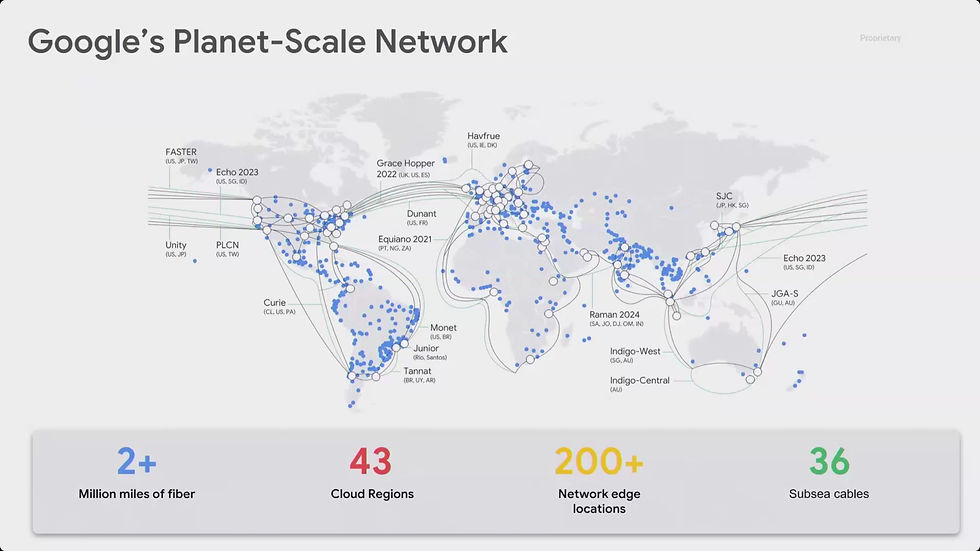
2. Google (Kevin Croussore): "Fiber Is the New Wavelength"
Google laid out a fundamental change in network design logic:
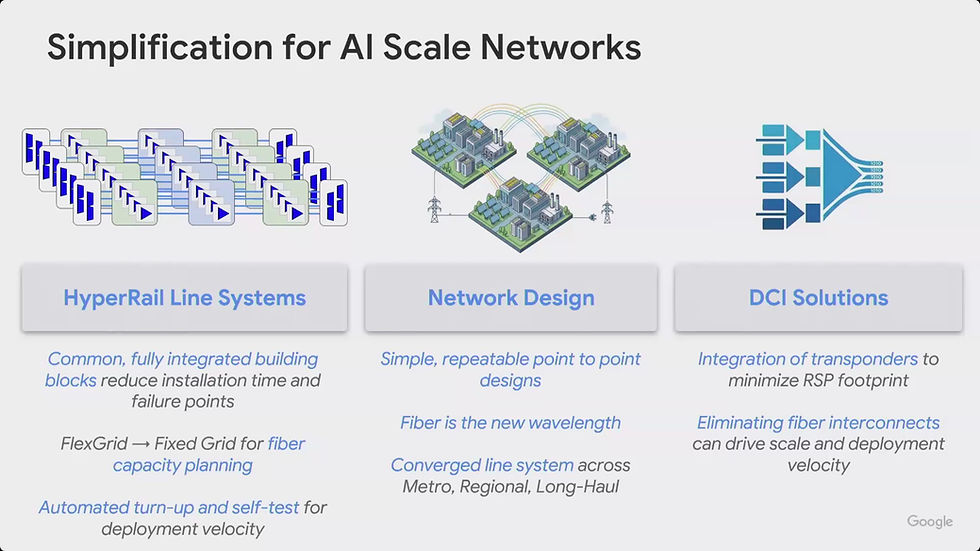
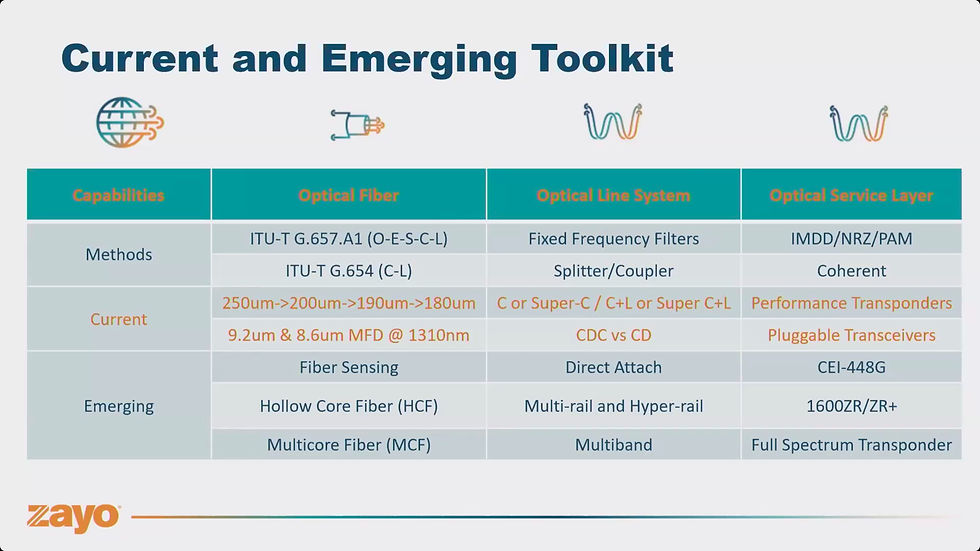
Horizontal scaling: With single-fiber capacity approaching its limit, Google no longer deploys at the granularity of a "wavelength" but designs in units of "fibers" or entire systems.
Hyper-rail (multi-rail) line systems: A key innovation Google is driving, using deep component integration and uncooled components to sharply raise rack density and cut power.
Radical architectural simplification: To speed deployment, Google is reducing its reliance on ROADM and FlexGrid and moving to simpler point-to-point designs.



3. Zayo (Todd McWhirter): Fiber Evolution in Pursuit of the Lowest TCO
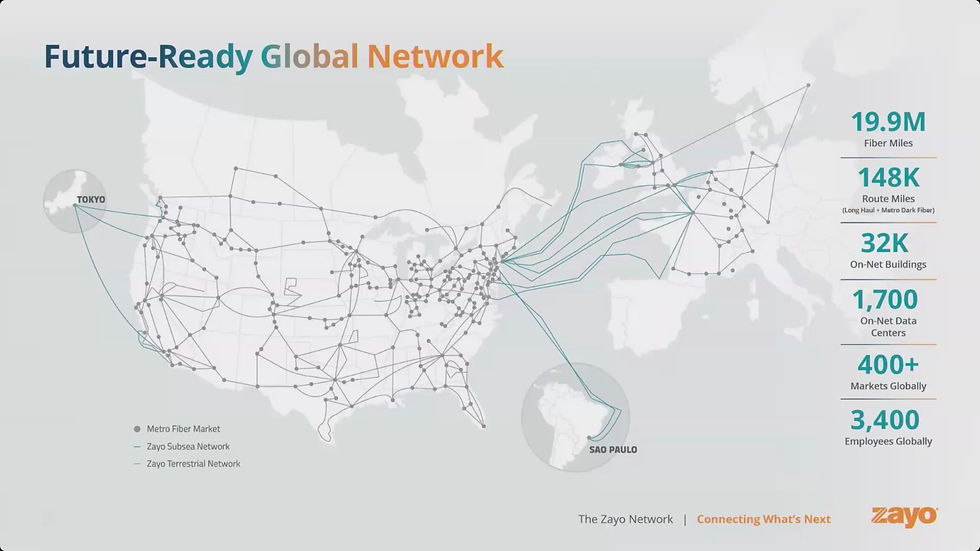
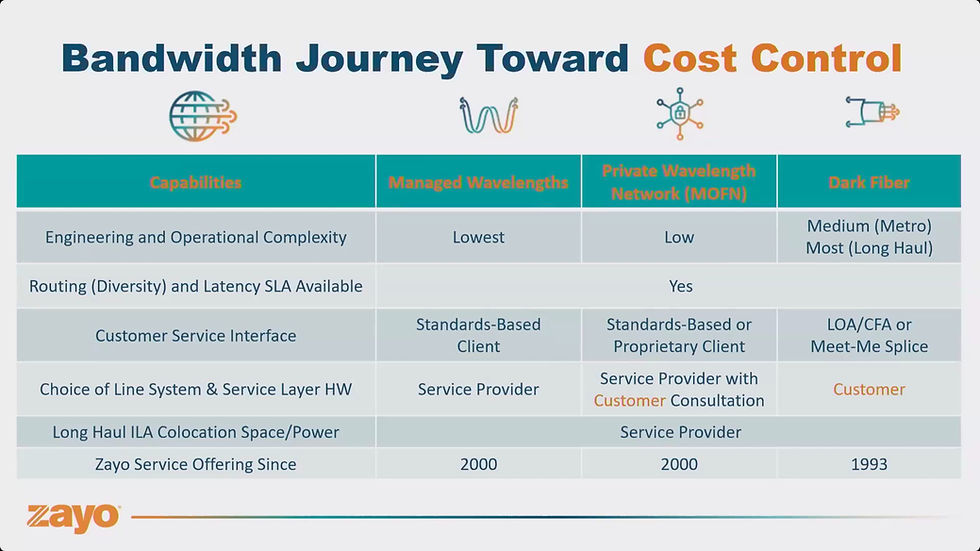
As a critical infrastructure provider, Zayo described customers shifting from managed wavelengths to dark fiber:
800G services go live: Zayo's core wavelength network is already 100% 400G-capable, and it plans commercial deployment of 800G wavelength services by the end of 2026.
The value of hollow-core fiber: For latency-sensitive Scale Across applications, hollow-core fiber could widen the geographic radius, but it is still held back by standardization and cost challenges.
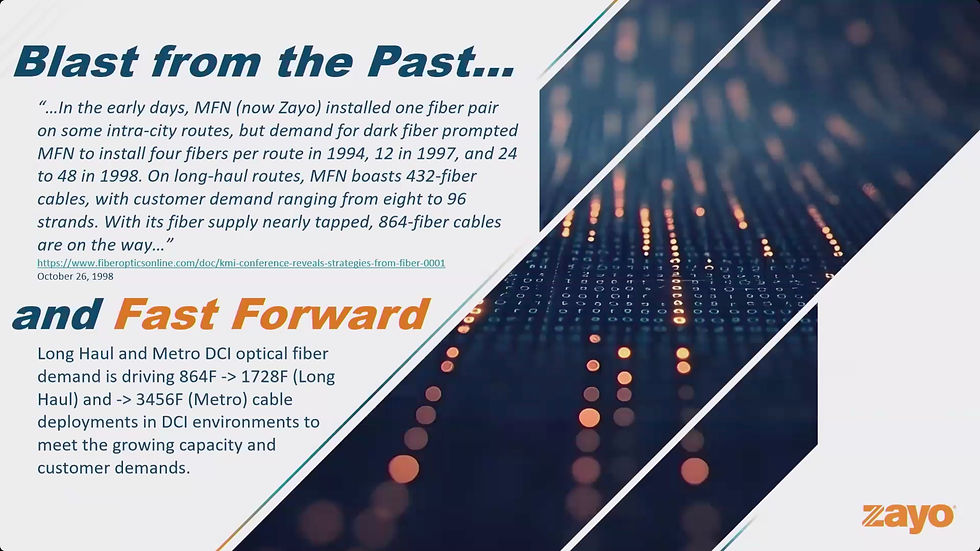
Staggering capacity demand: Fill a single route with 11,000 fibers using C+L band technology, and total capacity approaches 0.5 exabytes per second (exascale).







4. Lumen (Francis Ferguson): The Physical Force Behind AI Infrastructure
Lumen aims to be "the trusted network for AI," with a strategy focused on aggressive physical-layer expansion:
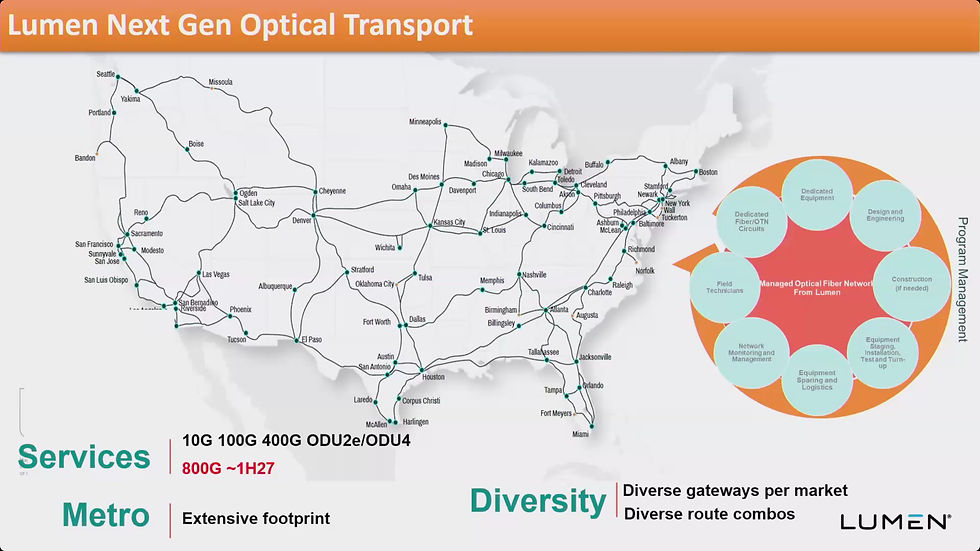
Fiber asset expansion: Lumen owns 17 million fiber miles today and plans to add another 41 million fiber miles over the next 3-5 years through its partnership with Corning.
Miniaturized optical facilities: To handle massive fiber counts, Lumen is building ILAs (in-line amplifier sites) in remote areas as "micro data centers," using precast concrete structures and efficient cooling.
1.7K-fiber deployments: Lumen has started pulling cables with as many as 1,724 fibers into existing conduits, showing that bandwidth demand has shifted from single fiber pairs to massive cable counts.



5. Nokia (Rodney Dellinger): The "Quadrification" of Hardware
Representing the vendor view, Nokia proposed a tiered response to market demand:
Jevons Paradox: Efficiency gains drive even greater resource consumption. When the cost of 800G modules halves, market capacity demand doubles.
Four product line roadmap:
Power-optimized: For short-reach coherent applications.
IP over DWDM: Pluggables advancing to 1.6T/3.2T.
Thin Transponders: A full-spectrum appliance offering very easy deployment.
Embedded Engines: For extreme-performance needs such as subsea.
A leap in energy efficiency: Today's 800G modules draw only about 28W, one hundredth of a 100G transponder 15 years ago, with 8x the capacity.


Consensus and Divergence
Technical Consensus: Pluggables Dominate
The two hyperscalers (Meta, Google) and the carriers (Lumen, Zayo) strongly agree: pluggable coherent optics are the key to lowering total cost of ownership (TCO). Even on 1,200km to 1,500km long-haul links, 800G modules are starting to threaten traditional embedded transponders.
Strategic Divergence: Hollow-Core Fiber and Latency Paths
The carrier (Zayo) is highly interested in hollow-core fiber to solve Scale Across latency, seeing it as a physical tool to widen data center site selection.
The hyperscaler (Google) is more cautious, seeing major operational deployment challenges for hollow-core fiber; in the near term its main strategy remains scaling out with more conventional fiber.
Simple Tech Trend View: Gigawatt Clusters Usher in a "Fiber Premium" Era
From this panel, STT's editor-in-chief sees a key trend: the main battleground of optical communications is extending from "data rate" to "deployment density and energy density."
A windfall for the fiber supply chain: Lumen's massive contract with Corning and the 11,000-fiber routes Zayo mentioned suggest that fiber cable makers and installers (such as Corning and Prysmian) will see a revenue surge over the next 24 months.
A transition period for LPO/CPO: Meta said it is watching the evolution of CPO (co-packaged optics), but pluggables remain mainstream in the 800G and 1.6T generations, a foreseeable tailwind for module and component players (such as Coherent, Marvell and Broadcom).
ILAs become infrastructure: When 1.6 petabits of data flow through a 3kW rack, ILA design will evolve from simple amplifier huts into small data centers, pushing industrial power and cooling technology out to the edge.
Outlook: Over the next 12 months we will see more field deployments of 800G ZR/ZR+. AI's "Scale Across" demand will force carriers and cloud giants into deep alliances (such as the MOFN model). Optical communications is no longer just an external accessory to the data center, but an indispensable "rubber band" holding gigawatt AI clusters together.


Comments