


ECOC 2026 | No Tech Revolution for a Decade, Only a Manufacturing War: Three Points of Consensus from Lumentum, Coherent, Marvell, and Ciena
The closing Market Focus panel at ECOC 2026 put Lumentum, Coherent, Marvell, and Ciena at the same table, and the moderators asked: "How will optics keep up with AI over the next three to five years?" The four answers were surprisingly consistent, and none of them romantic: demand has no bubble problem, technology has no revolution problem, and the real battlefield is manufacturing. The Coherent speaker went further — there will be no disruptive technology shift in the next decade, because everyone's energy will be consumed just keeping up with growth. For Taiwan's supply chain, that's both good and bad news: the good news is the roadmap won't suddenly be overturned; the bad news is that winners will be decided in the least glamorous places — yield, process, and automation.
1. Why Four Companies on One Stage Matters: The First Direct Answer to "Is This a Bubble?"
This 55-minute panel was part of the Market Focus track on Day 3 of ECOC 2026, co-moderated by Jon Pugh of Optica and Loukas Paraschis of Lumentum. On stage were Giovanni Barbarossa of Coherent (senior advisor to the CEO, former chief strategy officer), Rafik Ward of Lumentum, Xi Wang of Marvell, and David Rothenstein of Ciena. Systems, silicon, components, and materials/manufacturing all at once — a combination rarely seen at ECOC.
The opening question was the most practical one: AI is pouring pressure into the entire optical communications ecosystem — can this demand hold up? Ciena's answer was to split demand into three parts rather than lumping everything under "AI is hot."
The first is non-AI traffic. Cloud backbone and network application traffic didn't stop growing when AI arrived; by their estimate, this segment still has about 30% growth through 2030. The second is distributed AI training — because a single data center can't get enough power, training workloads must be split across multiple sites, and by 2030 roughly 30% of workloads will run on such distributed architectures. The third is inference, which is only just beginning: "The past few years were about building and training large models; the next few years are about distributing and monetizing that massive investment."
He quoted a line he heard at an AI infrastructure summit the week before — the most memorable line of the session:
Compute started the AI race, but networking decides who can scale.

▲ Ciena's three demand engines — non-AI traffic, distributed training, and inference — and the line "compute started the race, networking decides who can scale." Source: Simple Tech Trend
2. The Order Has Flipped: Connectivity Used to Wait for Compute; Now Compute Waits for Connectivity
Marvell's angle was closest to system architecture itself. He pointed out that the biggest change from general-purpose to AI computing isn't the compute numbers but that the order of innovation has been completely reversed.
The old rhythm: hardware and network infrastructure came first — subsea cables, terrestrial networks, and data centers laid down layer by layer — and compute caught up later; "compute was always two generations behind." Now it's the opposite: AI and compute run out front, and connectivity has become the side that must chase. This reversal is exactly why optical vendors are suddenly in the spotlight — not because optics got better, but because it became the limiting factor.
On that premise, he split interconnect into three layers — scale-up, scale-out, and scale-across — and previewed a fourth: scale-in, pulling optics into the package to connect directly to compute and memory. His recurring line: light is the carrier of data, electricity is the language of compute, and how to build that bridge at AI scale is the one big question facing the industry now.
Notably, unit volumes across these four layers differ by orders of magnitude. The further in you go, the higher the unit volume, the lower the unit price, and the less tolerance for power and yield issues. That's also why the same companies bet on seemingly contradictory solutions at once — they aren't competing for the same slot at all.

▲ Four interconnect tiers and their technology mapping: scale-across uses multi-rail fiber and coherent; scale-out is home turf for pluggables and LPO; scale-up is contested by CPO/NPO/slow-and-wide; scale-in is further out but has the largest unit volume. Source: Simple Tech Trend
3. "Which One Wins" Is the Wrong Question
The moderators pressed the question every attendee wanted to ask: with so many options — CPO, NPO, external light sources, pluggables, slow-and-wide — which one will win?
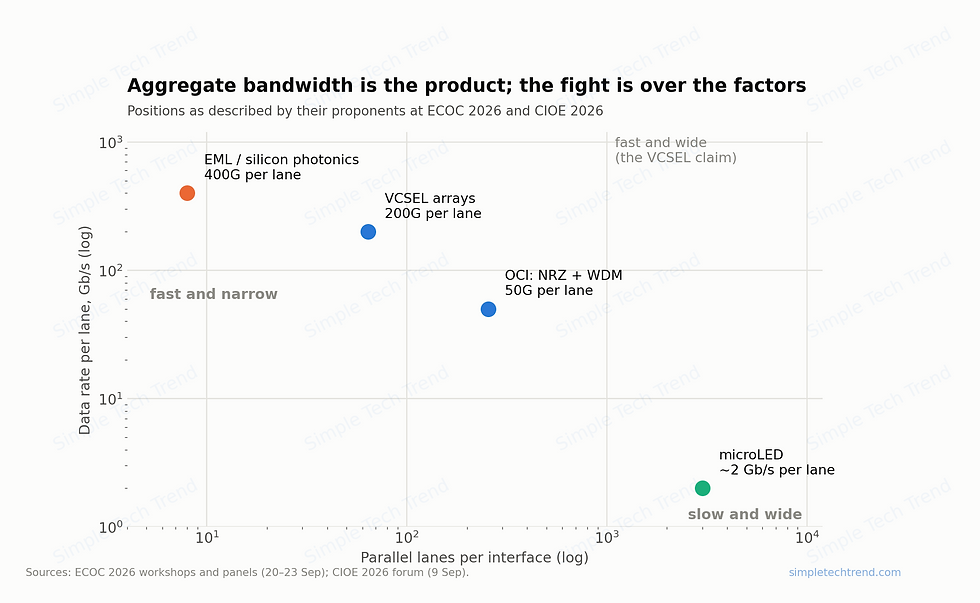
Lumentum's answer was candid: the industry periodically hits moments of "convergence" when everyone slowly aligns on a common roadmap, but this is clearly not one of those moments. We're in a divergent phase: many competing, overlapping solutions with no clear winner, and no answer yet on whether NPO or CPO comes first or in what order; the fast-and-narrow vs. slow-and-wide debate even forks again within the slow-and-wide camp. He added a line only a veteran could deliver: looking back, the answer often seems obvious, but looking forward, it never is.
In our take on the ECOC 2026 | Three Hours of Fast-Narrow vs. Slow-Wide, and Nobody Defined "Slow" workshop, we discussed the same phenomenon: debates stay unresolved often because people don't even share definitions of the terms.
Ciena flatly labeled either/or framings like "copper or optics, pluggable or co-packaged" an "almost dogmatic debate." Their view: all of these will happen, and multiple technologies will coexist for years. As per-lane rates move from 100G to 200G to 400G, and modules stack from 800G to 1.6T, 3.2T, and 6.4T, what changes is the fuel mix, not which fuel gets switched off. Pluggables will be around for a long time; CPO and NPO will enter the market in the next few years and then stay for a long time as well.

▲ Illustrative 2026–2030 interconnect technology mix — copper's reach is shrinking but it isn't disappearing, pluggables stay entrenched, CPO/NPO phase in, and slow-and-wide and OCS each find their place. Source: Simple Tech Trend (illustrative, not a market forecast)
4. The Real Incentive for Slow-and-Wide: A Production Line Someone Else Already Built Up
The most valuable stretch of the panel was the back-and-forth between Lumentum and Coherent on GaAs, because it pulled "slow-and-wide" out of technical debate and back into supply chain reality.
The Coherent speaker first cited Face ID: that supply chain went from a few million units a year to hundreds of millions, pulled along by Apple's design — one of the few cases of compound semiconductors truly reaching consumer-scale volume. Lumentum completed the story: that's GaAs, not InP, and both companies invested in those lines; but smartphone shipments haven't grown in years and each generation keeps shrinking the die, so those lines have idle capacity today — and they were designed from the start to produce photons in huge volumes.
Put the two together and slow-and-wide's appeal is clear: it's not just lower per-lane rates, lower power, and lighter DSP load; more practically, it can route around the InP choke point and ride a line already scaled up by consumer electronics that still has headroom. Marvell put it even more directly: the industry is hitting a ceiling in materials and capacity, and if you're willing to design architectures to be "wide and slow," you can use large numbers of micron-scale components born for consumer markets and already proven in volume, then bridge them on the electronic side.
The other side of this argument needs to be stated clearly too: idle GaAs capacity is built for 3D-sensing, short-reach device specs; converting it to high-density arrays for data centers means redoing wavelength, reliability, temperature specs, and test methods. Capacity isn't yield, let alone automotive-grade reliability. That's also the conclusion of the light-source workshop in ECOC 2026 | Data Centers Need Billions of Lasers, but the Bottleneck Is the 5 Minutes It Takes to Attach Them: the real bottleneck often isn't generating light but getting it into the system.
5. The Bottleneck Isn't Light, It's Manufacturing — a Road Silicon Wafers Finished 30 Years Ago
The Coherent speaker spent an entire segment on a very unfashionable topic: wafer size.
Electronics moved from 4-inch to 6-inch wafers in the 1980s, from 6-inch to 8-inch in the 1990s, and then on to 12-inch. Compound semiconductors in photonics are still working their way from small diameters toward 6-inch today. His conclusion was sharp: on the manufacturing side, photonics is still very far behind electronics — that's where the room for innovation is, but there are no shortcuts — nothing replaces materials science, and nothing replaces process technology, because real differentiation ultimately only grows from there.
Marvell added the same point from another direction. Their approach treats packaging itself as the object of optimization: first ask whether some packaging can be removed so components ship as bare die, making assembly more like building an iPhone — fewer stations, less manual labor, automation taking over — so customers can scale and ship quickly. This isn't a cost issue; it's a capacity flexibility issue.

Ciena framed this as an acceptance criterion: every solution discussed on stage is essentially about lowering power, cost, size, and latency while raising capacity, density, and signal integrity; but if you haven't designed manufacturability into the architecture, even the most elegant product is meaningless — if hyperscalers can't get volume, they won't buy.
6. The Most Underrated Remark: Customers Are Buying "Nothing Goes Wrong"
If I could keep only one segment of this panel for product managers, it would be Coherent's remarks on decision psychology.
His observation: the number of people who can actually sign off in this industry is astonishingly small — perhaps 10 to 20 decision-makers worldwide — and at hyperscale customers, some key decisions rest with a single person. Their shared behavior pattern: always choose the lowest-risk option. Not the most advanced, not the cheapest, but the one least likely to get them in trouble.
So his advice to new technology suppliers isn't "make the best specs" but find ways to minimize the risk customers must take on when adopting a new product. The industry's memory of failure is very long; one large-scale quality incident can make an entire generation of procurement decisions conservative.
Lumentum described the other side from a venture perspective. He said the fundraising environment for photonics startups is completely different from the past; he has met perhaps a hundred startups, and their founders fall roughly into two types: one has excellent technology development capability — but there's another gap to fill. That gap is the distance from technology to volume production to a customer willing to place an order.
Put these two segments together and you get the panel's most practical takeaway for the whole industry: good technology doesn't mean it gets bought; being manufacturable, replicable, and auditable does.
7. Build, Partner, Invest, Acquire: How the Four Allocate Their Bets
The moderators pushed to strategy: when do you build, when do you partner, when do you invest? Ciena's framework was the most complete and can be used directly as a decision table:
Build: if it builds on existing capabilities, do it yourself.
Partner: if the market is still uncertain, or you want to hedge before making a bigger strategic decision, find a partner.
Acquire: look at what the market needs and whether you can get there on your own while the market still exists — time is the real variable in M&A.
Invest: use corporate venture capital to understand emerging, disruptive technologies in adjacent markets — essentially buying a ticket to see the future.
He was also frank: bet long enough and you'll lose a few hands; that's the nature of the business. Lumentum added another M&A criterion — strategic fit is hard to describe, but you know it when you see it; and partnerships often happen when "each side has half the capability."
Coherent laid out the competitive reality: customers can go to four, five, or six suppliers for the same thing. In that structure, suppliers without differentiation just get price-compared. Marvell's answer is to go back to the foundation — deepen reusable technology building blocks so the same stack serves both scale-up and scale-out, and treat the ecosystem as an asset that must be maintained together. Lumentum summed up the whole segment in one line: the market is big, so knowing what you're good at matters more than anything.
8. What's Next on the List: OCS, and "Moving into the Package"
Asked which architectures excite them most, two topics came up.
The first is OCS (Optical Circuit Switch). Lumentum's description was vivid: it's a relatively new product category, and when you explain its capabilities to customers, you can almost see the gears start turning in their heads — because it's open and general enough to be placed in many different parts of the network. He expects OCS use cases to multiply over time. Coherent offered a clear technical wish: whoever can raise OCS switching speed will open up new room for innovation.
The second is what Marvell called "tearing down the wall": if optics can extend all the way to compute and then to memory, network tiers can be dramatically flattened, and the whole system can finally be optimized as one. He also pointed to the moving boundary — copper's reasonable reach is shrinking inward to distances of just a few millimeters, and everything beyond that is optics territory.
Ciena gave the most down-to-earth one: multi-data-center interconnect. Because power loads at a single data center have topped out, hyperscalers must split training workloads across sites; back-end GPU-to-GPU traffic runs at tens of Pb/s, far beyond what a single fiber can carry, so it must go multi-fiber, multi-rail. In his words, the fiber rail is becoming the new unit of data center capacity — the point isn't digging another conduit but densifying existing fiber assets so operators can upgrade without rebuilding in-line amplifier sites.
9. What It Means for Taiwan's Supply Chain
Distilling what the four said, Taiwan's supply chain really needs to watch only three things.
First, the timeline for materials and substrates has been confirmed. When Coherent goes as far as saying "nothing replaces materials science and process technology," it's effectively admitting that InP and GaAs capacity, wafer size, and yield will be the real gate for the next several years. That matches our view in You Can Ban Modules, but Not Substrates: Optical Communications' Decisive Battle Has Moved Down to Indium Phosphide — the expansion pace of substrate and epi makers will determine how many orders module makers can take.
Second, the value of packaging and test is rising, and structurally so. Marvell's bare-die shipping and automation, Ciena's manufacturability criterion, and Coherent's risk minimization all point to the same process stage. For companies in fiber coupling, packaging, and test, such as ASE, FOCI, and EZconn, this is both an opportunity and a responsibility — Opening Up the Package: What's Holding CPO Back Isn't Light, but the Test Nobody Wants to Talk About is about exactly this.
Third, don't bet on a single route. The panel's most consistent consensus was multi-route coexistence. Bet everything on CPO and you miss the pluggable long tail; bet everything on pluggables and you miss the scale-up explosion. The truly safe position is building capability in links used across all four tiers — light sources, fiber coupling, passive components, test, and mechanical parts.
The counterargument deserves mention too: all four are incumbents with vested interests, and "multi-technology coexistence" is both their judgment and their safest public stance. Truly disruptive change is never announced by the companies on that stage.
10. Conclusion
This panel announced no new specs and showed no new products, but it described the true state of the optical communications industry in 2026 more clearly than any technical session: the divergent phase of technology routes isn't over, but the industry has already shifted its effort from "inventing" to "being able to make it."
Coherent's line — "there won't be a major technology shift in the next decade, because we'll use everything we have just keeping up with growth" — sounds conservative, but it's actually the strongest possible warning to the supply chain: over the next few years, who makes money won't be decided by whose technology is most elegant, but by who can deliver reliably and in volume at exactly the moment customers fear something going wrong.
For Taiwanese companies, that translates into a single action: put resources into yield, automation, and test, not into the next buzzword.
This article is for technology and industry trend analysis only and does not constitute investment advice.
Related Reading
ECOC 2026 | Three Hours of Fast-Narrow vs. Slow-Wide, and Nobody Defined "Slow": The Real Watershed Is 448G: the route debate from the same ECOC; read it first and this article's "multi-technology coexistence" will land harder.
ECOC 2026 | Data Centers Need Billions of Lasers, but the Bottleneck Is the 5 Minutes It Takes to Attach Them: a breakdown of light-source and packaging bottlenecks, extending sections 4 and 5 of this article.


Comments