


It Wasn't Physics That Killed Slow-and-Wide, It Was 60,000 Fibers: The Network's Shape Before 2029 and Who Wins
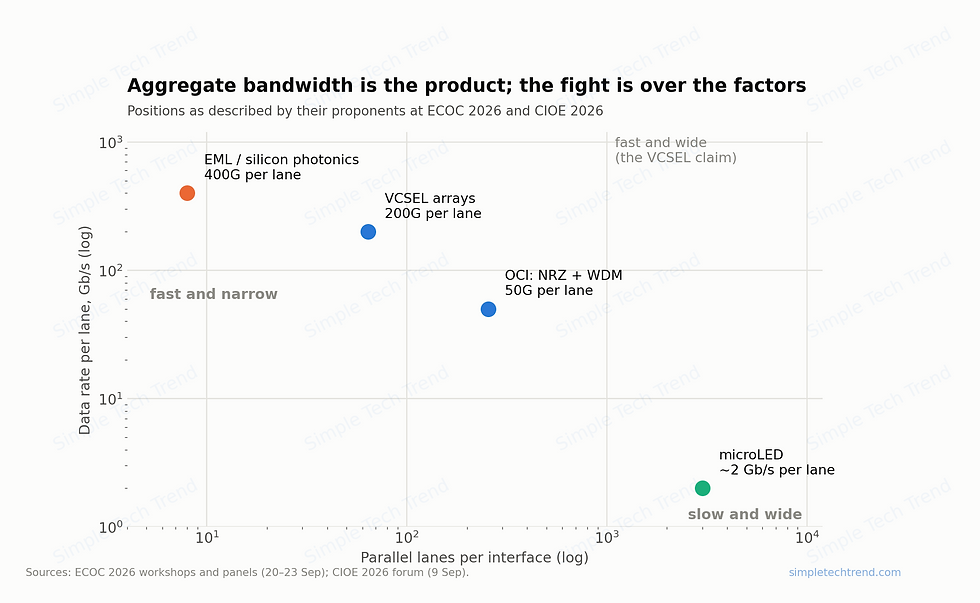
2026's biggest architecture debate splits like this: faster individual lanes (fast-and-narrow), or many more slower lanes (slow-and-wide)?
At ECOC, Microsoft made the most quantified case for the latter: even if the optics consumed zero power, fast-and-narrow SerDes alone cannot get below 1 pJ/bit. Memory links can't even absorb 100 ns of DSP/FEC latency, because a local memory access takes only 80 ns. Microsoft chose microLED because each lane needs only about 2 Gb/s, and top-surface emission trades linear shoreline density for areal density. Yet the same week, NVIDIA disclosed that its own slow-and-wide research project had been paused — not because the optics couldn't be built, but because the estimate came to 60,000 fibers per floor, and fiber and connector cost blocked it. The third topic on the same stage was OCS: analysts put current reality at 95% to 99% of OCS port shipments concentrated in a single customer's TPU reconfiguration use case.
The significance isn't architectural — it's the cost structure: every scheme that trades parallelism for bandwidth ends up billing the fiber and connectors, which is exactly where failure rates are highest.
Inside the Premium Section
The full slow-and-wide case: the SerDes 1 pJ/bit floor, the 80 ns memory threshold, and the math of trading redundancy for reliability
The reverse gearbox tax: a rarely documented mechanism that eats away on-paper power savings
20 / 10 / 5.6 / 4.7 / <4 pJ/bit in one table, with which figures include the light source
The sources and meaning of the four fiber counts: 64 / 1,152 / 4,096 / 60,000
OCS's real market: where the 95–99% sits, what the next application is, and why switching speed isn't the point
Why the company betting on slow-and-wide paused its own project
Which segment of Taiwan's supply chain each of the three paths benefits, and which path is least favorable
Eight counterarguments and six signals to watch
That's the summary of this piece.
STT's full read — how the supply chain reshuffles once this threshold falls — is in the premium section, with 3 original charts.
👉 Subscribe to STT Premium — read the full analysis on vocus (in Chinese): https://vocus.cc/article/6ab4ef5cfd8978000168480c


Comments