


850 nm Didn't Lose on Speed, It Lost on Junction Temperature: The 1060 Generation Replaces the Entire Chain
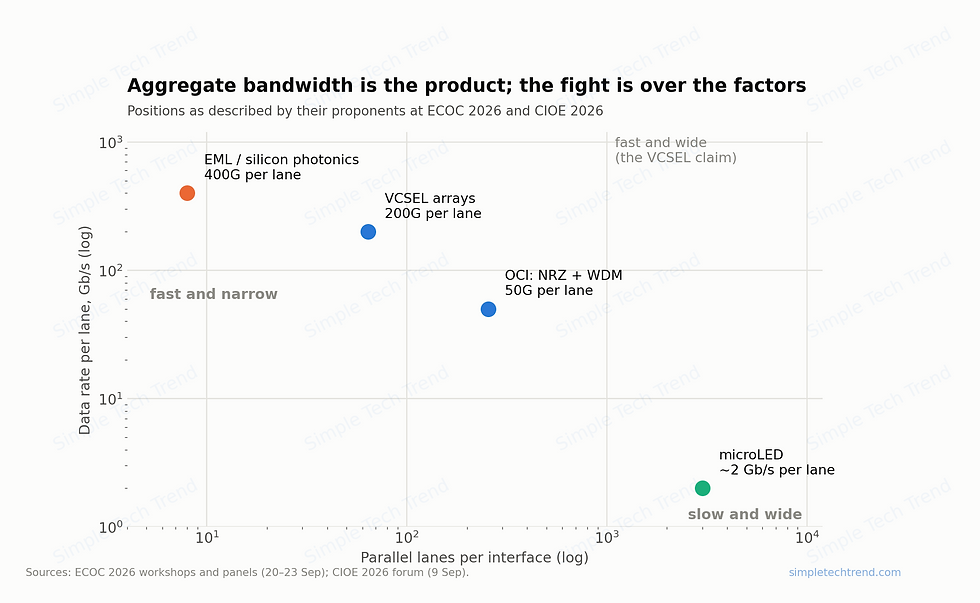
850 nm multimode has been the data center default for thirty years; the wavelength hasn't moved since the standard was set in 1999. In 2026 that answer is being challenged from two directions at once — silicon photonics claims it will eat short reach, and microLED claims it will eat even shorter reach.
ECOC 2026 gave an answer different from both. On Day 4, Lumentum showed a same-structure comparison: with the structure completely unchanged and only the active region swapped, 1060 nm ran 5000 hours with zero failures at a 115°C oven temperature and roughly 180°C junction temperature; 850 nm under identical conditions began to wear out at 2000 hours. And that 850 nm device that wears out is one that would pass production 100G specifications. The same week, Berxel pushed a 1060 nm back-emitting VCSEL to 106 Gb/s PAM4 over 100 m of OM3, with RIN better than −150 dB/Hz at just 4 mA bias, and used a meta lens integrated on the GaAs backside to achieve ±22 µm radial coupling tolerance; NVIDIA, meanwhile, poured cold water on it all: every 200G VCSEL so far is only a room-temperature demo.
The significance here is not the wavelength but the supply chain: moving to 1060 isn't swapping a die — fiber, PD, packaging and standards all change together.

In the Paid Section
The mechanism of carrier density and photon energy, and who "would pass production 100G specifications" is aimed at
The four ecosystem gaps for 1060: fiber, PD, packaging and standards (with original figure)
The real threshold for 200G: the gap between record values and deployable values (with original figure)
How back-emission + flip-chip + meta lens with ±22 µm tolerance rescues passive alignment
Definitions and comparability of FIT < 0.03, <50 ppm and 25 billion device hours
Four positive demand-side signals, including why one Chinese cloud provider says VCSELs still beat silicon photonics in the 3.2T generation
Why the side betting on wide-and-slow paused its own project
Taiwan's supply chain segment by segment: epitaxy, foundry, packaging & test, modules — opportunities and barriers
Nine counterarguments and six signals to watch
That's the summary of this article's key points.
STT's full analysis — what this comparison chart really means, and who can integrate the 1060 generation — is available in the paid section, with 3 original charts.
👉 Subscribe to the STT paid section and read the full analysis on vocus (in Chinese): https://vocus.cc/article/6ab4e864fd8978000166daae


Comments