


ECOC 2026 | Same Day, Same Wavelength, Opposite Answers on Fiber: Lumentum Says OM3 Won't Work at 1060nm, Berxel Just Ran 100m of OM3
This talk was given by Connie Chang-Hasnain on behalf of Berxel Photonics, and its value lies in two things. First, on the familiar "fast and narrow vs. slow and wide" chart, she drew a 45-degree arrow labeled fast and wide: using back-emitting VCSELs to win on both channel count and per-lane speed instead of choosing one. Second, and more pointed: earlier the same day, Lumentum told the audience that OM3 and OM4 are "simply not specified and cannot be used" at 1060 nm; Berxel's slides stated outright that 940 and 1060 nm work over existing multimode fiber, and showed 25 Gb/s NRZ over 100 m of OM3 at 140°C and 50 Gb/s NRZ over 100 m of OM5+ at just 4 mA bias. Both are serious 1060 nm players, and they gave completely opposite answers on whether fiber needs to be replaced. For Taiwan's fiber and connector supply chain, this matters more than any bandwidth number.
1. The 45-Degree Arrow: A Third Path Beyond Fast-and-Narrow and Slow-and-Wide
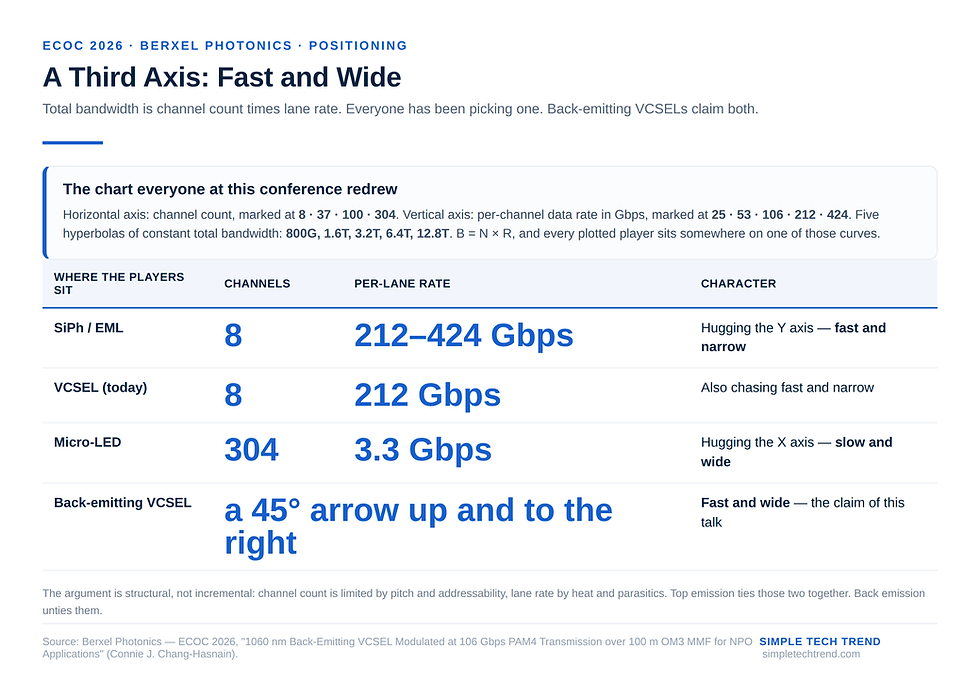
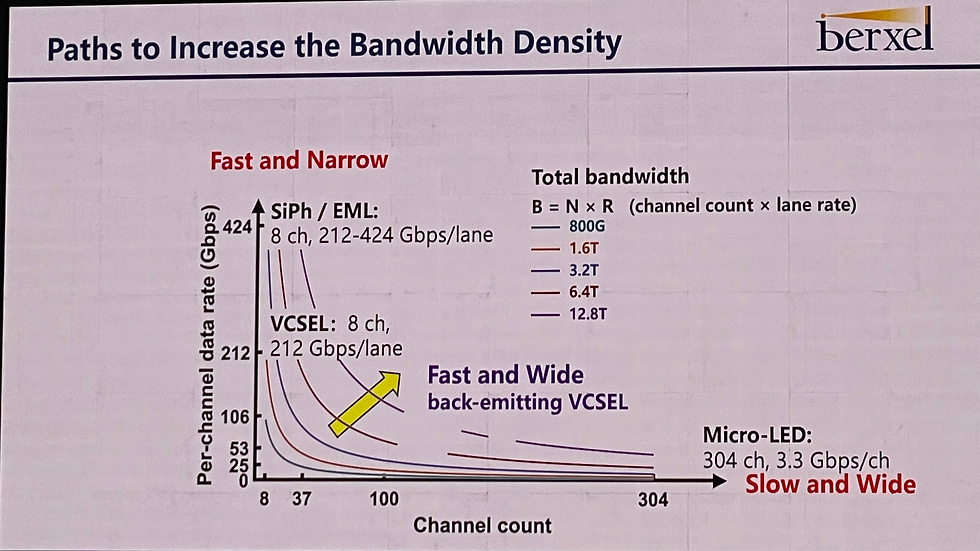
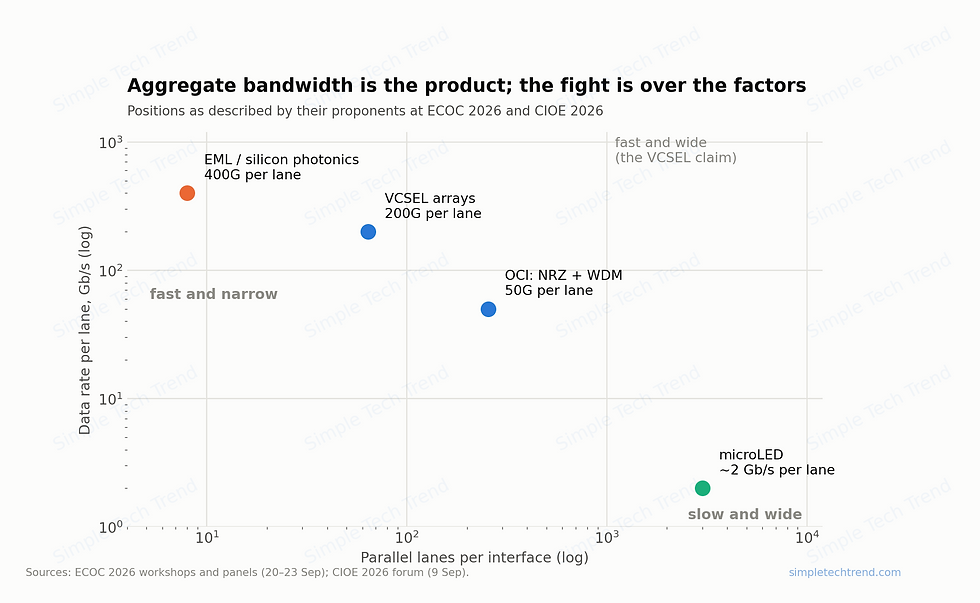
From the workshops to the market focus sessions, this year's ECOC kept circling the same question: total bandwidth B = channel count N × per-channel rate R. So how do you get to B?
Berxel's positioning chart is clean: the x-axis is channel count (8, 37, 100, 304), the y-axis is per-lane rate (25, 53, 106, 212, 424 Gbps), and five constant-bandwidth hyperbolas mark 800G, 1.6T, 3.2T, 6.4T and 12.8T. Three players are plotted on it:
SiPh / EML: 8 channels, 212–424 Gbps/lane — hugging the y-axis, classic fast and narrow
VCSEL: 8 channels, 212 Gbps/lane — today's VCSELs are also chasing fast and narrow
Micro-LED: 304 channels, 3.3 Gbps/ch — hugging the x-axis, classic slow and wide
She then drew a yellow arrow pointing up and to the right at 45 degrees, labeled Fast and Wide: back-emitting VCSEL.
The positioning is interesting because it doesn't pick a side; it argues that the back-emitting structure removes both constraints at once: channel count is limited by device pitch and addressability, while speed is limited by heat and parasitics. Top emission ties the two together; back emission decouples them.
For the full context of the fast-narrow vs. slow-wide debate, see ECOC 2026 | Three Hours of Fast-Narrow vs. Slow-Wide, and No One Defined "Slow": The Real Dividing Line Is 448G.
2. Top Emission vs. Back Emission: Addressable Channels Go from 10 to 1,000
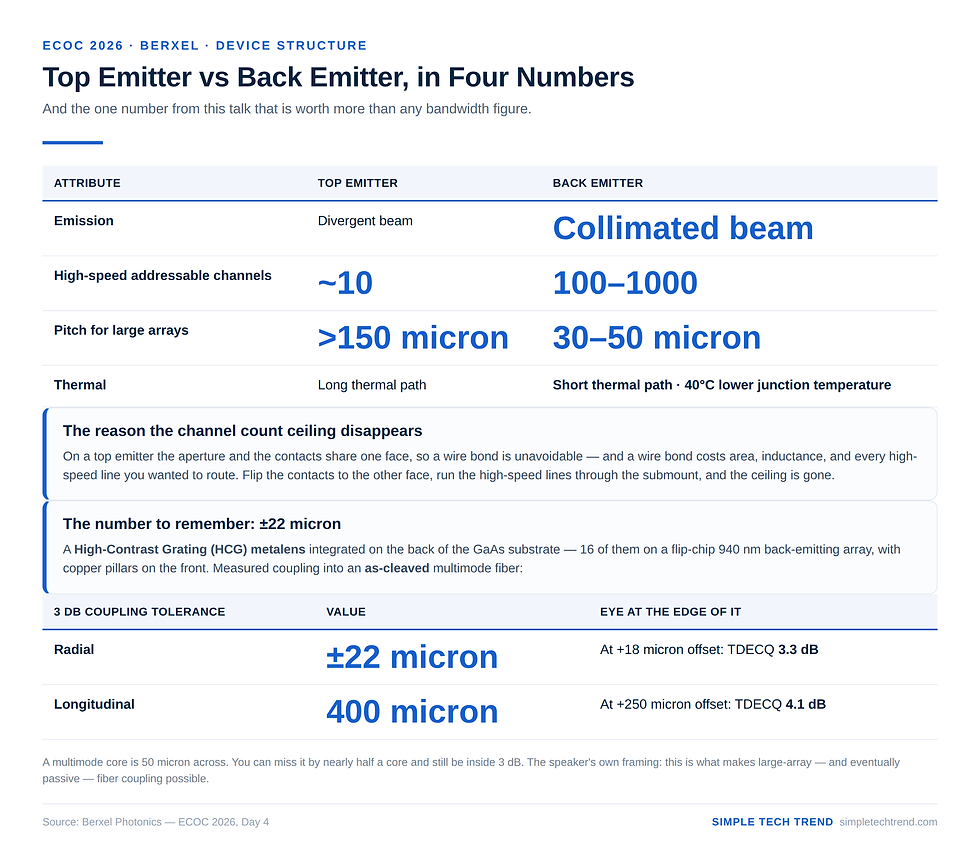
This comparison table is the most useful slide of the talk, and it gives four concrete numbers rather than adjectives:
Output beam: top emission is divergent; back emission is collimated
High-speed addressable channels: top emission ~10; back emission 100–1,000
Pitch in large arrays: top emission >150 µm; back emission 30–50 µm
Thermal: top emission has a long heat path; back emission a short one, with 40°C lower junction temperature
The three numbers deserve separate readings.
Addressability jumps from 10 to 1,000 because in top emission the emitting surface and the contacts are on the same side, so wire bonds are unavoidable. Wire bonds take up area, add inductance and limit how many high-speed lines you can route out. Back emission flips all contacts to the other side for flip-chip, high-speed lines run through the submount, and the channel-count ceiling disappears.
Pitch shrinks from >150 µm to 30–50 µm, which is the direct source of shoreline density. The slide claims bandwidth density of 10s of Tbps/mm, and the speaker put it more bluntly: "The other dimension of a 2D array comes for free, so I think 10 Tb/s per millimeter is achievable." Compared with the 4 Tb/s/mm Lumentum quotes for its first generation and the 0.8 Tb/s/mm of NVIDIA's microring test chip, this is aggressive, but the logic holds — a 2D array should never have been measured against a 1D shoreline.
40°C lower junction temperature is exactly the same physics as in Lumentum's talk: thermal resistance sets Tj, and Tj sets lifetime. The two companies quote it differently (Lumentum says roughly 40% lower thermal resistance, Berxel says 40°C lower Tj), but both point to the same conclusion — in 2026, back emission plus flip-chip is no longer one option among many; it is the ticket for VCSELs to enter NPO/CPO.
3. The HCG Metalens: ±22 µm Alignment Tolerance Is the Real Product Here
If I could take only one number away from this talk, it would be this one.
Berxel integrates a high-contrast grating (HCG) metalens on the back side of the GaAs substrate — the very technology Connie Chang-Hasnain spent twenty years developing at Berkeley, now inside a production device. The slide shows an SEM image: a 940 nm flip-chip back-emitting VCSEL with copper pillars on top and 16 integrated HCG metalenses on the back.
The result:
3 dB radial alignment tolerance of ±22 µm, and longitudinal tolerance of 400 µm.
This number needs context. A multimode fiber core is 50 µm, which means you can be off by nearly half the core and still keep coupling loss within 3 dB. The 0.4 mm longitudinal tolerance is even more striking — that's a distance visible to the naked eye. And it was measured with as-cleaved multimode fiber (MMF), not polished end faces.
The slide also shows two eye diagrams: TDECQ of 3.3 dB at a +18 µm offset and 4.1 dB at a +250 µm longitudinal offset — even that far off, the eye stays open.
The speaker spelled out what this means: "This guarantees the possibility of large-array fiber coupling, and ultimately passive coupling."
Passive coupling is the key phrase. The real capacity bottleneck for light sources and packaging isn't epitaxy or testing — it's the few minutes of active alignment spent attaching the fiber. We broke this down fully in ECOC 2026 | Data Centers Need Billions of Lasers, Yet the Bottleneck Is the 5 Minutes It Takes to Connect Them. A ±22 µm tolerance effectively downgrades that step from "alignment" to "placement".
4. The 940nm Scorecard: Error-Free at 140°C, and a 16-Channel 1.6T NPO Module
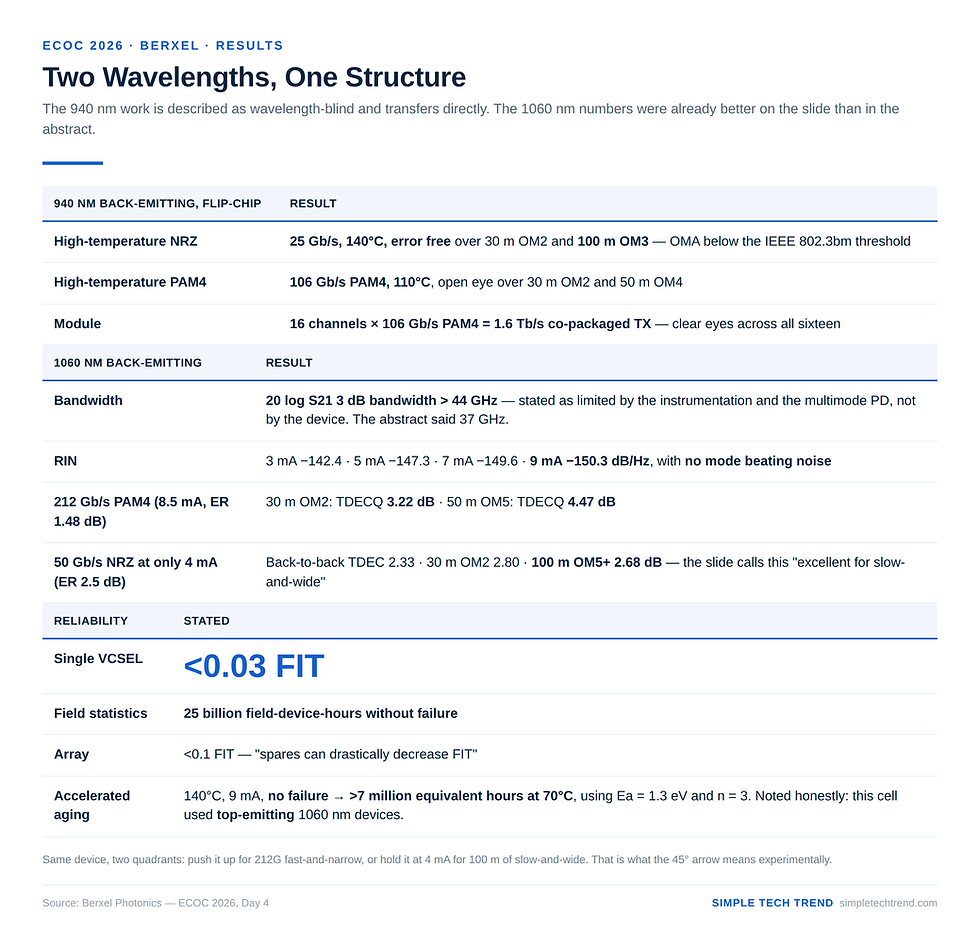
The speaker made a point of saying the 940 nm results are "wavelength blind" and carry straight over to 1060 nm. So this section isn't old news; it's the technical foundation.
The high-temperature slide is hard-hitting:
25 Gb/s NRZ, 140°C, error-free transmission over 30 m of OM2 and 100 m of OM3, with OMA below the IEEE 802.3bm threshold
106 Gb/s PAM4, fully open eye at 110°C, over 30 m of OM2 and 50 m of OM4
BER curves measured at 5 mA bias, shown for both 125°C and 140°C
How hot is 140°C? Lumentum's high-temperature eye diagrams were at 105°C on a silicon submount, and most 850 nm devices are characterized at 75–85°C. 140°C is beyond what data center components are normally required to handle.
Then there's the module: a 16-channel co-packaged transmitter at 106 Gb/s PAM4 per lane, 1.6 Tb/s in total. The slide shows 16 eye diagrams in a 4×4 grid, all open, next to a photo of the hardware — a small board with a bundle of magenta multimode fiber jumpers coming out.
The signal is clear: this isn't a device-level demo; it's module-level. A startup has already built 16-channel back-emitting VCSELs into an NPO package with every channel running.
5. 1060nm: >44 GHz, −150 dB/Hz, 212G PAM4
One detail in the 1060 nm numbers is worth noting: the paper abstract says 37 GHz bandwidth and −149.5 dB/Hz RIN, but the slides on stage had already been updated to >44 GHz.
And the speaker was candid about that 44 GHz:
20 log S21 3 dB bandwidth >44 GHz, limited by the available measurement equipment and multimode photodetectors.
In her words: "We believe it's faster than 44, but our measurement system tops out at 44. We're buying better equipment and hope to show you a better number next time." — NVIDIA's retrospective keynote at the same conference called out the 10log/20log ambiguity in VCSEL bandwidth figures; Berxel states 20 log in black and white, so this number can be compared directly.
RIN was given at four bias points: −142.4 dB/Hz at 3 mA, −147.3 at 5 mA, −149.6 at 7 mA and −150.3 dB/Hz at 9 mA, and the slide specifically notes no mode beating noise.
The transmission results come in two sets that point in opposite directions:
High-speed set (212 Gb/s PAM4, 8.5 mA bias, ER 1.48 dB):
30 m OM2: TDECQ 3.22 dB
50 m OM5: TDECQ 4.47 dB
Low-power set (50 Gb/s NRZ, only 4 mA bias, ER 2.5 dB):
Back-to-back: TDEC 2.33 dB
30 m OM2: TDEC 2.80 dB
100 m OM5+: TDEC 2.68 dB
The slide's footnote on the low-power set: "Ideal for slow-and-wide."
In other words, the same device can be pushed up to 212G for fast and narrow, or dialed down to 4 mA for slow and wide — this is what the 45-degree arrow means experimentally: not a compromise, but one device covering both quadrants.
6. The Direct Contradiction: Can OM3 Be Used or Not?
Now for the most interesting part of this talk.
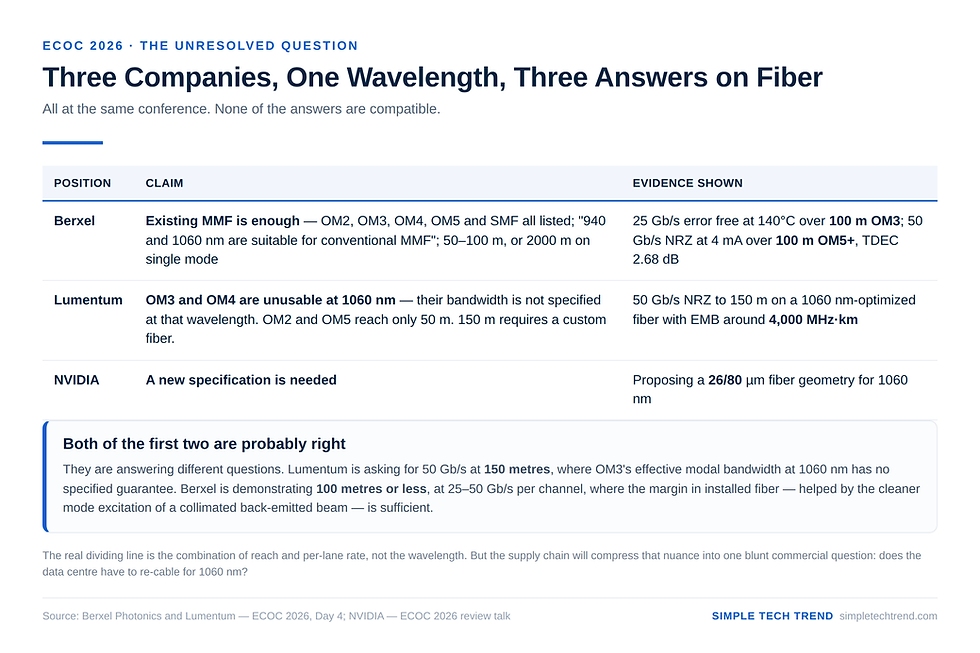
On the same day and in the same track, Lumentum, presenting its 1060 nm VCSEL arrays, concluded on fiber that OM3 and OM4 are ruled out because their bandwidth simply isn't specified at 1060 nm; only OM2 and OM5 work, and only up to 50 m; reaching 150 m requires a custom fiber with modified doping that shifts the minimum dispersion point to 1060 nm.
Berxel's slide, by contrast, read:
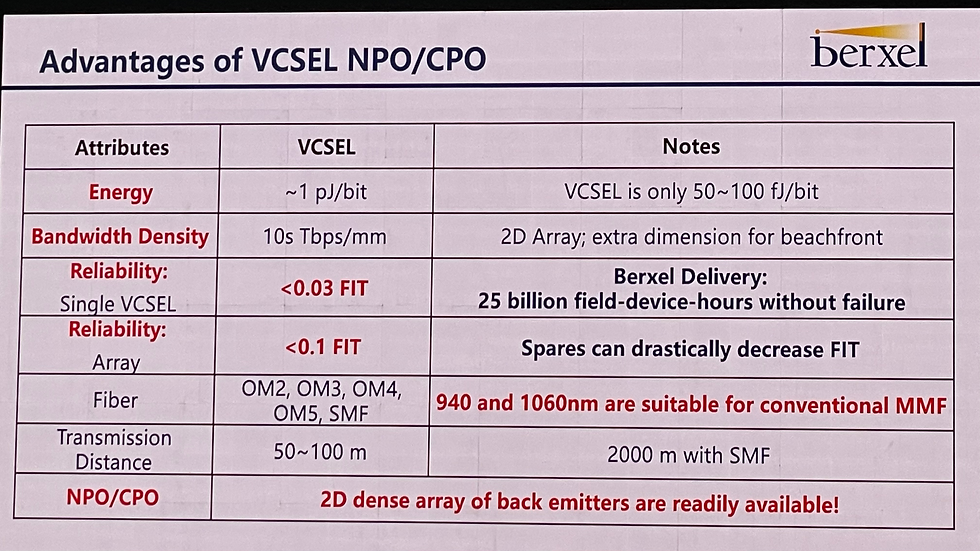
Fiber: OM2, OM3, OM4, OM5, SMF. 940 and 1060 nm work with existing multimode fiber. Reach 50–100 m; up to 2,000 m on single-mode fiber.
And it wasn't just talk — the 940 nm set ran 100 m of OM3 error-free at 140°C, and the 1060 nm set ran 100 m of OM5+ at 4 mA bias with a TDEC of just 2.68 dB.
Neither side is bluffing. So who's right?
My reading: both are right; they're answering different questions. Lumentum wants 50 Gb/s NRZ over 150 m, and at that reach the effective modal bandwidth (EMB) of OM3 at 1060 nm genuinely has no specified guarantee, so only a custom fiber that pushes EMB to 4,000 MHz·km will do. Berxel is showing reaches under 100 m — at relatively low per-lane rates like 25G and 50G, combined with the cleaner mode launch of a collimated back-emitted beam, existing OM3 has enough margin.
So the real dividing line isn't wavelength; it's the combination of how far and how fast per lane. Under 100 m and below 50G per lane, existing fiber works; go farther or faster, and the fiber has to change.
For the supply chain, though, this technical nuance gets compressed into a blunt business question: will data centers have to re-cable for 1060 nm? One side says no, the other says yes — and at the same conference NVIDIA was proposing an entirely new 26/80 specification. Three answers, none of them compatible.
For the full comparison of the seven paths diverging across scale-up optical interconnects, see After Copper Runs Out for AI: Seven Paths for Scale-Up Optical Interconnects, and Two Ways to Survive the Bottlenecks They Hit.
7. Reliability: 25 Billion Hours, <0.03 FIT and Seven Million Equivalent Hours
Berxel is a startup, so she pushed especially hard on this section — and the numbers hold up.
Field statistics:
Single VCSEL: <0.03 FIT — based on shipment statistics with zero failures across 25 billion field-device-hours
Array: <0.1 FIT — with the slide noting that "redundant channels can greatly reduce FIT"
Accelerated life testing:
High-stress condition of 140°C, 9 mA, no failures
Converted to normal operation at 70°C, that's over 7 million equivalent hours
Acceleration factor calculated with Ea = 1.3 eV, n = 3
Optical power and voltage drift curves for two wafers stay within ±10% out to 6,000–7,000 k-hrs equivalent time
An honest footnote: this reliability data comes from top-emitting 1060 nm VCSELs
That last point deserves emphasis, because Lumentum also admitted its flip-chip reliability data is still early and that nearly all current failures come from assembly. Neither company yet has complete reliability data for back-emitting flip-chip devices.
The paper abstract projects a lifetime of over 1,000 years under normal operation — the same kind of extrapolation as the "100,000-year-class MTBF" Lumentum cited, so take it with a grain of salt. What actually matters is the 25 billion hours of field statistics.
The idea that redundancy lowers FIT is exactly what Lumentum and Microsoft said at the same conference: when channels are plentiful, the marginal cost of a few spares is close to zero, so reliability is achieved through architecture.
8. Conclusion
First, some positioning: Berxel Photonics is a Chinese startup headquartered in Shenzhen, and co-founder Connie Chang-Hasnain is a leading HCG authority from Berkeley. The technical density of this talk is well beyond what you'd expect from a startup — two wavelengths (940 and 1060), from devices up to a 1.6T module, plus 25 billion hours of field reliability statistics. She closed by saying: "We're a small startup, we're ready, and we'd love to collaborate."
For Taiwan's supply chain, there are three concrete takeaways.
First, the thing to watch isn't the VCSEL itself — it's the HCG metalens. A ±22 µm radial and 400 µm longitudinal tolerance hits the entire equipment and labor cost structure of active alignment. If back emission with an integrated metalens becomes standard, value in optical sub-assembly (OSA) shifts from alignment skill to lens design and process — bad news for makers of active-alignment equipment and precision fixtures, an opportunity for those who can produce wafer-level optics. Note that Berxel's HCG is fabricated on the back of the GaAs substrate together with the VCSEL, not an attached microlens array.
Second, the fiber answer hasn't converged, and that has time value. The same conference produced three positions: Berxel says existing OM2–OM5 is enough, Lumentum says OM3/OM4 won't work at 1060 nm and custom fiber is needed, and NVIDIA is proposing a new 26/80 spec. For fiber and connector makers, it's too early to bet on any one side; a product line that supports 850/940/1060 nm all at once is the only safe position during this period of uncertainty.
Third, 2D arrays will completely change how shoreline density is calculated. The slide says 10s of Tbps/mm and the speaker says 10 Tb/s/mm is feasible, versus Lumentum's 4 Tb/s/mm — the gap isn't about device quality; it's that Berxel counts in 2D. Once everyone moves to 2D, every per-millimeter comparison in use today will have to be recalculated, and Taiwanese companies working on fan-out, submounts and fiber-bundle alignment fixtures should prepare for 2D specs with 30–50 µm pitch and 100–1,000 channels, not today's 1D linear arrays.
Verdict: the most important thing in this talk isn't 212G PAM4 or 140°C — it's ±22 µm. When a VCSEL can tolerate an offset of nearly half a fiber core while keeping coupling within 3 dB, optical packaging goes from precision alignment to simple placement — and that is precisely the most expensive, most capacity-constrained step in scale-up optical interconnects today. As for whether OM3 can be used, Lumentum and Berxel gave opposite answers on the same day, and that answer will decide whether data centers re-cable their multimode fiber over the next three years. Until that answer is in, no one should bet a production line on a single fiber specification.
This article is for technology and industry trend analysis only and does not constitute investment advice.
Related Reading
After Copper Runs Out for AI: Seven Paths for Scale-Up Optical Interconnects, and Two Ways to Survive the Bottlenecks They Hit: where back-emitting VCSELs sit among the seven major scale-up approaches, and the full breakdown of the fiber-count trade-off
ECOC 2026 | Three Hours of Fast-Narrow vs. Slow-Wide, and No One Defined "Slow": The Real Dividing Line Is 448G: why Berxel opened a third path, fast and wide, outside both camps
ECOC 2026 | Data Centers Need Billions of Lasers, Yet the Bottleneck Is the 5 Minutes It Takes to Connect Them: why a ±22 µm alignment tolerance is worth more than any bandwidth number


Comments