


It's Not the Chip That Gets You Designed In: Fiber Attach and a Speck of Dust
In CPO and NPO, the market likes to compare pJ/bit, per-lane speed and bandwidth density. Those three numbers decide whether an architecture looks good on paper, but they don't decide whose product ends up in the BOM.
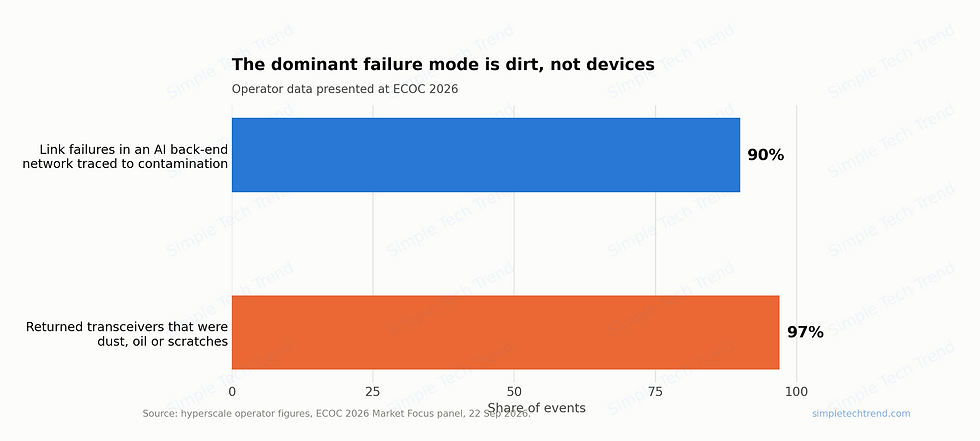
The most striking data at ECOC 2026 came from a hyperscaler's operations team: in AI back-end networks, more than 90% of link failures are related to contamination; of the transceivers pulled from switches and sent for inspection, 97% were diagnosed with dust, oil or scratches — not actual device failures. Three more numbers from the same week completed the picture: expanded-beam connector (EBO MSA) samples top out at 800 mW, which customers already say is not enough, and PM fiber compatibility is still unsolved; Corning pointed out that the real spec on the external light source path is end-to-end PER, and in its 1 RU example, 128 of the 1,152 fibers are PM fibers dedicated to the external laser source; and a UBC speaker gave the figure quoted all week long — roughly 80% of the cost of optical components sits in packaging, not in the laser.
The significance here isn't optical, it's manufacturing: when 90% of failures come from contamination and 80% of cost comes from packaging, the front line of competition isn't photonics — it's mechanics, materials and process control.
Premium Content
Concrete numbers on fiber count, per-fiber power and connector placement all getting worse at once
Two gaps in expanded-beam connectors — the 800 mW ceiling and unresolved PM support — and what they mean for ELS architectures
End-to-end PER: why a spec nobody writes on a datasheet is becoming a delivery criterion
Packaging economics: 80% of cost, six-axis active alignment, 0.8 dB coupling and a 3 µm alignment window
The derivation: at 99.865% per-end yield, a 51.2T system reaches only 23% for DR and 67% for FR
Two things admitted by the very people most eager to sell you expanded-beam connectors
Taiwan's supply chain segment by segment: connectors, FAU, packaging equipment, foundry — which one is the real opportunity
Seven counterarguments and five signals to watch
That's the summary of the key points.
STT's full read — what these numbers really mean and what Taiwanese suppliers need to close — is in the premium section, with 3 original charts.
👉 Subscribe to STT Premium and read the full analysis on vocus (in Chinese): https://vocus.cc/article/6ab4ec14fd89780001679d04


Comments