


Can You Swap the Fiber? The Most Underrated Hurdle in CPO Volume Production — and the Fifteen Companies Racing to Clear It
Technical presentations on CPO (Co-Packaged Optics) usually spend 90% of their time on three things: how the EIC and PIC are stacked with hybrid bonding, how the grating coupler is designed, and how good the 3D-stacking yield looks. All of that matters, and all of it is sexy. But walk into a data center that is actually deploying CPO, stand next to an operations engineer, and the first question they ask is often so basic it makes the design engineers wince:
"If a fiber breaks, can we swap it?"
This question, which sounds like something an outsider would ask, is in fact the hidden gate that determines whether CPO can move from the lab into volume production. And the component sitting at that gate is something long overlooked and dismissed as a "purely mechanical part" — the Fiber Array Unit (FAU). It's the small passive block that lines up a bundle of fibers and aligns them precisely to a silicon photonics chip. For the past decade nobody paid it much attention, but in the CPO generation it has suddenly become a hotly contested chokepoint in the supply chain — and around it, a battle of competing approaches is being fought that few people have explained clearly.
This article lays out that battle — the four competing coupling physics and the fifteen companies racing to own this chokepoint — in full and in depth.
1. What Is an FAU, and Why Has a Passive Part Suddenly Become a Battleground?
What an FAU does is simple: line up multiple fibers, hold them firmly in place, and make sure the light from each fiber lands precisely on a waveguide on the surface or edge of the PIC (silicon photonics chip). The most traditional approach etches a row of V-grooves into a glass or silicon substrate, lays the fibers into the grooves one by one, glues them in place, and grinds and polishes the end face. It sounds like precision machining, with little to do with "semiconductors."
The problem is that CPO makes this an order of magnitude harder. In the pluggable era, an 800G module had just 8 to 16 fibers; CPO moves the optical engine next to the ASIC, or even on top of it. A 102.4T-class CPO switch may be surrounded by 8 to 16 optical engines, each pulling out 16 to 64 fibers — hundreds to thousands of fibers in total that must be aligned and fixed simultaneously with low insertion loss, and survive high-temperature reflow during packaging.
Even more critical is serviceability. Pluggable optics dominated for a decade precisely because "if it breaks, pull it out and swap it." Hyperscalers cannot accept having to tear down an entire switch and send it back to the OSAT for re-bonding just to replace a fiber. But once CPO solders the optical engine into the ASIC package and completes hybrid bonding, it's a one-shot deal: a single bad fiber may mean replacing the entire multi-chip module; and if one fiber failure takes a whole 102.4T switch offline, hyperscaler losses run to millions of dollars per minute.
That's why "can you swap the fiber?" escalates from a minor ops issue into the big question of whether CPO can be mass-produced at all. The industry has already reached consensus that the fiber-to-chip connection must be detachable. But on how to make it detachable without sacrificing insertion loss, and in a manufacturable way, there is no consensus at all. That is where the battle of approaches begins.

2. Understand the Four Coupling Physics and You'll Understand What Every Approach Is Arguing About
Trace every FAU approach down to the bottom and they're all solving the same problem: how to get the beam leaving a fiber (single-mode fiber has a mode-field diameter of about 7 to 10µm) into an on-chip waveguide (whose mode field is only about 1µm). The two mode fields differ several-fold, and the chip side is only about 1µm, yet for volume production on a real assembly line, alignment tolerance needs to be relaxed to at least 5 to 20µm. So the whole contest boils down to one sentence: whoever can widen the alignment tolerance can mass-produce cheaply. There are four mainstream physical approaches to widening it.
The first is butt coupling (V-groove + edge coupler). The fiber end face sits directly against a waveguide at the chip edge, and light travels straight across. Insertion loss can be the lowest (under 1dB at best) and bandwidth the widest (about 120nm), but alignment tolerance is extremely tight (under 1µm laterally), and once glued it cannot be detached. It's the approach that "can be mass-produced today but has a physical ceiling."
The second is expanded beam + turning mirror. A micro-mirror first bends the optical path, and a lens then expands the beam into a large 30 to 50µm spot. With a bigger spot, lateral misalignment matters much less, so tolerance jumps to 10 to 30µm — a natural fit for pluggability. The price is an extra reflection and beam expansion, so insertion loss is somewhat higher than butt coupling (1 to 1.5dB). This is the most crowded camp.
The third is wafer-level metalens. Nanostructured flat surfaces (one-thousandth the thickness of a human hair) replace traditional 3D curved micro-lenses for focusing and steering. The key isn't the optics itself but the process — metalenses can be mass-produced on standard 12-inch CMOS lines with wafer-level packaging, ultra-thin and detachable. This is the approach that turns the FAU into a semiconductor.
The fourth is glass waveguide. Ion-exchange (IOX) waveguides inside glass, combined with passive alignment, couple fiber directly into the PIC. It sidesteps the unit-by-unit assembly of traditional V-grooves, survives reflow, is detachable, and allows flexible pitch conversion. It is the only approach that "doesn't really make a traditional FAU and aims to replace it outright."
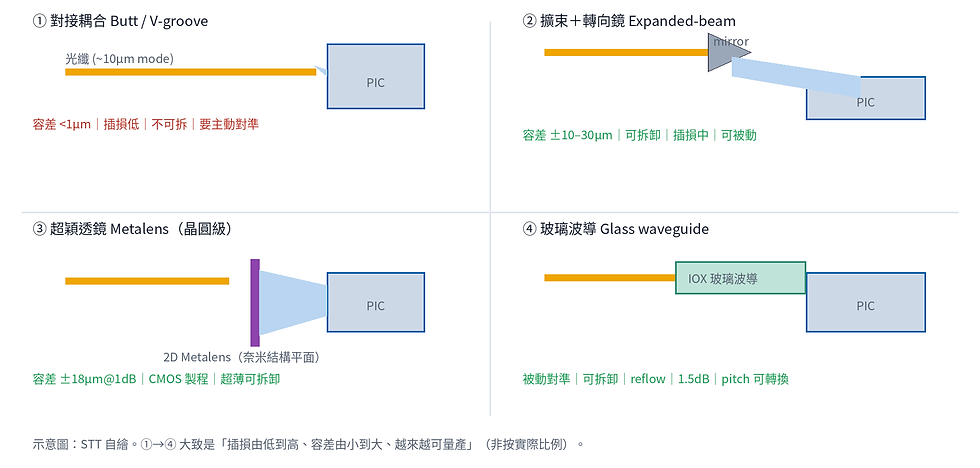
One sentence to remember this axis: from the first to the fourth approach, it's roughly "insertion loss from low to high, tolerance from tight to loose, increasingly manufacturable." Every FAU player picks a position on this line, trading insertion loss for tolerance and complexity for serviceability. There's also an often-overlooked detail that determines bandwidth density: fiber pitch. Traditional FAU pitch is 250 to 260µm; the CPO generation needs to shrink it to 127 to 130µm, and even reach an effective 64µm with double-decker designs. Every time pitch is halved, the number of fibers along the same chip edge doubles, directly determining how many Tb/s per millimeter you can move.

3. The Real Switch Is NVIDIA: From Fixed Sockets to Pluggable
To understand how the pie gets divided, start with NVIDIA's generational shift. Quantum 3400 (InfiniBand, in production July 2025) uses a fixed socket (about 120×120mm) with non-pluggable fiber; the FAU is almost exclusively supplied by TFC Communication, with co-packaging by Amkor. Spectrum 5/6 (Ethernet, late 2025 / mid-2026) switches to a pluggable connector (about 110×110mm), which is what let Corning and SENKO in as second sources; co-packaging also moved from Amkor to TSMC (Spectrum 5) and then was outsourced to SPIL (Spectrum 6). In other words, "detachable" is a hard requirement NVIDIA forced at the architecture level.
Three generations of TSMC COUPE set the revenue timeline for Taiwanese FAU vendors: 1.0 for early Blackwell (1.6T, 0.3dB / ±10µm); 2.0 (iOIS) for advanced Blackwell (CPO around 6.4T, BBC broadband coupling, tolerance >±20µm with integrated micro-lenses, power down about 40%); 3.0 (OLSI) for Rubin Ultra (Q1 2027, >3.2T, 12.8T), introducing detachable optical sockets plus double-sided wafer-level test — exactly the entry point for detachable FAUs.
So here's the question: with the pluggable door now open, an 80,000-unit pie on the table, and COUPE 3.0 bringing detachable sockets in 2027 — who exactly is fighting for this chokepoint? And what physics is each using to get light into the chip?
That concludes the key highlights of this article.
STT's full analysis — an in-depth breakdown of each of the fifteen companies' approaches and hard specs, a spec comparison table covering every solution, the complete timeline for the GlassBridge disruption thesis (why 2026–27 will barely register and the real battle starts after 2028), and a tiered betting map with investment signals on "who profits now, who's betting on 2027, and who rewrites the rules" — is available in the subscriber section (in Chinese).


Comments