


ECTC 2026 | GlobalFoundries × Corning | Detachable Glass Waveguide Connector for Co-Packaged Optics on Silicon Photonics platform with <1.5 dB/Facet Passive Coupling and 280 mW Power Handling
Detachable optical connectors for CPO have long faced a "four requirements that are hard to meet at once" problem: low loss, passive alignment, high-power handling and detachability. At ECTC 2026, GlobalFoundries and Corning achieved all four together for the first time — passively integrating Corning's GLASSBRIDGE ion-exchanged glass connector onto a GF Fotonix silicon photonics PIC: insertion loss <1.5 dB per facet (TE 1.44 / TM 1.75), polarization-dependent loss ~0.3 dB, 280 mW of incident optical power handled, all through a detachable, MT-compatible interface. Alignment relies entirely on on-chip mechanical Z-stops (vertical) plus lithographic fiducials (X-Y), with no active optical feedback at all. In one sentence: foundry-grade silicon photonics plus a glass connector turns "detachable, manufacturable, high-power" CPO optical I/O from a wish into a first proof point.
1. Background: The "All Four at Once" Problem of Detachable Connectors
This is a large collaboration between GlobalFoundries (GF, Malta, New York) and Corning (Corning, New York / Berlin), with more than 30 authors, presented at the 2026 IEEE 76th ECTC. AI is pushing data-center bandwidth and energy efficiency to the limit, making optical interconnect the choice for the next generation — but one checkpoint keeps blocking the way: the detachable, manufacturable, low-loss optical I/O interface between the silicon photonics PIC and the external fiber system.
Conventional direct fiber attach (whether passively or actively aligned) lacks modularity and reworkability — high-volume CPO and field-serviceable system designs need parts that can be "removed and replaced." So next-generation optical packaging needs an interface that satisfies four things at once: low loss, passive assembly, high optical-power handling and full detachability. These four requirements pull against one another, and that is exactly what this paper sets out to solve in one go.
We surveyed the competing approaches to detachable connectors in The Great Optical Packaging Transition (Part 5): The Detachable Fiber Battle; for glass's role on this path, see Glass Substrates Are No Longer Slideware: The TGV Race. This paper is GF and Corning's proof-of-concept of bringing a glass connector onto a foundry platform.

2. The Core Question: The Whole Paper in One Sentence
What this paper sets out to prove: can a detachable glass waveguide connector be integrated onto a foundry-grade silicon photonics PIC with passive alignment, while achieving <1.5 dB/facet low loss, low polarization-dependent loss and 280 mW power handling?
The answer is yes — and the key is that "alignment relies entirely on mechanical and lithographic structures, not on active optical feedback."
3. Key Figures, One by One
3.1 This figure shows how passive alignment achieves foundry-grade repeatability

This figure (Fig. 2, Fig. 3) shows the integration architecture. GF Fotonix is a 300 mm monolithic silicon photonics platform that uses advanced CMOS to integrate photonic devices, circuits and back-end packaging features in a single flow, supporting both O-band and C-band. Alignment relies on two things: on-chip mechanical Z-stops define the vertical gap (the tool presses the glass down until it hits the Z-stop, yielding repeatable z-axis alignment without active monitoring); and lithographic fiducials on both the PIC and the glass define X-Y (both sets of marks come from lithography, so relative placement accuracy is repeatable across the wafer). The V-grooves are lithographically etched and co-fabricated with the SSC, ensuring consistent lateral placement.
The point: alignment accuracy comes from process structures, not from active light-searching at the assembly line — exactly the "repeatable, scalable" quality foundry-grade volume production needs.
3.2 This figure shows low loss and low polarization-dependent loss — <1.5 dB/facet
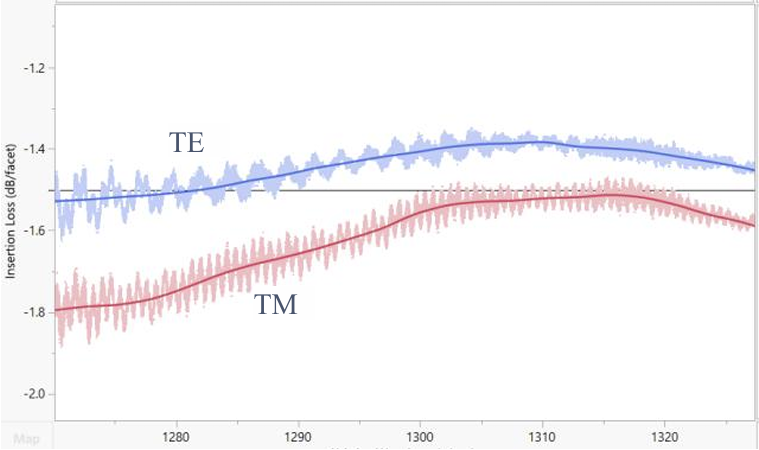
This figure (Fig. 4) shows insertion loss. The SiN (silicon nitride) SSC is designed to match the 9 µm mode field of Corning's ion-exchanged waveguide, minimizing coupling loss and PDL. Measured: TE averages 1.44 dB/facet and TM 1.75 dB/facet, with TE wavelength dependence <0.2 dB (spectrally flat, low dispersion). Polarization-dependent loss (PDL) is ~0.3 dB, which the paper attributes mainly to extra waveguide loss of the TM mode inside the PIC; the PDL of the optical I/O itself is expected to be <0.1 dB.
What this number means: coupling performance with passive assembly has reached a level comparable to active alignment.
3.3 This figure shows 280 mW high-power handling

This figure (Fig. 5) shows IL stability at high power. Why does high power matter? Because optical intensity in CPO engines is high, and silicon edge couplers suffer nonlinear absorption at high power. GF uses a SiN-based SSC (rather than a pure silicon edge coupler), which offers significantly higher power handling and suppresses nonlinear absorption — the key to the whole module sustaining >280 mW. Measured IL stays stable at high power.
4. Technical Highlights
The first highlight is "all four requirements met at the same time for the first time": low loss (<1.5 dB/facet), passive assembly (Z-stop + fiducials, no active alignment), high-power handling (>280 mW) and full detachability (MT-compatible, reworkable). In the past these four always traded off against each other; this is the first proof point that hits all of them at once.
The second highlight is bringing the glass connector into the foundry flow: GF Fotonix's SSC, V-grooves, Z-stops and precision fiducials are all made with 300 mm CMOS and lithography, then mated with Corning's GLASSBRIDGE ion-exchanged glass. The SiN SSC simultaneously solves "matching the 9 µm glass mode field to cut coupling loss" and "resisting high-power nonlinear absorption." It's a one-two punch of foundry capability × glass materials.
This approach, Intel's glass coupler and Sumitomo's collimating lens represent different schools of "detachable optical I/O"; for related context, see Polymer Waveguides Withstand +20 dBm for Six Hours.
5. Industry Link: How Far from Volume Production? Who Benefits?
Distance: maturity is relatively high — this is an integrated module on a foundry platform (GF Fotonix 300 mm), passively aligned, with complete IL/PDL/power data, and GLASSBRIDGE uses an MT-compatible ferrule compatible with solder-reflow conditions. This is engineering aimed at high volume and field replaceability, not a single-point lab result.
Beneficiaries: most directly the pairing of GF (foundry silicon photonics) and Corning (glass connectors) — effectively turning "detachable optical I/O" into a foundry solution that multiple designers can adopt. Next is the entire CPO connector and MT ferrule ecosystem. A note of caution: detachable connectors are a battle of standards and ecosystems; for the GF × Corning solution to become the industry default still depends on customer adoption and convergence with other schools (Intel, Teramount, Senko and others).
6. Conclusion
The one sentence to remember from this paper: the four requirements of detachable CPO optical I/O — low loss × passive × high power × detachable — were achieved together for the first time by GF × Corning with foundry silicon photonics plus a glass connector: <1.5 dB/facet, 280 mW, fully passive alignment. For anyone tracking the CPO supply chain, the takeaway: detachable connectors aren't won on any single metric, but on "all four holding at once × whether it can run in foundry volume" — and GF × Corning has clearly raised that bar.
References
Arpan Dasgupta, A.K.M. Zahidur Chowdhury, Takako Hirokawa, Yusheng Bian et al. (GlobalFoundries) and Sean Garner, Rajesh Vaddi, Jasmeet Singh et al. (Corning), "Detachable Glass Waveguide Connector for Co-Packaged Optics on Silicon Photonics platform with <1.5 dB/Facet Passive Coupling and 280 mW Power Handling," 2026 IEEE 76th ECTC.
GlobalFoundries, Malta, NY, USA; Corning Incorporated, Corning, NY / Berlin
Related Reading
The Great Optical Packaging Transition (Part 5): The Detachable Fiber Battle, CPO Volume's Hidden Gate: a panorama of detachable-connector approaches
Glass Substrates Are No Longer Slideware: Why the TGV Race Comes Together in 2026: glass's role in advanced packaging
Technical Analysis | Polymer Waveguides Withstand +20 dBm for Six Hours: another materials route for high-power optical I/O


Comments