


ECOC 2026 | The Question Is No Longer "How Many Wavelengths" but "How Many Fibers": Acacia Swaps $/bit for GPU Utilization and Redraws the Optics Map
Acacia's Tom Williams had only fifteen minutes, but his was the most "customer's-eye-view" talk of the entire ECOC. He wasn't talking about how many GHz some component reaches; his point was that the yardstick has changed — and the slide spelled it out plainly: "$/bit still matters, but optimizing GPU utilization is the key metric of success." Measured with this new ruler, the whole optics technology map gets redrawn: CPO, NPO, LPO, LRO, FRO, coherent-lite and ZR/ZR+ are laid out as a staircase from the rack to the metro, with each step labeled by what it really trades off. And the hardest physics line of the talk: IMDD chromatic dispersion tolerance falls with the square of the baud rate — the limit at 200G/lane is roughly 10 km, and at 400G/lane anything beyond 2 km requires coherent. Add to that the most underrated observation of the talk: the scale-across planning question has shifted from "how many wavelengths do I need" to "how many fibers do I need".
1. The Yardstick Has Changed: $/bit Gives Way to GPU Utilization
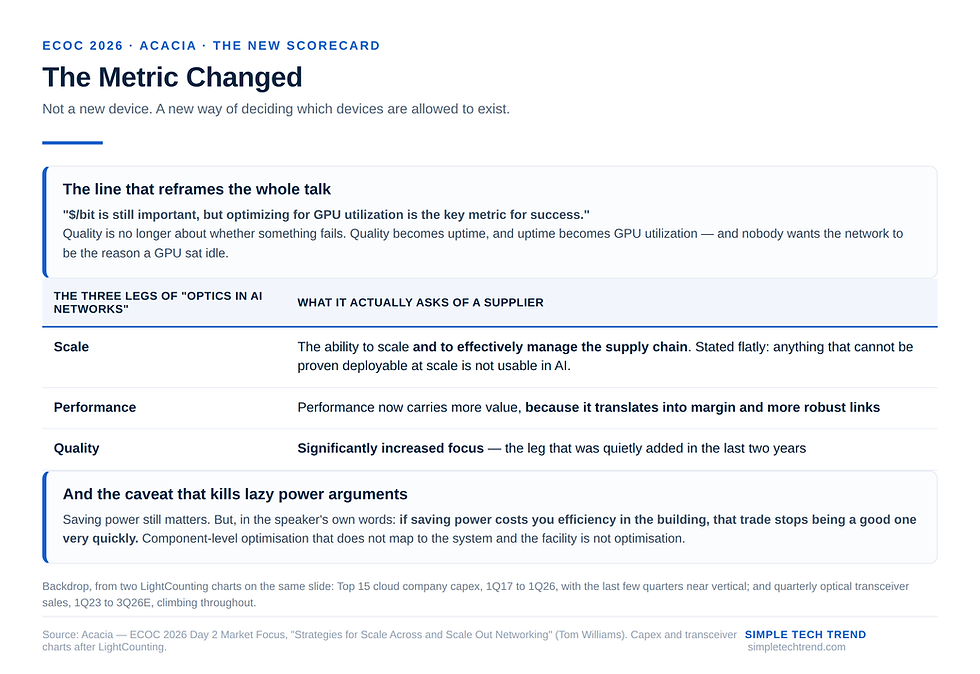
For the past decade, the common language of the optical module industry has been $/bit and pJ/bit. Acacia opened by saying that these two numbers of course still matter, but they are no longer the first column on the scorecard.
The line at the bottom of the slide set the tone for the whole talk:
$/bit still matters, but optimizing GPU utilization is the key metric of success.
The speaker put it bluntly: quality isn't just about "will it fail"; quality translates into uptime, and uptime ultimately translates into GPU utilization. Nobody wants the network to be the link that leaves GPUs idle.
His follow-up on "power saving" is especially worth noting. He doesn't deny that saving power matters — everyone can calculate the value of an hour of network power saved — but he went on:
If the way you save power makes the whole building less efficient, that trade quickly stops paying off.
That's a heavy statement. It effectively says: component-level power optimization that doesn't map to the system and facility levels is fake optimization. It's the same line of thinking as the "four walls" framework Microsoft presented at the same conference when discussing slow-and-wide — we broke it down fully in After Copper Can't Keep Up with AI: Seven Paths for Scale-up Optical Interconnect, and Two Ways to Live With Each Bottleneck.
2. The Three-Legged Stool: Scale, Performance, Quality
The slide showed a three-legged stool with "Optics in AI Networks" on the seat; the three legs are Scale, Performance and Quality.
He defined the three legs quite concretely:
Scale: the ability to ramp volume and to manage the supply chain effectively
Performance: performance is worth more now, because it translates into margin and more robust links
Quality: the focus on quality has increased significantly
All three share an unspoken implication: any new material or new architecture that cannot prove it can be deployed at scale is unusable in AI. The speaker's exact words were "Anything we do has to be able to be deployed at scale" — a sentence designed to filter out a whole crowd of lab results.
Two LightCounting charts on the right gave the backdrop for this argument: Top 15 cloud companies' capex from 1Q2017 to 1Q2026, with the last few bars rising almost vertically; and below it, quarterly optical transceiver sales from 1Q2023 through a 3Q2026 forecast, likewise climbing all the way up.
3. Why Scale-across Has Become Coherent's Home Turf
Acacia's definition of scale-across is clean: back-end connectivity between geographically distributed data centers.
The Meta network traffic chart on the left (from the OFC 2026 Exec Forum) breaks growth into three layers, and the breakdown itself is the point:

User: user traffic, nearly flat
DC-DC: Synchronization: synchronization traffic between data centers
DC-DC: Gigawatt scale clusters: traffic between gigawatt-scale clusters
From 2017 to the 2026 forecast, almost all of the chart is propped up by the latter two, and the 2026 "gigawatt-scale clusters" bar grew from nothing. In other words, traffic growth between data centers has almost completely decoupled from user behavior — it is generated by AI training itself.
The Cignal AI adoption curve on the right gives a very persuasive comparison. It plots six technology generations — 100G (2011), 200G (2014), 400G+ (2017), 800G (2020), 400ZRx (2020) and 800ZRx (2025) — with "years after launch" on the x-axis and annual shipments on the y-axis. The slide's conclusion was direct:
Strong scale-across demand has made 800ZR+ the fastest-growing coherent technology ever.
And Acacia's own position:
Acacia is the leading supplier, with more than 75,000 800ZR+ modules shipped.
What the speaker added on stage was more interesting: back then everyone thought 400ZR's upgrade pace was already absurdly fast, and 800ZR+ left it in the dust; when the next-generation 1600ZR/ZR+ arrives, customer expectations will be the same — new customers will go straight to 1600ZR+ rather than climb the staircase again.
4. From "How Many Wavelengths" to "How Many Fibers"
This is, in my view, the most underrated observation of the talk, and the speaker only mentioned it in passing:
People no longer ask "how many wavelengths do I need" but "how many fibers do I need" — and that is sparking all kinds of new discussions.
Why does this change in the question matter so much? Because it means scale-across capacity demand has grown to the point where the entire spectrum of a single fiber is no longer enough. Once the planning unit shifts from wavelengths to fibers, every downstream engineering problem changes with it:
Power at regenerator sites becomes the bottleneck. The speaker said explicitly: regenerator sites can no longer supply enough power to light as many fibers as capacity demand requires. This is a power problem, not an optics problem.
This forces new optical designs. If the entire fiber has to be lit on day one, you need something that handles a whole band at once — hence full band transponders are now on the table.
Integration has to go higher still. The directions listed on the slide: higher baud rates to reduce the number of wavelengths per band (C+L is widely deployed, more bands are being considered), power- and size-optimized architectures, higher integration and fewer interconnect points (multi-rail amplifiers, full band transponders, media converters), and multi-core fiber and hollow-core fiber.
On the media converter, the speaker gave a very precise definition: it trades design flexibility for a power-optimized integrated solution. The slide's diagram makes this clear — the long chain of Client Optics → Client DSP → SerDes → electrical connector → Line DSP → Line Optics collapses into Client Optics → one DSP handling both Line and Client → Line Optics. The electrical connector and SerDes that disappear are the power saved.
The last line of the slide matters because it reins in expectations for all of these new architectures:
These new architectures are expected to coexist with pluggable solutions.
The speaker also added a status update that's useful for the supply chain: today most scale-across uses the very same technology as DCI; at shipment it's often hard to tell whether a unit is going to traditional DCI or scale-across, and in many cases it's literally the same part. But he expects to see more designs optimized specifically for scale-across in the future.

5. The Physics Line: Dispersion Tolerance Falls with the Square of Baud Rate
If I could keep only one slide from this talk, it would be this one — because what it gives is not a forecast, it's physics.
The slide's chain of logic goes like this:
First, acknowledge IMDD's territory. High-volume applications inside the data center use IMDD optics for two reasons: an established high-volume supply chain, and IMDD's low latency where end-to-end FEC is possible.
Second, draw the physical limit:
IMDD chromatic dispersion (CD) tolerance falls with the square of the baud rate. • At 200G/lane, the IMDD limit is about 10 km • At 400G/lane, coherent is required beyond 2 km
This line locks in the timeline. Because 400G/lane is not a far-future technology — it sits squarely in the 2-to-5-year box. In other words, "when will coherent enter the data center" is no longer a question of market preference; it's the inevitable consequence of doubling the baud rate.
Third, standards have already moved first. IEEE has already taken ZR technology for 800G interfaces beyond 10 km — 800GBASE-ER1 and 800GBASE-ER1-20 support 20 km and 40 km links. And the next line on the slide spells out the future: 1600G/lane coherent technology can support campus DCI applications beyond 2 km.
Fourth, why switch from IMDD to coherent? The slide listed four reasons: 4x the capacity per lane or wavelength, digital compensation of dispersion, DWDM support, and fewer amplifiers where needed.
Of the chart on the right, the speaker said they have "shown it for almost a decade, and it has held up well": the x-axis is distance (0.5 km to 1000 km, labeled Intra DC / Campus / Edge-ZR / Metro / LH-ULH), the y-axis is data rate (100G to 3.2T), and a diagonal "Transition Phase" band separates Direct Detect from Coherent — with a big arrow pointing left: coherent is pushing into ever shorter distances.
His stance on coherent-lite was measured and worth recording verbatim: IMDD is still effective inside the data center and will remain the solution there; but there are indeed some use cases where coherent is starting to become relevant inside the data center. He also cautioned that coherent-lite is not one application but a whole range of applications, each with requirements to be considered separately — and the OIF is working on coherent-lite standards, trying to draw the boundaries between them.

6. Mapping Technology to Need: The Seven-Step Staircase from CPO to ZR/ZR+
This chart is where the whole talk converges, and it's the most practical page.
Acacia arranges seven optical solutions along a curve running from upper left to lower right, mapped to four scales: switch/rack scale → row/building scale → campus scale → metro scale. And what's labeled next to each step isn't a spec, but what it really trades off:
CPO: supply chain diversity vs. power/performance optimization
NPO: front-panel serviceable, or must the box be opened for service
LPO: reach, reliability and interoperability vs. power and cost
LRO
FRO: reach — the IMDD vs. coherent trade-off
Coherent-lite
ZR/ZR+: capacity per fiber
The brilliance of this chart is that it doesn't declare a winner. The speaker stressed this repeatedly on stage: "I'm not here to say which one is the right answer; our industry as a whole needs to do real due diligence on these architectures and then decide which ones are right."
He also offered a concrete view on CPO vs. NPO: CPO's architecture is more robust and its security is clearly better, but we need more visibility to understand how the two compare in scalability. And on LPO/LRO versus traditional pluggables, his attitude was: if there's a good case that we can achieve the same results at the same quality, then the power saved is of course a plus — but we need more data.
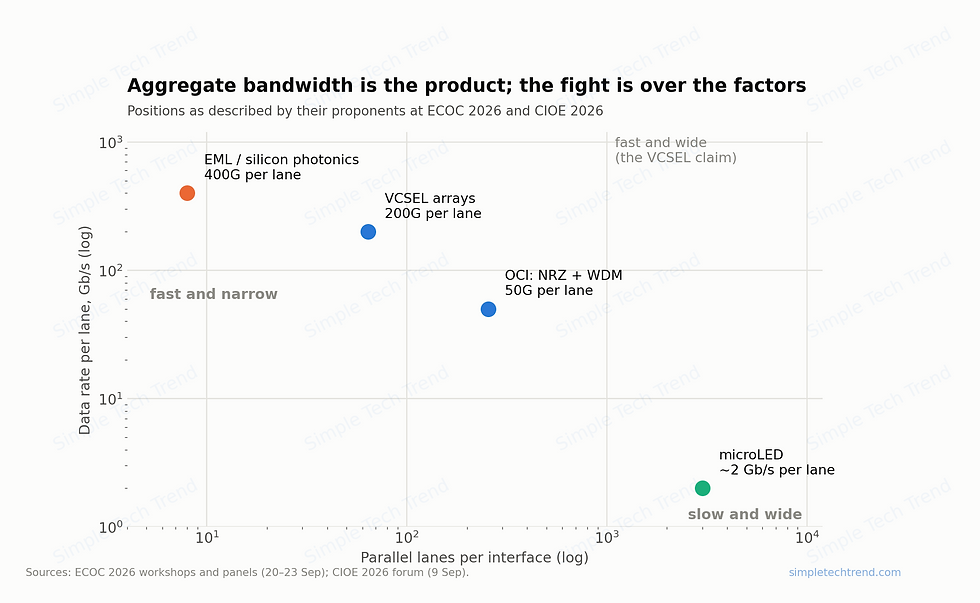
We covered the entire fast-narrow vs. slow-wide debate, and where each solution sits in it, in ECOC 2026 | Three Hours of Fast-Narrow vs. Slow-Wide, and Nobody Defined "Slow" First: The Real Watershed of the Debate Is 448G.
7. Liquid Cooling and XPO: The First Package Spec Defined for Liquid Cooling
This section is short, but it carries a lot of information.
The slide listed: liquid cooling is already common on the compute side and will become more widespread on the network side — to reduce facility cooling power and to enable higher power-density designs. The current state: today's pluggable optics support air-cooled or cold-plate designs; and designs optimized for liquid cooling can increase system density.
Then came the conclusion:
XPO is the industry's first effort to define a package specification optimized for liquid cooling.
Taiwanese suppliers should pay special attention to this. It pulls liquid cooling out of "a data-hall matter" and into the level of "optical module package specs" — once the package spec itself is designed for liquid cooling, thermal interfaces, mechanical parts, sealing and quick-disconnect fittings all enter the optical module's bill of materials. That's a new component market that hasn't been settled yet.
The speaker remained open-minded on liquid cooling too: he said there are many different views right now on how liquid cooling gets into network equipment, and what he cares about more is whether we're asking the right questions — if the cooling loop is configured correctly, you can fully capture its benefits; "I'm not sure that's the right answer, but I think it's the right question we should be asking."
8. Conclusion
The value of this talk isn't in any single number; it's that it provides a common yardstick for evaluating every new technology. And that yardstick has three very concrete implications for Taiwan's supply chain.
First, the selling point must shift from "how much power we save" to "how much GPU utilization we protect". This isn't just rewording. When the customer's first metric is GPU utilization, reliability, MTBF, yield consistency, and serviceability — "can a failed unit be swapped without downtime" — all move from nice-to-haves to hard requirements. Note that the trade-off Acacia labels for the NPO step isn't power; it's "front-panel serviceable, or open the box" — a purely mechanical, purely operational criterion, placed on the same level as power. Suppliers who can bring data for this column will get onto evaluation shortlists more easily than those who can only quote pJ/bit.
Second, the 400G/lane physics line is a hard timeline you can use for product planning. IMDD dispersion tolerance falls with the square of baud rate; 200G/lane reaches 10 km, while 400G/lane needs coherent beyond 2 km — and 400G/lane sits right in the 2-to-5-year box. In other words, the technology owning the campus DCI segment (2–10 km) will be forced to change hands in the next generation. Makers of EMLs and DR/FR optical modules need to think hard about how much territory they'll have left in the 400G/lane generation; those in coherent-related areas (DSP peripherals, TFLN, ICR/ITLA, C+L amplification) should be ready for that demand to arrive early.
Third, the "how many fibers" question will shift value toward fibers and connectors. When power at regenerator sites becomes the capacity ceiling, and full band transponders and multi-core/hollow-core fiber land on the same slide, the bottleneck moves from the module to the fiber itself and its management. For Taiwanese suppliers this is both an opportunity and a warning: the opportunity lies in multi-core fiber alignment, fiber bundles, high-density connectors and MPO evolution; the warning is that if the industry really shifts to "light the whole fiber at once", the growth curve for modules sold per wavelength will be redrawn.
Verdict: Acacia launched no new product in this talk, but it is the one session at this ECOC most worth reading page by page for Taiwanese suppliers, because it laid out the customer's real scorecard. The seven-step chart has no winner, only trade-offs — and next to every trade-off is a topic Taiwanese suppliers can cut into. What to really worry about isn't whether CPO wins, but whether, once the customer's first metric shifts from $/bit to GPU utilization, your datasheet can still answer the question they're really asking.
This article is for technology and industry trend analysis only and does not constitute investment advice.
Related Reading
After Copper Can't Keep Up with AI: Seven Paths for Scale-up Optical Interconnect, and Two Ways to Live With Each Bottleneck: a comparison of seven scale-up routes, complementary to Acacia's scale-across staircase
ECOC 2026 | Three Hours of Fast-Narrow vs. Slow-Wide, and Nobody Defined "Slow" First: The Real Watershed of the Debate Is 448G: why doubling the per-lane rate is the starting point of every architecture decision
ECOC 2026 | Data Centers Need Billions of Lasers, but the Bottleneck Is the 5 Minutes It Takes to Attach Them: when the planning unit shifts from wavelengths to fibers, the packaging and alignment capacity bottleneck gets magnified several times over


Comments