


Earnings Call Highlights: MaxLinear (MXL) | Q3 FY2026 — Infrastructure Up 210% and Now Bigger Than Everything Else Combined; 1.6T More Than Doubles Content per Module
1. Executive Takeaway
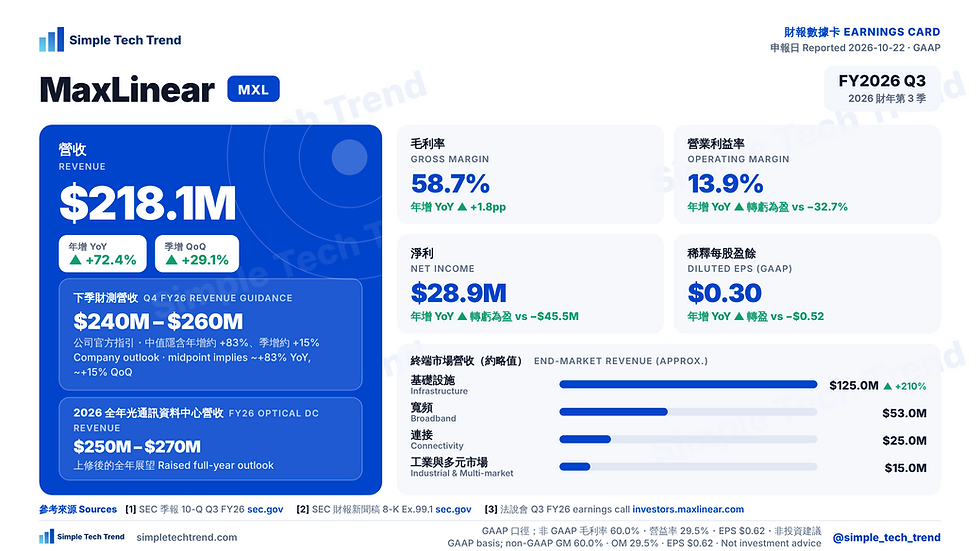
First, MaxLinear is no longer a broadband chip company. Three years ago it was known as an SoC supplier for cable modems, Wi-Fi and PON gateways. This quarter, the data-center-driven infrastructure category made up about 57% of revenue, and that share is still climbing. The full-year optical data center revenue outlook was raised to $250M–$270M.
Second, it is betting on being the pure-play DSP vendor. CEO Kishore Seendripu put it bluntly in the Q&A: MaxLinear is the only pure-play DSP supplier in optical pluggables. Its two rivals (Marvell and Broadcom) also build switches and custom ASICs, so their wafer allocations have to be split across their own product lines. The subtext: when foundry capacity is tight, MaxLinear's 5nm capacity does not have to compete with in-house GPUs or switches.
Third, management talked big but gave few numbers. No 2027 revenue guidance, no hard market share figure, and a flat "no comment" on an analyst's math pointing to a billion-dollar business by 2030. The only hard numbers on the table: Q4 revenue of $240M–$260M, full-year optical data center revenue of $250M–$270M, and optical lead times of 26–28 weeks.
2. Revenue and Financials Breakdown
Metric (GAAP) | Q3 FY26 | YoY | QoQ |
|---|---|---|---|
Revenue | $218.1M | +72.4% | +29.1% |
Gross margin | 58.7% | +1.8pp | +0.9pp |
Operating income | $30.2M (op. margin 13.9%) | Swung to profit (vs. −32.7%) | Prior qtr −2.5% |
Net income | $28.9M | Swung to profit (vs. −$45.5M) | Prior qtr $1.8M |
Diluted EPS | $0.30 | Turned positive (vs. −$0.52) | Prior qtr $0.02 |
On a non-GAAP basis: gross margin 60.0%, operating margin 29.5%, EPS $0.62 (vs. $0.14 a year ago). The gap between GAAP and non-GAAP is mainly about $28.8M of stock-based compensation and performance-based equity, plus acquisition-related amortization.
End-market revenue (approximate figures from management's remarks): infrastructure about $125M, broadband about $53M, connectivity about $25M, and industrial and multi-market about $15M. Broadband and connectivity also grew sequentially, driven by fiber PON and Wi-Fi 7 gateway deployments at tier-one carriers in North America and Europe — but they are no longer the main story.
Three numbers worth a second look:
Operating leverage is kicking in: revenue rose $91.6M year over year while GAAP operating expenses fell 14% ($113.2M → $97.8M). Non-GAAP opex grew only 12%, and non-GAAP operating margin jumped from 12.1% to 29.5%.
Operating cash flow was negative: Q3 operating cash flow was −$13.6M, mainly because prepaid expenses and other assets absorbed about $45.7M in the quarter. The CFO said most of it was wafer prepayments to support orders booked through 2027.
Borrowing to buy capacity: the company drew $40M on its revolver during the quarter and ended with $109.9M in cash, cash equivalents and restricted cash. It also announced a $70M increase in the revolving credit facility to $200M. The CFO said plainly that prepayments will keep rising.
3. Technology and Business Highlights: A Product Map from 100G to 400G per Lane
The most informative part of this call was MaxLinear laying out its entire data center product line for the first time, each with a revenue timeline attached.
Keystone (800G, in volume production): a 5nm CMOS, 100Gb-per-lane PAM4 DSP shipping in high volume at multiple hyperscalers. Nearly all of this year's optical revenue comes from it.
Rushmore (1.6T, ramping from 2027): 200Gb per lane. The first design win starts shipping in 1H 2027 and accelerates in the second half; by 2028, 1.6T will be the bulk of optical revenue. 800G will not disappear right away — the CFO thinks it could last into 2029.
Big Sky (3.2T, next generation): 400Gb per lane, in both optical and electrical versions.
Washington (TIA): a 200Gb-per-lane transimpedance amplifier (TIA) that works with DSP-based pluggables and also supports DSP-less LPO, half-retimed LRO, NPO and CPO. First revenue in 2027, volume ramp in 2028.
Annapurna (1.6T electrical interconnect): active electrical cables (AEC) and on-board retimers, with first revenue in 2027.
Control plane and adjacent products: RackCommander (rack-level USB/PCIe/UART bridges, telemetry and power management), an XGS-PON inter-data-center control network that has completed qualification and has secured backlog (first deployments in 2027), and the Panther storage accelerator, whose revenue roughly doubles this year.
The point of this map is not the number of products. MaxLinear wants to own the whole "analog plus digital" content inside a module, not just one DSP.
Why is the DSP slot so valuable? As we noted in ECOC 2026: Lumentum's 1.6T volume production playbook, the DSP accounts for nearly half the power of a pluggable module. Whoever owns the DSP owns the module's power budget and system interoperability — which is why hyperscalers will run an entire qualification cycle for one DSP.
4. Management Outlook and Language Analysis
Q4 guidance: revenue of $240M–$260M; the $250M midpoint implies roughly 83% YoY and 15% QoQ growth. Infrastructure grows strongly, broadband and connectivity dip seasonally, and industrial and multi-market rises. GAAP gross margin 58%–61%, non-GAAP 59%–62% (60.5% midpoint); non-GAAP opex $65M–$70M.
How certain each statement is (from most to least):
Confirmed numbers: the Q4 revenue range, the full-year optical data center outlook "raised" to $250M–$270M, bookings "throughout 2027 into 2028," and optical lead times of 26–28 weeks.
Expectations backed by specific events: the first Rushmore design win ships in 1H 2027; design wins bundle both DSP and TIA; XGS-PON has secured backlog.
Directional claims with no numbers: 2027 growth "outgrowing the market" — when analysts asked whether optical could exceed $400M or double in 2027, the CFO only said he was very confident they are outgrowing the market.
The CEO's personal views: looking backward, share is "well above" the previously cited 5%–7%; in two years it "should be in the teens for sure"; within 12 to 24 months it could be "neck and neck" with one of its two competitors — which he himself framed as "the hope and the goal."
The line worth remembering: pricing is holding this time. Historically, the claim that ASPs double with each new speed never stuck; prices were quickly cut back. Seendripu said that from 800G to 1.6T, DSP ASP roughly doubles and is sticking, and with the TIA it did not sell before, MaxLinear's content per module will more than double. He also expects the TIA attach rate on Rushmore to be "at least 100%" in 18 months.
Put that next to the lead times — 26–28 weeks, customers ordering well beyond lead times, and Q4 gross margin guidance still rising — and this is a supply-constrained market where the seller has pricing power, not one where share is bought with price cuts.
5. Supply Chain and Customer Clues
The bottleneck is the fab, not the laser. Asked where the optical supply chain is constrained, Seendripu said optical component supply is easing and the real bottleneck is DSP — foundries allocate capacity by company, and new fabs take years. That differs from the past year's dominant "lasers are the biggest bottleneck" narrative and is worth cross-checking. The CFO noted that prepayments are "not just TSMC," indirectly confirming the main wafer source.
No 10% customers. No single customer exceeded 10% of revenue this quarter. Management described optical DSP revenue as spread across all major module makers, with both Asia and the U.S. growing geographically.
U.S. hyperscalers will matter more in the 1.6T generation. The CEO said U.S. data centers are adopting 1.6T earlier than their Chinese counterparts, and that U.S. 1.6T deployments are just starting to ramp beyond NVIDIA and Google. In other words, much of MaxLinear's 800G volume may lean toward Asia; 1.6T is the real gateway into large U.S. customers.
AEC: selling silicon, not cables. On Annapurna, Seendripu pointed to Credo as holding over 90% of the AEC market. MaxLinear's plan is a pure silicon play supplying cable makers or paddle card makers, targeting 20%–30% share in the 1.6T cycle through one or two U.S. data centers. It is a strategy of not fighting head-on — we covered Credo's full-cable model and its PILOT telemetry moat in Credo Q1 FY2027 earnings highlights, and the two business models are not really competing for the same position.
NPO takes over CPO's script. Seendripu offered a rare quantified view (stressing it is personal): by 2030, about 60%–70% pluggable, about 20% NPO, and about 10% other forms. His reasoning: CPO locks optics to the switch or GPU, while NPO preserves serviceability, modularity and supplier diversity. That matches our take in OCP Global Summit 1/6: NPO wins on buying power, not volume — buyers want to avoid being locked in by a single ASIC vendor.
LRO is the DSP vendor's answer to linear optics. He said outright that LPO has no legs, while LRO, which keeps half of the DSP function, is already a real option in the U.S. at 200G per lane and will be a major option at 400G per lane. Oracle's position in OCP Global Summit 2026: Oracle on OIF, LRO and 1600ZR points the same way. For a company that sells DSPs, this is the most favorable roadmap, so readers should apply their own discount.
Qualification bandwidth is another bottleneck. Seendripu admitted that as many as ten module makers may want to enter data center qualification at the same time, and MaxLinear has to pick and choose; 1.6T modules also have to interoperate with both rivals' switch silicon and existing 800G silicon. This is one of the ceilings on growth, and it cannot be solved overnight by spending money.
6. Risks and Counterarguments
Timing gap between capacity and cash: growth is bought with wafer prepayments, operating cash flow turned negative, and $40M of the revolver is drawn. Any delay in 1.6T qualification means prepayments sit on the balance sheet first.
1.6T execution challenge: the volume of the first design win is "not clear" yet, and qualification bandwidth is a bottleneck; if Rushmore slips a quarter, the entire 2027 growth curve shifts out.
The scale of rivals: an analyst cited Marvell's roughly 65% CAGR for AI interconnect units through 2030 as the market baseline. We broke down Marvell's scale and full-stack approach in Marvell Investor Day 2026; for MaxLinear to "outgrow the market" means taking share from two giants.
Share figures cannot be verified: 5%–7%, the teens, neck and neck — all are management's words, with no third-party data behind them.
The GAAP gap is still large: non-GAAP adjustments were about $34M this quarter, stock-based compensation remains a major expense, and the arbitration with Silicon Motion is ongoing and listed as a risk factor in the 10-Q.
7. Summary
This quarter proved two things for MaxLinear: its 800G DSP is established at major customers, and its P&L can scale profit as revenue grows. The next question is no longer "can it sell in," but "will 1.6T arrive on time and will pricing hold."
Three metrics to track next quarter:
Whether Q4 revenue lands above the $240M–$260M midpoint, and whether full-year optical data center revenue reaches the $270M top end.
Whether first Rushmore shipments happen on schedule in 1H 2027, and whether design wins keep bundling both DSP and TIA.
When operating cash flow turns positive: prepayments and revolver draws are the fuel for growth, and also the thermometer for risk.
In one line: MaxLinear's transformation from broadband vendor to DSP vendor has finished its first act. The ticket to the second act is doubled pricing at 1.6T — provided foundry capacity and qualification bandwidth keep up.
This article is for technology and industry trend analysis only and does not constitute investment advice.
Related Reading
Earnings Call Highlights: Semtech (SMTC) | Q2 FY2027: another analog veteran being rewritten by 1.6T, worth reading alongside MaxLinear's TIA strategy
OCP Global Summit 2026 | Molex, Broadcom | 224G AECs for AI Data Centers: the AEC market is diversifying — this is the battlefield Annapurna is entering


Comments