


2026 OCP APAC Summit | Linque | Jonathan Förste | Fast Optical Circuit Switching in the Scale-Up
Optical circuit switching (OCS) has already been proven with real money in scale-out by Google, yet for a decade it has never made it into scale-up. The reason is simple: today's 3D MEMS OCS switches in milliseconds to seconds, while AI collective communication bursts last only microseconds. When the switch is slower than the event, all it can be is a patch panel that gets rewired every few hours.
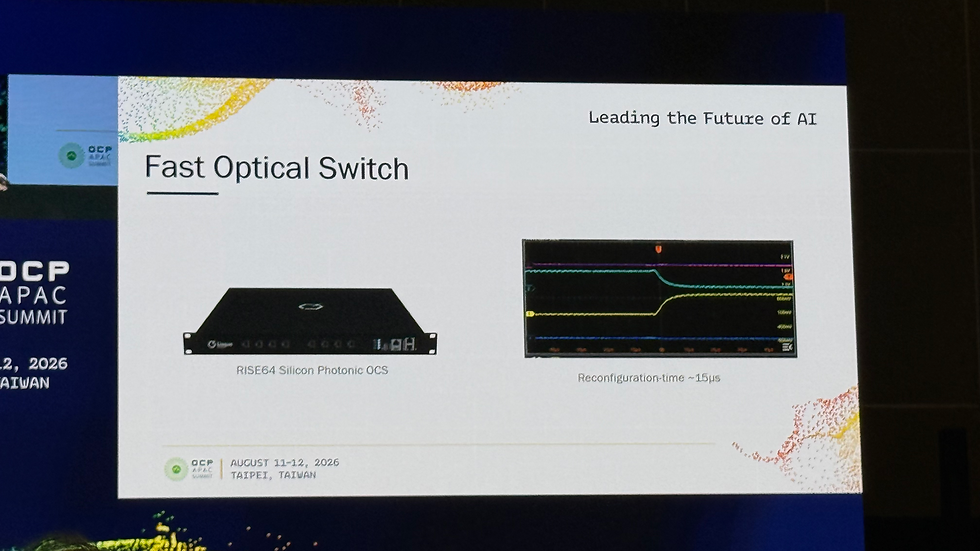
Linque's answer in this keynote is a silicon photonics 2D OCS: 64 channels with a measured reconfiguration time of 15 µs, with a goal of pushing it even lower. The “switch is too slow” hurdle has effectively been cleared first.
What remains unsolved is the other end: once the optical path switches, the transceiver on the far side has to re-lock. Today that takes milliseconds, and it must come down to the tens of nanoseconds to avoid becoming the new bottleneck—which requires replacing the paradigm of the entire link, not just swapping mirrors for waveguides. The speaker himself admitted it is “technically feasible, but not yet experimentally validated, and there is a long way to go.”
What it means for Taiwan's supply chain: if fast OCS works in scale-up, the unit count of pluggable modules and switch ASICs will be cut sharply, but the spec bar for each unit (burst-mode receivers, CPO integration) will rise. This is a structural reshuffle—lower volume, higher value, a reordered vendor list—not a simple rise or fall in demand.
1. Why Now: Bandwidth Is Concentrating in Scale-Up
Over the past two years, the center of gravity in AI networking has clearly shifted from scale-out to scale-up. The reason is straightforward: as models grow, communication demand gets packed into the domain that must behave like a single GPU. The scale-up domain is extreme by definition—shared memory, far more bandwidth than scale-out, a topology as non-blocking as possible, ideally single-hop reachability, and above all, predictable latency.
In the past, copper was enough for this domain. The problem is copper's reach. Once scale-up has to extend beyond a single rack, optics is the only way forward—we broke this down in full in After Copper Gives Out for AI: Seven Paths for Scale-Up Optical Interconnect.
But optics comes with an “entry fee”: every optical link pays the power cost of OE/EO conversion. Worse, once scale-up becomes a multi-tier network, you pay not only once per link but again at every switching tier in between. That cost is tolerable in a single tier; with multiple tiers it simply blows up.
That is why OCS is being brought back into the conversation now: it does not convert the signal, so it cuts both the number of optical links and the number of switching tiers.

2. The Old Problem with OCS: Great Savings, Speed in the Wrong Place
First, let's be clear about where current OCS shines and where it falls short.
Today's state of the art is free-space 3D OCS: fibers launch into free space, and a micromirror array steers each input fiber onto an output fiber. Its strengths are low loss and high radix, and it is rate-agnostic—the switch can stay in place across generational upgrades. Google's Apollo is the textbook case: 136×136 non-blocking, a Palomar micromirror package with 176 mirrors (136 in use), and about 108 W for the whole unit versus 3,000 W+ for a comparable electrical switch—a 96% power difference. Google estimates cumulative savings of about US$3 billion and claims +30% throughput, −40% power, −30% capex, and network downtime cut to 1/50.
The problem is switching time. The mirrors must physically move, so reconfiguration takes milliseconds to seconds. Apollo is therefore used as quasi-static wiring on the scale of hours: the topology is planned per job in advance, left untouched while the job runs, and reconfigured only when it must change. The speaker was blunt in the Q&A—today's OCS is a pre-wiring tool under SDN control, not something that follows the traffic.
So how short are AI collective bursts? By the speaker's numbers, once message sizes exceed 100 MB, communication bursts fall roughly in the microsecond-to-millisecond range. The switch is two to three orders of magnitude slower than the event—and that is the whole reason OCS has stayed out of scale-up.
3. Four Hurdles: Fast OCS Is Not Just a Faster Switch
The most valuable part of this keynote was breaking “fast OCS in scale-up” into a checklist of four mutually constraining requirements. All four are mandatory, and the industry's maturity on each varies widely:
First, traffic must be structured and predictable. Because the signal never turns electrical end to end, you cannot read it, so all scheduling must be arranged in advance. The good news is that distributed AI training naturally looks like this: the compute phase barely uses bandwidth, and the all-reduce gradient exchange saturates it instantly—and the bigger the model and the messages, the longer both the bursts and the idle gaps, which makes scheduling easier. This is luck for OCS, not something designed in.
Second, transceivers must be compatible with fast OCS. When the optical path changes, the far end becomes a different receiver, and the link must rebuild immediately. This is the hardest of the four hurdles and gets its own section below.
Third, the control plane must be precise. The speaker's line is worth quoting: if your switching is triggered by a Python script, that timing uncertainty itself becomes your performance floor. And the speed of light has to be accounted for too—100 m of fiber equals about 0.5 µs of flight time, so the SDN controller must embed a physical cabling model of the entire domain (which link is 1 m, which is 100 m) to compensate; otherwise jitter becomes the floor. With switching-time targets of 100 ns to 1 µs, controller precision must reach the high-nanosecond level.
Fourth, the optical switch itself must be fast enough. 3D free space is out; the alternatives are 2D integrated photonics: silicon photonics, SiPh-based integrated MEMS, III-V or amplified architectures, and wavelength-based rather than space-based switching. What they share is that they are inherently fast—from microseconds all the way down to nanoseconds.
4. 15 µs: Silicon Photonics Clears the “Switch” Hurdle First
Linque's evidence at the event was its own 64-channel silicon photonics OCS with a measured reconfiguration time of 15 µs, and the company stated plainly that it aims to go lower before it qualifies for scale-up deployment.
Some company background: Linque was founded in 2021 by Samarth Vadia (CEO), Victor Funk (VP R&D), and this talk's speaker Jonathan Förste (CTO). It is based in Europe and works with partners in Germany and Taiwan. Its first product, RISE, is positioned as an all-optical circuit switch, with disclosed specs of ~10 µs-class reconfiguration, more than 100 fibers, and over 1,000 electrical I/Os; funding is €4.5 million in non-dilutive capital.
The scale is small, and the numbers are still lab-grade. But the direction is right: placed on the map of “message size above 100 MB, bursts in the microsecond-to-millisecond range,” 15 µs lands inside the usable zone for the first time. This is the first time OCS has entered the scale-up conversation on measured data rather than a roadmap.
Note that 2D integrated photonics buys speed at the cost of loss and radix. 3D MEMS is hard to displace precisely because it is nearly unbeatable on both. Linque itself lists loss—the accumulated attenuation as light passes through multiple on-chip components—as a core challenge. The gap between 64 channels and 136×136 is not just a number; it is whether the switch can support a real scale-up domain.
5. The Real Bottleneck Isn't the Mirror—It's Transceiver Lock
The best question from the floor went straight to the heart of it: OCS latency comes from two places—the physical action of the switch itself, and the far-end transceiver re-locking—and the two are of similar magnitude. Silicon photonics solved the first; what about the second?
The speaker's answer was refreshingly honest: this is the more fundamental problem, and the fix is to change the paradigm—adopt something like burst-mode reception from optical access networks, so the link locks within a few to tens of nanoseconds and stays out of the way. Today's data center pluggables take milliseconds or longer from link training to actually passing data.
I believe it is technically feasible, but it has not been experimentally validated yet, and there is a long way to go.
This line deserves amplification: only half of fast OCS has evidence today. The switch half has 15 µs of data; the transceiver half has only a claimed technical path. And this half is harder, because no single company can fix it by changing one chip—it requires the entire optical transceiver ecosystem to redesign CDR, DSP, and AGC lock behavior, effectively rewriting the startup procedure of data center links.
Incidentally, this also explains why “OCS and CPO are two ends of the same thing.” Another question pointed out that all-optical scale-up means every NIC needs a scale-up optical interface—doesn't that force CPO? The speaker agreed: by the time fast OCS reaches deployment scale, CPO will already be mainstream. We covered the other side of this timeline coupling in CPO Is No Longer “Crying Wolf”: Six Real Signals from the LightCounting CPO/NPO Conference.
6. The Power Breakdown: From 10%, to Infeasible, Back to Parity
The most persuasive slide was the power comparison, in three steps:
Today's single-tier copper-backplane scale-up: network power is roughly 10% of compute power, or slightly more. This is the current baseline.
Multi-tier pluggable-optics scale-up: power goes straight into what the speaker called the “prohibitive” zone. In his words—in its most naive form it is basically infeasible. CPO and NPO help, but they alone cannot rescue a multi-tier architecture.
Fast OCS + CPO scale-up: replacing all switching tiers with fast optical circuit switching, integrated with CPO, can achieve a network power share comparable to or even lower than an efficient copper backplane—even across a very large scale-up domain.
The value of this curve is not numerical precision (the speaker said it is illustrative), but that it repositions OCS from “a power-saving option” to “the only premise under which multi-tier scale-up can work.” Applying the same pJ/bit logic, OIF Draws the Official Map for AI Interconnect: Three Networks, One pJ/bit Battlefield, and CPO as the Endgame ran the numbers from the standards-body side, and the conclusion points the same way.

7. Counterarguments: Four Ways This Could Fail
Taking a position means laying out the other side too:
1. It will not replace Ethernet switches. The speaker said up front that “it is unrealistic to think OCS will completely replace every Ethernet switch.” Fast OCS is a data-plane bypass, not a substitute for control and exception traffic. Any narrative casting OCS as the switch-ASIC killer is getting way ahead of itself.
2. It favors training, not inference. This is also the speaker's view: training is more predictable, does not have to respond to traffic from outside the domain, can be scheduled precisely, and the synchronization of compute and communication creates stronger burstiness—all of which feed OCS. Inference tends to spread compute out over time, erasing exactly the structure OCS needs. AI capex is tilting toward inference, which is not good news for fast OCS's market timing.
3. SDN complexity is underestimated. Requiring the controller to embed a physical cabling model of the whole domain, compensate for every link's flight time, and absorb jitter and time drift across hardware and software layers is not a feature add—it is an entirely new network operations model. At deployment you either document every cable length or learn them through training sequences. That is expensive discipline in a real data hall.
4. The ecosystem is just getting started. OCP's OCS sub-project was formed in July 2025 and debuted publicly at the OCP APAC Summit in Taipei that August. Led jointly by iPronics and Lumentum, with participation from Google, Microsoft, Coherent, Lumotive, nEye, Oriole Networks, and POLATIS (HUBER+SUHNER), it aims for open specs and software and integration with SDN frameworks through standard interfaces such as gNMI/gNOI/gNSI and OpenConfig; its white paper was released in April 2026. The direction is right, but a sub-project just over a year old is still a long way from a procurable interoperability spec.
8. Conclusion
The value of this keynote is not the 15 µs figure but how clearly it located the fast OCS battlefield: silicon photonics has cleared the optical switch hurdle, and all remaining difficulty is concentrated in the transceiver and the control plane. Whoever can cut link lock time from milliseconds to tens of nanoseconds holds the key to scale-up OCS—and that is not something a switch company can do alone; the entire optical transceiver supply chain has to change together.
For Taiwan's supply chain, my take comes down to three points:
First, this is a “lower volume, higher value” structure, not a change in demand. Once fast OCS enters scale-up, the most direct effect is fewer optical links and fewer switching tiers. Business models priced per module will be hurt first; but each unit that survives will face a spec bar raised to burst-mode reception and CPO integration. Companies built on “more” will be squeezed; companies built on “harder” will be lifted.
Second, this path locks the CPO timeline forward. All-optical scale-up means every NIC needs an optical interface, and under that power budget there is no room for pluggables. CPO goes from “worth tracking” to “a prerequisite for fast OCS”—Taiwanese investment in CPO packaging, optical engines, FAU, and thermal management is effectively a bet on both lines at once. For a roundup of the players, see [CPO Breakdown 6/6] A Full Survey of CPO Vendor Roadmaps.
Third, there is only one signal worth watching: the first experimental validation of burst-mode transceivers. Not who announces another microsecond-class switch, but who brings lock time into the nanosecond range on a real link. Until then, fast OCS in scale-up remains a half-finished roadmap—beautiful, but with data for only half of it.
This article is for technology and industry trend analysis only and does not constitute investment advice.
Related Reading
AMD Writes “Open Ethernet” into the Rack Backbone: The Real Signal of Advancing AI 2026 for the Optical Supply Chain: industry signals from another scale-up optical interconnect path, for comparison.
Technical Analysis | 51.2T NPO Switch Thermals: An 835 W ASIC Plus 16 Optical Engines—Air or Liquid Cooling?: what the power and thermal budget looks like if the switching tier stays.




Comments