


2026 OCP APAC Summit | Arista | Andy Bechtolsheim | XPO: Liquid-Cooled Optics Buy Pluggables One More Generation
In this talk Andy Bechtolsheim didn't stand against Co-Packaged Optics (CPO); he stood against poor yield. His only doubt about CPO is whether "the attach yield of that whole pile of components around the ASIC is good enough," not the underlying principle.
XPO isn't a new optical technology; it's a new mechanical and power interface: 64 lanes, two 32-lane paddle cards sandwiching a cold plate, a 48V bus fed straight into the module, and a card-edge connector. A single module carries 12.8T, a single OCP rack unit packs 204.8T, and front-panel density is 4x that of 1600G-OSFP.
The hardest lead for Taiwanese suppliers: Foxconn is building XPO's next-generation cartridge connector, and simulations show bandwidth rising from 80 GHz to above 100 GHz, with measured data due in September 2026. This connector decides whether XPO works in the 400G/lane generation.
The real selling point isn't the optical module itself; it's building cost. A data center with 1,024 GPU racks needs 1,400 switch racks with OSFP; XPO cuts that in half, so the data center can be half the size.
1. Andy isn't against CPO; he's against poor yield
His first sentence made his position clear: Arista is a systems company, not an optics company. "Our core concern is simply shipping systems, optics included, in high volume," and "we're not against any future co-packaged anything."
Then came the twist of the knife: technologies like CPO take longer than expected to reach volume production.
During Q&A someone asked directly, "Will XPO replace CPO?" His breakdown is worth noting point by point:
CPO's advantage is a short electrical path. That's not in dispute.
CPO's first drawback is that you're locked into one kind of optics. Whatever sits around the chip is what you get; you can't mix and match modules of different reaches or technologies in the same system.
CPO's truly fatal problem is manufacturability and yield: you have to attach a large number of components around the ASIC or GPU, and "if that attach yield isn't very, very good, you have a big problem on cost."
His conclusion was measured: the industry is still improving the yield of that assembly flow; the day it gets there, volume will shift over, but it looks quite difficult.
This is a systems-company CTO's view, not a turf war between optics vendors. We broke down the pluggable wall in [CPO Breakdown 1/6] Have Pluggable Optics Hit the Wall? Understand the Wall Before You Understand CPO. Andy's talk offers a third answer to the same wall: not a new architecture, but a new mechanical design.
2. OSFP is hitting the front panel, not a speed limit
He started with today's volumes: 99.9% of optics shipped today are pluggable, mostly OSFP, with shipments approaching 100 million units this year and forecast to possibly exceed 200 million by 2028 (the transcript's speech recognition rendered this as "2018"; context indicates 2028).
The problem isn't speed: OSFP will go one more generation to 400G/lane. The problem is the front panel: 1U fits 32 OSFPs, with a thermal budget of roughly 30 to 40 W each, and both numbers are close to the ceiling.
That leads to an absurd picture: Broadcom's next-generation Tomahawk 6 is a 102.4T single chip, yet building a system with OSFP takes a 4U chassis, and that 4U chassis holds just one chip. Andy's verdict was one line: that's not a good match.
XPO fits the same 102.4T into 1U. And beyond 400G/lane, 1U can accommodate the following 409.6T generation.
Broadcom's push at the same event to take Ethernet into scale-up can be read alongside 2026 OCP APAC Summit | Ethernet Starts Eating Scale-Up: Broadcom's Keynote Takes Aim at NVLink: chips double every 12 to 18 months, the front panel doesn't, and the gap in between is the hole XPO is designed to fill.
3. What XPO actually looks like: two cards, one cold plate, a 48V bus

On specs, let's pin down the key numbers:
Lanes per module: 64 (two 32-lane paddle cards); Capacity per module: 12.8T (200G/lane generation)
Module dimensions: 60.8 × 111.8 × 21.3 mm; Front-panel density: 4x 1600G-OSFP; Per OCP rack unit: 204.8 Tbps
Optical connectors: 8 × MPO-16; Power: 48V bus fed directly in, with point-of-load conversion inside the module
Cooling: integrated cold plate, 0.35 LPM (below 100W) to 0.7 LPM (above 300W), deionized water or 25% propylene glycol; Power ceiling: 400W in the MSA baseline, though Andy said on stage the latest spec has been relaxed to 500W
Three design decisions deserve special mention:
First, two cards are about yield. Each 32-lane card is a fully independent test unit, and "each card's board area equals four OSFPs." That means module makers can copy an existing OSFP layout four times onto the paddle card and reuse all the DSP, TIA and driver silicon. It's the lowest-transition-cost path.
Second, the cold plate sits in the middle of the module. The two cards clamp the cold plate belly-to-belly, pulling heat out from the center. Andy stressed this helps both high- and low-power modules: lasers and silicon photonics prefer lower temperatures, and lower temperature translates directly into reliability.
Third, a 48V bus replaces voltage conversion on the motherboard. On stage he said "50 volt" colloquially; the MSA document specifies 48V. This removes a whole row of VRMs from the motherboard, raising motherboard reliability too. He also explained why 48V: when the spec allows 500W per module, you want a small connector carrying a small current.
Is the cooling enough? He gave the math. The most power-hungry interface is coherent: a standard coherent chip is estimated at 30W, and 16 of them in one module is 480W, which is exactly what the cold plate is designed for. As for conventional direct-detect data center optics, roughly 10W per 1.6T, a 25.6T module is only 160W: "cooling is simply not a problem." With air cooling, by contrast, you're bound by heatsinks, airflow paths and how much air the chassis can move; liquid cooling removes that constraint entirely.
4. Density buys down building cost: 1,400 racks cut in half
This is the most underrated part of the talk.
Cluster level: 512 GPUs, each with 25.6T of scale-up bandwidth. Built with OSFP, you need 4 switch racks to connect 4 AI racks; with XPO, 2 switch racks connect 4 AI racks.
Data center level: a typical customer design with 1,024 GPU racks, supplying both scale-up and scale-out bandwidth, needs 1,400 switch racks with OSFP (and that only assumes 12.8T scale-up and 1.6T scale-out per GPU). Switch to XPO and the rack count halves.
Andy's emphasis here wasn't networking; it was construction:
This trend toward densification will actually reduce building costs, building materials and carbon emissions: everything tied to constructing these enormous buildings.
In other words, XPO isn't selling optical-module margin; it's selling floor area per MW of compute. As GPU racks head past several hundred kilowatts, keeping switch racks at one chip per 4U is the real waste.
5. The 400G/lane hurdle is the connector, and Foxconn's simulation offers an answer
This is the part of the talk most directly relevant to Taiwan's supply chain, and the only part that named a specific Taiwanese company.
The premise: 400G/lane is around the corner, and chips after that will default to 400G/lane; the debate is only over PAM4, PAM6 or another modulation, and all three may coexist.
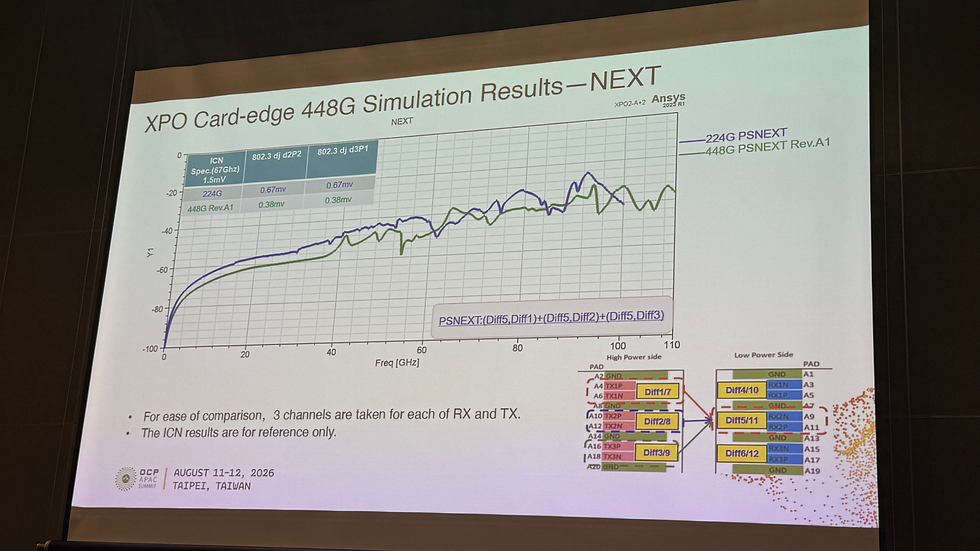
Andy showed simulation results for the cartridge connector Foxconn is preparing:
The blue line is the first-generation XPO connector (he called it F1). It drops off after 80 GHz, unsuitable for 400G/lane.
The green line is the same cartridge and the same module with improved connector technology, pushing bandwidth above 100 GHz.
Differential impedance: the first generation swings up and down at the cartridge interface, while the green line is much flatter. Differential return loss and SCD21 near-end and far-end all improve.
His own reading: this connector looks sufficient for 400G PAM6 (Nyquist around 80 to 85 GHz) and slightly short for 400G PAM4 (Nyquist 100 GHz), but these are only first-pass simulation results, and further improvement can't be ruled out.
He also gave a timeline: Foxconn is sampling now, and if all goes well, measured data from a real system will be available in September 2026.

6. The PAM6 move is about copper and slow & wide
Andy offered a call most people wouldn't expect: 400G PAM6 could become very popular.
The reason isn't optics; it's copper. PAM6 has a lower symbol rate than PAM4 (at 400G, Nyquist drops from 100 GHz to about 80 GHz), so copper cables can reach farther. If you live in a world where scale-up relies mainly on copper, PAM6 is free reach.
The second reason is compatibility: PAM6 pairs with any retimed optics, whether coherent, coherent-lite, fully retimed optics, or retimer boxes heading toward slow & wide. So you can imagine a world where the volume interface inside the chassis is PAM6, and on the fiber it's slow & wide NRZ, or coherent, or PAM4 with a retimer.
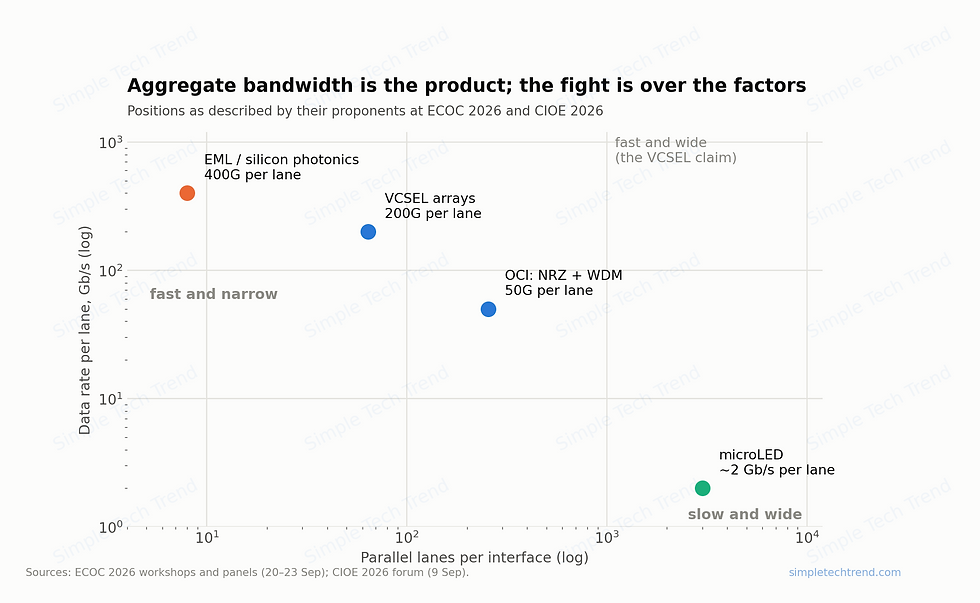
This ties right into the fork in scale-up optical interconnect roadmaps. We broke down the fast & narrow versus slow & wide trade-off in After Copper Gives Out for AI: Seven Paths for Scale-Up Optical Interconnect, and Two Ways to Live With the Bottlenecks. Andy's XPO stance: the form factor doesn't pick a side, and lets both paths plug in.
He also threw some cold water on silicon photonics. One slide compared cost and power: the upper lines (copper, microwave, and a class of short-reach optical technologies) were cheaper and lower power than silicon photonics, which only started at the yellow line below. In his words:
In a scale-up world where cost and power reign supreme, it's actually not obvious that silicon photonics is the real winner.
But right after came the crucial caveat: none of these technologies cheaper than silicon photonics can be co-packaged.
That sentence is the core argument of the whole talk. It's not that XPO is better than CPO; it's that the range of technologies a pluggable form factor can host is inherently an order of magnitude broader than co-packaging. SemiAnalysis's argument at the same event that "copper vs. optics" is a false dichotomy is worth reading alongside: 2026 OCP APAC Summit | SemiAnalysis | Dan Nishball | Scale Up Sophistry: Copper vs. Optics Is a False Dichotomy.
Can an External Laser Source (ELS) use XPO? He said some vendors want to pack 64 liquid-cooled lasers into one module; "I'm not sure from a yield standpoint that's a good idea," and the high-speed connector is completely wasted, since what you really get is just liquid-cooling infrastructure. He suggested a dedicated 16- or 32-lane liquid-cooled module makes more sense for ELS.
7. What it means for Taiwan's supply chain
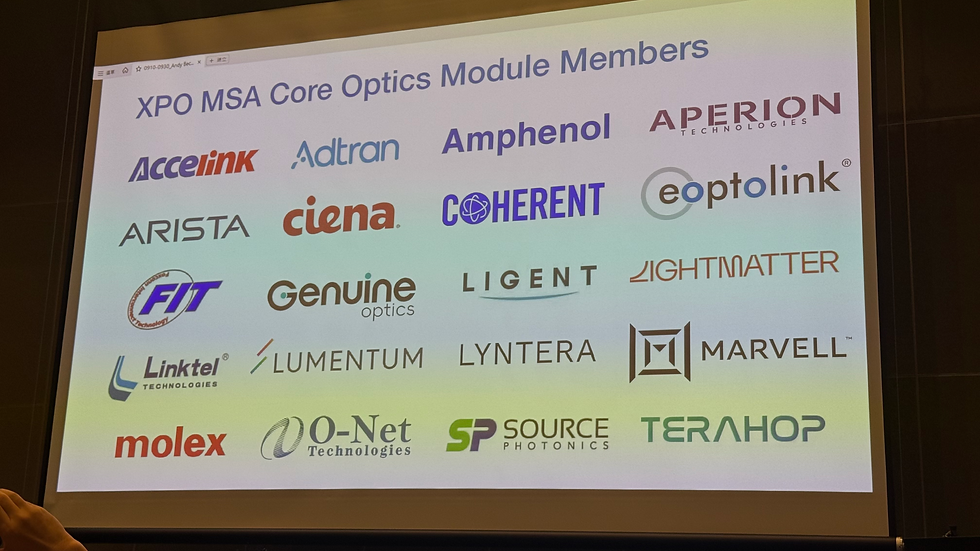
Andy cited the membership count twice (once 150 companies, once 144; treat it as a round number) and added the statistic that matters most to Taiwanese readers: half of the member companies are located in Taiwan or mainland China. EE Times counted more than 100 companies in the MSA and more than 10 live demos at OFC 2026.

Here's the talk broken into four lists for Taiwanese suppliers:
Already at the table: connectors. Andy named Foxconn's cartridge connector work on stage, with measured results due in September. This is the single-point bottleneck for XPO's 400G/lane generation: if it can't clear 100 GHz, the entire next generation of XPO stalls. Connector makers sit one tier higher in the XPO value chain than they did in the OSFP generation.
Lowest barrier: optical module makers. The paddle card area equals four OSFPs and reuses the same DSP/TIA/driver silicon. That means design assets from existing OSFP lines can be carried over directly, without rebuilding an entire optical engine and packaging capability as CPO requires. For Taiwanese module makers, XPO is the lowest-cost defensive play.
A brand-new barrier: liquid-cooling mechanics. Module makers now have to learn cold plates, sealing, quick-disconnect couplings, leak detection and flow specs (0.35 to 0.7 LPM, deionized water or 25% propylene glycol). This is a set of mechanical and quality capabilities completely unrelated to optics, and it's the entry point for thermal-module and mechanical-component makers. Optical module makers never had to answer for leaks before; now they do.
Time to redo the timeline: the companies betting on CPO. XPO won't make CPO disappear; Andy himself said volume will shift once yield is solved. What it does is push the "how long can pluggables last" timeline back by a full generation. For Taiwanese companies investing in FAU, fiber alignment, glass substrates and OSAT photonic packaging, this isn't bad news but a repricing of timing: CPO's revenue curve may steepen later than assumed, and in the meantime the liquid-cooled pluggable mechanical supply chain will capture volume first.
Conclusion
Andy Bechtolsheim didn't declare a winner. He did something more practical: he redefined the consensus that "pluggables have hit the wall" from an architecture problem into a mechanical one.
Not enough front panel, heat that air can't remove, noisy power delivery: all three can be solved with "two cards around a cold plate, 48V straight in, card-edge connection," without touching a single piece of optical silicon. The cost is that module makers must learn liquid cooling; the payoff is 4x density, a data center half the size, and optical technologies that can keep being mixed and matched.
Over the next 12 months there are only two things to watch:
September 2026: measured data for Foxconn's cartridge connector. Simulation says above 100 GHz; if measurements match, a 400G PAM6 XPO works. If it falls back to 80 GHz, PAM6 is the only path left for XPO in the 400G/lane generation.
Whether CPO attach yield shows publicly documented improvement. Andy staked his entire argument on this point; the day it arrives, this keynote reaches its expiry date.
For now: liquid-cooled pluggables aren't a replacement for CPO; they're the rent collectors while CPO runs late. And most of the rent-collecting positions (connectors, cold plates, quick-disconnects, 48V power) are in Taiwan.
This article is for technology and industry trend analysis only and does not constitute investment advice.
Related Reading
[CPO Breakdown 1/6] Have Pluggable Optics Hit the Wall? Understand the Wall Before You Understand CPO: understand the wall first, and you'll see why XPO attacks it through mechanical design.
What Does OSFP 800G SR8 Actually Mean? Five Axes Behind Optical Module Naming: the DR/FR/LR/SR flexibility Andy mentioned is one of these five axes.








Comments