


2026 OCP APAC Summit | SemiAnalysis | Dan Nishball | Scale-Up Sophistry: Copper vs. Optical Is a False Choice
The market loves to frame scale-up as a copper-vs-optical death match. At OCP APAC 2026, SemiAnalysis's Dan Nishball dismantled that binary outright: optics was never meant to replace copper; the two are complementary. The inflection point really worth watching is not a copper-vs-optics fight but a trade-off locked in only in the past week or two: an HBM downgrade that channels the savings wholesale into scale-up networking, expanding the scale-up domain from one rack to eight. The result is that the TAM for copper (backplane, mid-board connectors) and optics (NPO first, CPO later) grows together, memory's share of TCO falls from 41% to 28%, and scale-up network cost triples.
1. Why Now: Puncturing the Market's Binary
This talk was really about a thinking trap that investors and market analysts have collectively fallen into over the past two years. Nishball set the tone right away: people like to simplify the world into good and evil, the Empire and the Rebellion, copper and optics, and this either-or "copper vs. optical" framing has led many to misread where the entire scale-up supply chain is heading.
STT's position is clear: if you are still asking "when will CPO replace copper cables?", you are asking the wrong question. The entire talk set out to prove one thing: in every system he showed, optics is not there to replace copper but to connect where copper cannot reach. We laid out the skeleton of this thesis in After Copper Can't Keep Up with AI: Seven Paths for Scale-Up Optical Interconnect; this time SemiAnalysis's roadmap nails it down.
2. "Copper at Its Limit" Is Not a Slogan, It's a Physical Ceiling
First, the iron law that hasn't changed. Nishball showed a chart he admits is old, because it simply doesn't need updating: figure of merit = bandwidth density ÷ energy (Gbps/mm divided by pJ/bit); higher is better. The longer the reach, the worse the number; and once you switch to optics, the curve drops a full step because you have to feed a DSP and convert electrical to optical and back again.
Hence the old adage holds: "copper where you can, optical where you must". Q&A forced hard numbers on copper's physical ceiling: passive copper in the scale-up domain is good for roughly 2 meters, and that assumes 200G per lane. Push to 400G/lane and copper's reach drops to only about 1 meter, and not in a gentle, linear "10% shorter" way. AECs (active electrical cables) can stretch to about 7 meters, but top out at 1.6T and consume more power. That's why everyone is racing to cram GPUs into the same high-density rack: keep the domain tight enough and you can hold onto copper.

3. Landscape Breakdown: From NVL72 to Kyber, Copper Is Cornered but Not Retreating
The showcase for taking "copper where you can" to the extreme is NVL72, unveiled in March 2024: the first copper-backplane design, using 5,184 backplane cables to link 72 GPUs into a single scale-up domain, with 7.2 Tbps of unidirectional bandwidth per GPU. On the procurement side, that works out to roughly US$4,000 per GPU in connectivity cost (including margin).
Then look at how it evolves. From Oberon to Kyber: the first-generation Kyber crammed four canisters into a single 600 kW rack, relying on a complex PCB midplane to connect GPUs and switches. By GTC 2026 it morphed into two canisters with 18 compute blades each, plus 12 longer switch blades at the back, so long they need flyover cables. Every step along the way is about pushing copper to its limit: more complex PCBs and more flyover cables, all to avoid switching to optics.
And it's not just NVIDIA. Trainium is ramping at scale and is now one of the biggest growth engines for the copper backplane market, with backplane inside the rack and AECs only between racks. The rack AMD disclosed at Advancing AI likewise uses a backplane to connect GPUs inside the rack, paired with 12 Tomahawk 6 Ethernet switches. We broke down the industry signal behind AMD's move in AMD Writes "Open Ethernet" into the Rack Backbone. The key takeaway: no one is using optics to replace copper. Everyone keeps copper inside the rack and adds optics between racks.
4. Optics Arrives to Fill Gaps, Not Replace: NPO First, CPO Later
The most important pivot on the roadmap is NPO (Near-Package Optics) emerging as a stepping stone. NVL576 was originally envisioned as a CPO test rack with two deployment styles (an NVL72-style one and a CPO-style 576). That has changed: Vera Rubin Ultra's 576 is now likely to go NPO.
Why? Because CPO is simply hard. Look at the eight-rack topology: 8 racks, 72 GPUs and 72 NVLink switches per rack, with cross-rack links using only 10 of 16 optical engines (32 Tbps of available bandwidth), and downlink copper using only 14 of 16 Tbps available. This redundancy isn't waste. Precisely because CPO is so hard to get right, you build in redundancy wherever you can. In theory 68 of the 72 switches would suffice; the extras are insurance. We tracked the real pace of CPO commercialization in CPO Is Finally No Longer "Crying Wolf", and this time SemiAnalysis gives a clear sequence: NPO first, CPO later.
Even more noteworthy is the TPU counterexample. Google has always favored optical ICI networks and started from optics, yet it is now adding a copper backplane to fill gaps. TPUv9 is the first time we see "copper coming in to complement optics." Opposite direction, same conclusion: copper and optics are complementary, not substitutes. As for AMD MI500, Nishball thinks it is more likely to go NPO with a single-tier flat network: one hop end to end and lower latency, at the cost of giving up copper and paying more.

5. The Real Inflection: An HBM Downgrade Shifts Money from Memory into Scale-Up Networking
If you take away only one thing, take this. Rubin Ocho was initially specced with 384 GB of HBM, and rising HBM prices first added roughly US$1.2–1.5 million in cost. Then, just a week or two before the talk, the supply chain locked in an HBM downgrade: from 384 GB of 12-Hi HBM4 to 192 GB of 8-Hi HBM4, saving nearly US$2 million.
Where did the savings go? Straight into scale-up networking. The default moved from a "single-rack scale-up domain" to an "eight-rack scale-up domain." With that one cut, memory's share of TCO fell from 41% to 28%, while scale-up network cost tripled: scale-up connectivity content per GPU jumped from about US$4,000 to about US$11,000 (adding optics and switches).
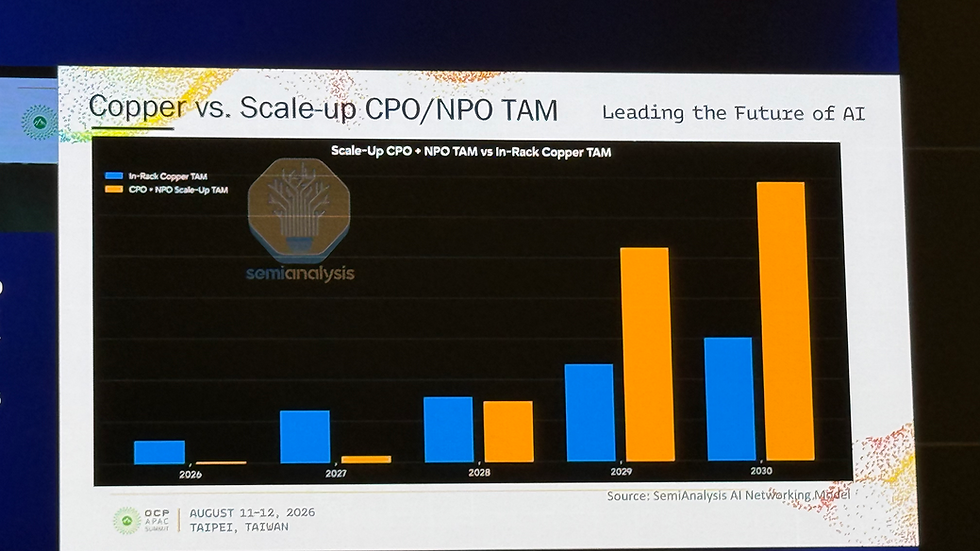
This is the real punch line of the talk: the industry was already moving toward "more copper, more optics, more scale-up," but this trade-off was only recently formalized and accelerated by system vendors. The TAM for copper and optics expands together: copper (backplane + mid-board connectors) starts ramping in earnest in 2028, while CPO/NPO accelerates in 2029 with NPO leading the way. In the cost structure, scale-up's share climbs from 3.8% all the way to 12.5%, and this pivot "happened just recently."
Incidentally, Nishball flagged the next landmine: cumulative AI capex will reach about US$11 trillion by 2029, US$7 trillion of which must be debt-financed, large enough to become the second-largest asset-backed credit market in the US (behind only the US$13 trillion mortgage market). Beneath the scale-up arms race lies a financing race, but that's a topic for another article.

6. What It Means for Taiwan's Supply Chain
The most direct point first: don't treat the CPO narrative as a death sentence for copper cables. The signal for Taiwanese suppliers is that both the copper and optics pies are growing at the same time, and copper's role inside the rack will persist for several generations to come.
First, "unsexy" segments like copper backplanes, mid-board connectors, flyover cables and AECs represent the most certain volume in 2026–2028. As 600 kW high-density racks like Kyber evolve, the difficulty and value of PCB midplanes, flyovers and high-speed connectors will only rise. Taiwanese makers of passive copper cables, connectors and high-speed PCBs are not being sidelined by optics; they stand to benefit from the expanding scale-up domain.
Second, on the optical side, bet on NPO before CPO. SemiAnalysis's sequence is NPO ramping first, with CPO taking over later. For Taiwan's optical module, packaging, FAU and optical engine supply chain, that means "lock in near-package NPO solutions first, then prepare for CPO," rather than betting on CPO arriving in a single leap. For where each CPO roadmap stands, see The Complete CPO Roadmap Rundown.
Third, the "eight-rack scale-up domain" is the new default. That means cross-rack connectivity (whether CPO, NPO or interim approaches such as bidirectional optics) will be an order of magnitude larger than the market's original single-rack assumption. Whoever can make cross-rack optical interconnect cheap, reliable and redundant will capture the fattest increment of this wave.
Conclusion
"Copper vs. optical" is a false choice. The real question was never which replaces which, but how large the scale-up domain should be, and where system vendors are willing to move money from to make it larger. SemiAnalysis's answer is sharp: from memory. When HBM gets so expensive that system vendors would rather downgrade it and pour the money into networking, copper and optics ramp together. Taiwanese suppliers shouldn't pick sides; they should identify where they sit on the highest-certainty axis: "copper inside the rack, optics between racks, NPO before CPO." Copper where you can, optical where you must: that line won't go out of date for generations.
This article is for technology and industry trend analysis only and does not constitute investment advice.
Related Reading
After Copper Can't Keep Up with AI: Seven Paths for Scale-Up Optical Interconnect: the seven technology paths for complementary copper and optical scale-up, broken down in one place
CPO Is Finally No Longer "Crying Wolf": Six Real Signals from LightCounting's CPO/NPO Conference: first-hand signals on the pace of CPO/NPO commercialization
AMD Writes "Open Ethernet" into the Rack Backbone: what AMD's rack backplane strategy really means for the optical communications supply chain
The Complete CPO Roadmap Rundown: Beyond the Big Four, a Whole Row of Challengers: a scorecard of CPO players' roadmaps




Comments