


2026 OCP APAC Summit | Edgecore × NTT ID | LPO Came Up Empty at 1.6T, Pulling the CPO Timeline Forward a Generation
The weightiest line of this talk was not "how great CPO is" but Edgecore's own admission that linear pluggable optics (LPO) for the 1.6T generation are "not yet successful". After 800G was finally tuned to work and 1.6T forced a restart, data centers are not "choosing" co-packaged optics (CPO); they are being pushed there by power and density. The real change in 2026 has two layers: in hardware, three MSAs (Open CPX, OCI and XPO) emerged at OFC at the same time, breaking CPO from "one vendor does it all" into "swappable engines"; in software, SONiC only this year added the models CPO needs. Hardware openness decides who can ship in 2027; software completeness decides who can deploy at scale in 2027.
1. The Real News of This Talk: LPO Didn't Pass at 1.6T
Edgecore's Powen Tsai said something switch vendors rarely say in public.
The logic of LPO is "remove the DSP and save the power." But in his words: the DSP is gone and the power is saved, but the work doesn't disappear. The equalization and link maintenance the DSP used to handle are all pushed back onto the switch chip's SerDes, and it takes a higher-end SerDes to carry that load. Worse, the tuning cost is not one-time: pairing one LPO vendor with one NIC vendor takes a round of tuning, and switching to another NIC vendor takes another, because the optimal points for TX FIR, TIA drive and NR/ER modes are fundamentally different.
And that is not the only cost. When the DSP is removed, debugging capability goes with it. Without a DSP there is no readable layer of link statistics, and the switch chip side has few diagnostic tools left. Edgecore's hands-on conclusion was blunt: link flapping and link down were common on the 400G production line, and it took two years to bring 400G and 800G LPO into volume production; at 1.6T, it is "really really challenging and not yet successful."
The weight of this statement is that LPO has always been treated as "the stopgap until CPO is ready." If the stopgap breaks at the 1.6T generation, CPO adoption can no longer "wait another generation."
2. No Going Back to 2RU: The Math of 24 Watts Times 64
Edgecore gave a handy set of numbers for why pluggables hit a wall at the 1.6T generation:
800G pluggable: about 15 W per module, 2RU for a 64-port system
1.6T DSP (5nm optical engine): about 30 W per module, 3RU needed for 64 ports (air-cooling limit)
1.6T DSP (3nm): about 24 W per module, still 3RU
In other words, moving the process from 5nm to 3nm only cuts per-module power from 30 W to 24 W, still 1.6 times that of 800G. The density of 64 front-panel 1.6T ports won't fit in 2RU; the best air-cooled answer is 3RU, which means a third less switching capacity in the same rack height.
This is exactly the wall we described in [CPO Breakdown 1/6] Have Pluggable Optical Modules Hit a Wall? Before Understanding CPO, Understand This Wall: it is not a speed wall but a power and density wall. Edgecore simply converted it into rack units this time.
3. Edgecore × NTT Measurements: 40% Power Savings and 2RU Regained
The CPO system Edgecore built with NTT Innovative Devices uses a closed-loop (liquid-cooled) architecture with 16 optical engines and 16 ELSFP external light sources, and measured two immediately visible benefits:
About 40% power savings (system level, not module level)
The chassis shrinks from 3RU back to 2RU, and can go further using ORv3's OU height definition
NTT's component-level target is 50% power savings versus pluggable solutions. By comparison, Broadcom's Tomahawk 6 – Davisson, announced last October (102.4 Tbps, 200G/lane, sixteen 6.4T optical engines), is officially said to cut optical interconnect power by 70%, to about one-third of pluggables, while NVIDIA Spectrum-X Photonics claims 3.5x power efficiency. The three numbers use different bases (system level vs. optical interconnect segment) and can't be compared directly, but they point the same way: CPO's power savings at the 1.6T generation are now too large to ignore.
Notably, Edgecore said explicitly that these two benefits are "already enough to support scale-up deployment." In other words, CPO's first real battlefield is not the traditional scale-out switch but in-rack interconnect, where copper gives out first.
4. Why a Socket: Two Physical Facts Drive the Entire Design
NTT's Wataru Ishida distilled CPO design logic into two points, the cleanest technical narrative of the session.
First, keep the electrical signal clean. In a pluggable architecture, the signal has to cross the PCB to the front-panel connector, and insertion loss quickly exceeds 20 dB; moving the optical engine next to the ASIC on the same substrate brings it down to about 10 dB. Those 10 dB saved are budget. Powen said the linear transmission that couldn't be done with LPO becomes feasible with CPO because there is enough margin. That margin is also why they believe this architecture can last beyond 400G/lane.
Second, keep the laser cool. The laser is the most temperature-sensitive component in the system, yet it is asked to sit next to the hottest ASIC. The solution is to pull the light source out into an ELSFP placed farther away, exactly the contradiction discussed in [CPO Breakdown 3/6] The Most Fragile Link in CPO Is the Laser, and OIF made ELSFP an IA back in 2023.
Hence NTT's approach: take a Tomahawk 6 bare die from Broadcom, design its own CPO substrate, and instead of soldering the optical engines down, plug them in via ultra-low-loss LGA sockets. Each engine is 6.4T, and the socket carries high-speed signals, power and management pins, so no extra side cabling is needed. This one socket is the entire basis for "serviceable" and "vendor-swappable."
5. Three MSAs at Once: Year One of Open CPO
At OFC in March 2026, three MSAs debuted almost simultaneously. They don't replace each other; they target different positions:
Open CPX (Microsoft, Marvell, Cisco and others): standardizes the socket and connector mechanics, thermals and electrical pinout, covering CPO, NPO and co-packaged copper (CPC). Each module has 32 bidirectional lanes, 6.4 Tbps @ 200G/lane, with a roadmap to 12.8T and 448G/lane.
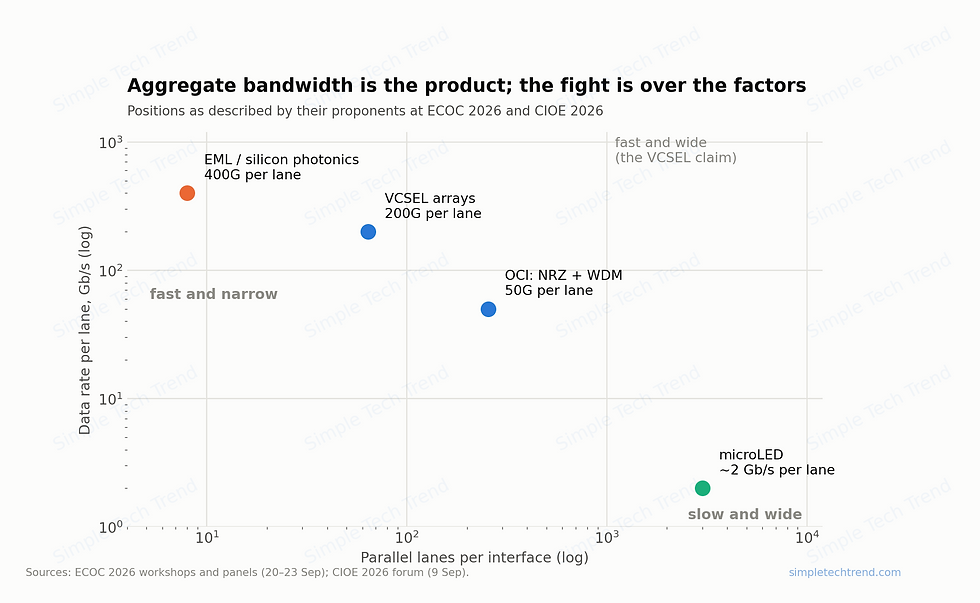
OCI (AMD, NVIDIA, Meta, Broadcom): pushes the industry toward low-power optical SerDes using a silicon-centric, WDM-based model rather than a module-centric one, focused mainly on architectural guidance.
XPO (Arista, Andy Bechtolsheim): rather than moving into the package, it takes pluggables to the extreme: 12.8 Tbps per module, 204.8 Tbps of front panel in a single OCP RU, liquid-cooled modules up to 400W, and 4x the density of 1.6T OSFP.
We have written a full breakdown of the XPO path: 2026 OCP APAC Summit | Arista | XPO: Immersing Optical Modules in Liquid Cooling to Stretch Pluggables Another Generation.
In parallel, OIF already has the world's first co-packaging standard, the 3.2T Co-Packaged Module IA, and at its Q2 meeting in June 2026 it opened a new 12.8T NPO module project (200G/lane, covering 12.8T and 6.4T, and addressing liquid cooling, power delivery, laser integration, connectors and mechanics).
The signal is clear: 2024–2025 was "vertical integration proves CPO works"; 2026 is "the open ecosystem starts fighting for the right to define it."
NTT places a third path on this map. On the left is vertically integrated CPO: optical engines soldered to the substrate, single-sourced, with no recourse if one fails or you want to switch vendors. In the middle is Open CPX-style NPO: a standard ASIC package with sockets around the package perimeter. On the right is NTT: sockets on the CPO substrate, with far lower loss than NPO but still replaceable. And the chip in the middle is Broadcom's Tomahawk 6, with a ready-made customer base.
This architecture also opens up mix and match. On the same substrate, most slots take optical engines for short-reach optical interconnect, while the remaining slots near the front panel take cages for pluggables instead, minimizing electrical loss and letting the configuration adapt to the deployment scenario.

6. Software Is the Real Production Line: What SONiC Added This Year
Hardware is only half the story. Ishida spent a disproportionate amount of time on SONiC, because that is the yardstick for "can it deploy at scale." What the SONiC community added this year is concrete and tedious, but every item is a prerequisite for volume production:
Code supporting Broadcom Bailly-architecture switches has been merged
Channel mapping management between optical engines and ELSFPs, since CPO breaks the "one module per port" assumption
Existing software assumed transceivers have at most 8 lanes, while optical engines usually have more. NTT contributed model changes that brought support for transceivers with more than 8 lanes into SONiC
A flexible architecture that makes the mix-and-match configurations above manageable at the software layer
None of this is sexy, but it is the threshold for CPO to go from demo to fleet. Hardware specs can be announced at OFC, but if the SONiC PRs aren't merged, data centers won't place orders.
7. What It Means for Taiwan's Supply Chain: The Chain Is Narrowing, and the Narrow Points Are Where to Stake a Position
Edgecore itself acknowledged something that was the most important line of the session for Taiwanese suppliers: CPO will change the structure of the supply chain. In their model, NTT supplies both the ASIC and the packaged optical engines, and Edgecore assembles the complete switch. This is no longer the loose plug-and-play ecosystem of pluggables, but a narrow chain that requires deep ties with a single partner. Edgecore calls this the industry's first switch specification combining "ASIC vendor + third-party optical engine + completed packaging." The flip side of that honor is fewer choices.
First, the bottleneck is on the production line, not in the spec. Edgecore said explicitly that assembly and fiber alignment are "not trivial"; the hard part is ensuring correct alignment on the line and fixing it when it's wrong, which directly caps CPO capacity. We broke down this layer in [CPO Breakdown 4/6] Fiber-to-Chip: The Least Sexy Step in CPO That Holds Everyone Back. Whoever turns FAU alignment yield and rework into a repeatable production line will win orders.
Second, the next generation will rely on advanced packaging. Both Ishida and Powen noted that pushing density further (for example, next-generation 200T-class systems) may require processes such as 3D hybrid bonding to package optical engines with ASICs. That moves CPO's decisive battle onto the turf of OSATs and foundries, the very theme of [CPO Breakdown 5/6] The CPO Ecosystem Is Being Reshuffled: Foundries and OSATs Move from Supporting Roles to Leads.
Third, the socket itself is a new part number. An ultra-low-loss LGA socket that carries high-speed, power and management pins at once is a high-end challenge for connector makers; ELSFP is an entirely new market for external light source modules. Both were created by the architectural need for "replaceability." Openness is not just politics; it generates part numbers.
8. Conclusion
Ishida closed with the poll chart from a 2023 OCP webinar: about half of respondents thought it would take 2 to 5 years for CPO to reach scale deployment in data centers. His conclusion: "on track."
I agree, but with a sharper addendum: part of why the CPO timeline looks on schedule is that LPO failed to take the 1.6T baton. Edgecore spent two years tuning 400G/800G LPO into volume production, and at 1.6T it has to start over, with no DSP for debugging. In an era when GPU lead times are more expensive than anything, customers won't have the patience to go through that twice. So the 2026 progress bar should be read like this:
Hardware: three MSAs appearing at once means CPO is moving from "one vendor does it all" to "swappable engines." Open CPX defines the socket, OCI sets the SerDes direction, and XPO bets pluggables can last another generation. All three paths will see volume, but only the socketed one will decide whether Taiwanese suppliers can get in.
Software: SONiC only this year completed channel mapping and models for more than 8 lanes. With hardware in volume production in 2027, software must catch up by the end of 2026.
Supply chain: CPO narrows the ecosystem and deepens partner lock-in. That is a risk for system makers, but for Taiwanese suppliers with packaging, alignment, light source and connector capabilities, it is a once-in-a-decade reshuffle.
In one sentence: CPO isn't still on its way; it has already started choosing who gets in.
This article is for technology and industry trend analysis only and does not constitute investment advice.




Comments