


OFC 2026 - Scaling the Optical Future: How Optics Defines the Foundation of AI Compute - Coherent
In her opening keynote at OFC 2026, Coherent CTO Dr. Julie Sheridan Eng set a clear tone for the global optical communications industry: optics has moved from behind the scenes to center stage, and is now a core consideration in AI data center architecture. With AI compute demand growing 4.5x per year, the traditional Moore's Law (2x every two years) can no longer close the performance gap, and the focus of system scaling has shifted decisively toward parallel architectures and optical interconnects.
1. The Foundation
Core message: The keynote opened with "photonics is foundational." Dr. Eng divided the evolution of optics into four eras: long-haul telecom in the '80s and '90s, enterprise data centers in the 2000s, hyperscale data centers in the 2010s, and today's AI data center era.
Key trend: Optics has evolved from pure transport infrastructure into part of the compute fabric.

2. The Scaling Miracle of the Past 20 Years
Key data: Optical interconnects have improved simultaneously along three dimensions:
Bandwidth density: up 150x (Gb/s/mm²).
Energy efficiency: energy per bit down 40x (pJ/bit).
Bandwidth cost: price per Gb down 60x


3. Scaling Speed and Time Pressure
10G modules: took 15 years to reach 10 million units shipped per year.
1.6T modules: expected to reach the same scale in just 4 years. This puts enormous pressure on the supply chain's ability to ramp.

4. The Compute Supply-Demand Gap
Deep dive: Compute demand for training large language models (LLMs) grows 4.5x per year, while Moore's Law delivers only 2x performance every two years.
Industry impact: Because single-chip performance cannot keep up with demand, systems are shifting to parallel architectures, making interconnect bandwidth the performance bottleneck.

5. The Three Domains of the AI Data Center
Definitions:
Scale Up: interconnect between processors/accelerators, currently dominated by copper and moving toward CPO (co-packaged optics).
Scale Out: networking between nodes over 10 m to 10 km, where pluggable modules remain mainstream.
Scale Across: interconnect between data centers (DCI).


6. The Evolution of Pluggable Modules
Technology paths: three light source technologies in parallel:
VCSEL: high volume and energy efficient, targeting 30 m short-reach multimode fiber.
Silicon photonics (SiPh): excellent potential for integration and scaling, suited to 500 m–2 km.
InP EML: the strongest electro-optic performance, supporting 10 km reach.

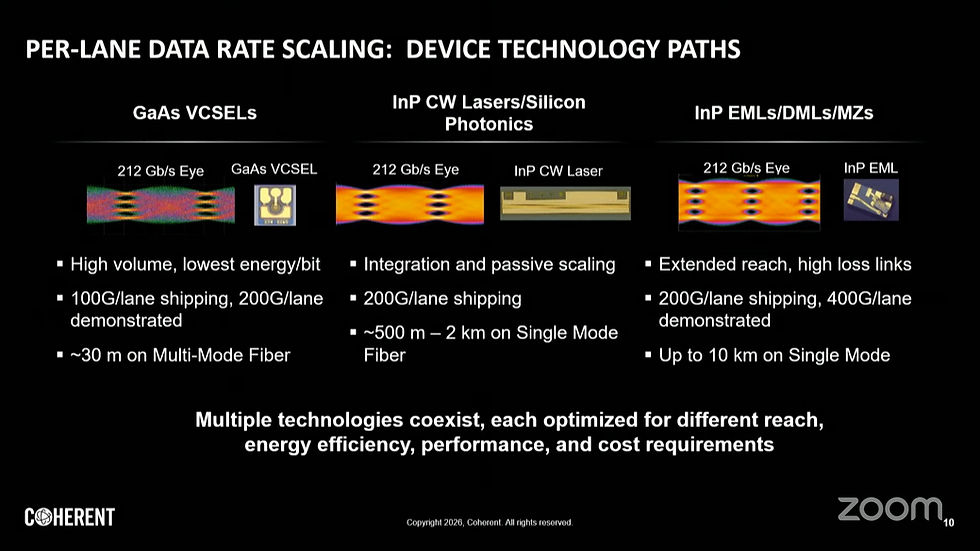
400G per lane: technically feasible, but uncompensated reach is limited to 500 m–1.5 km.

High-density form factors: the move from CFP to QSFP28 for 100G modules delivered an 8x density gain. The newly launched XPO already supports 12.8T of bandwidth.

7. The Physical Limits of Copper
Technical data: at 200G per lane, passive copper reach shrinks to just 1 meter. This means optics has become indispensable even inside the rack.

8. A Deep Dive into Co-Packaged Optics (CPO)
Core idea: CPO is an "architectural redraw" that moves the optical engine from the front panel to sit next to the ASIC (switch or XPU).
Pros and cons: it improves bandwidth density and energy efficiency, but reduces system flexibility and serviceability.
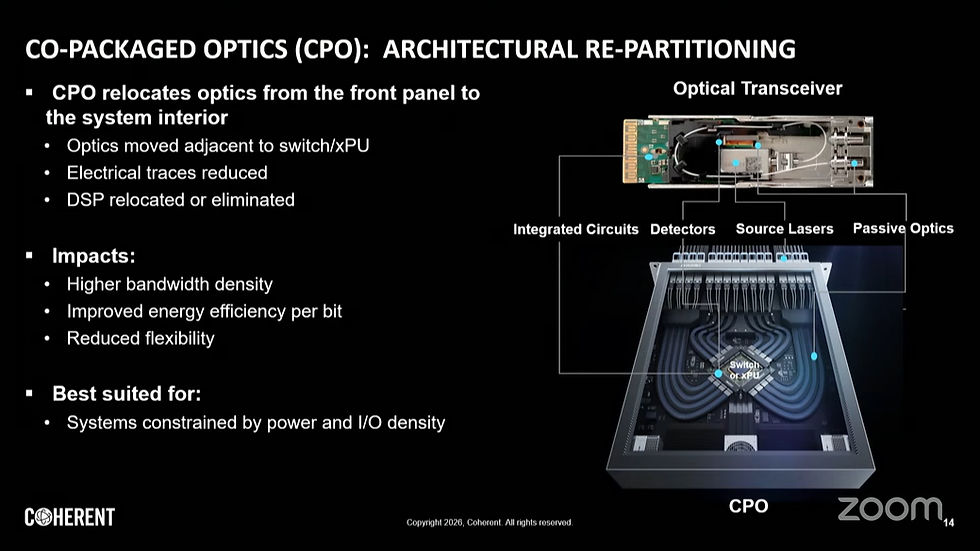

Two approaches:
Fast and Narrow: fewer lanes at higher speeds; requires high-performance SerDes but keeps fiber management simple.
Slow and Wide: more lanes at lower speeds; avoids power-hungry SerDes, but packaging is extremely complex.

9. Optical Circuit Switching (OCS)
Why it is back: AI training traffic is heavy and highly predictable. OCS uses software-defined control to reconfigure topology directly at the physical layer, reducing packet processing and improving accelerator (XPU) utilization and system availability.

10. Thermal and Transport-Layer Challenges
Thermal pressure: accelerator power has passed 1 kW, and liquid cooling is becoming mainstream. Coherent is developing diamond and silicon carbide (SiC) materials to address extreme thermal challenges.
Transport bottleneck: the marginal gains from improving spectral efficiency alone are diminishing (the Shannon limit). The industry is shifting to expanding spectrum (C+L band) and adding spatial parallelism (multi-rail amplifier sub-systems).


11. Conclusion
Keynote summary: physical limits are tightening while the demands of AI scaling intensify. Future system scaling will depend heavily on continued innovation in optics.

Simple Tech Trend's Take
The practical reality of co-packaged optics (CPO): Coherent made clear that CPO and pluggable modules are complementary rather than competing. In scale-out, where flexibility is paramount, pluggables will continue to dominate; but in scale-up, where maximum energy efficiency is the goal, CPO is the only way forward.
The silicon photonics (SiPh) positioning battle: the 6.4T silicon photonics CPO engine Coherent showcased reaches a bandwidth density of 15 Gb/s/mm². This signals that over the next two years, vendors with silicon photonics integration capability will hold the upper hand in AI data centers.
Thermal management becomes a hidden battleground: as XPU power spirals, R&D on thermal materials (such as diamond ceramics) will move from the fringe into the core of the optical interconnect discussion, opening new opportunities for materials suppliers.


Comments